


Siemens AG, the world's fourth-biggest mobile-phone maker, said it slashed handset inventory in China after a switch to direct selling to consumers in bigger cities helped increase sales.
Siemens has reduced inventory days to four weeks from a peak of about nine weeks during the SARS outbreak six months ago, Joerg Ayrle, chief financial officer of Siemens' China mobile unit, said in an interview in Shanghai.
The improvement is a sign that China's US$3 billion stockpile of unsold mobile phones, which built up during the SARS epidemic, may be starting to ease. Siemens is boosting sales by focusing on wealthier cities, opening direct sales counters and introducing new models aimed at young people.
"Inventory remains quite a serious problem within the industry in China," Ayrle said, who didn't disclose Siemens' China sales. "But we saw a turnaround in the market in the past two months. Things are looking better."
Only six of 10 handsets made for the local market were sold in the first half, as SARS kept shoppers at home and cellphone makers boosted production.
About 15 million mobile phones are still languishing in warehouses and stores, which will take as many as four months to clear, Ayrle said.
Based on an average handset price of 1,750 yuan, the stockpile has a retail value of 26.3 billion yuan (US$3 billion).
TCL Mobile Communication Co, the No. 4 cellphonee maker in the country and the No. 2 domestic manufacturer, said last week it expects inventory days to drop to three weeks, the usual level for the company, by the end of this month, from about five weeks in June.
About 4 million handsets are sold each month in China, the world's biggest market with 244 million cellphone subscribers at the end of last month. Unit sales rose an average 17 percent in the past two years.
Growth slowed to 1.7 percent, or 25.2 million units, in the first half because of SARS, according to Beijing-based Sino Marketing Research.
Some analysts such as J.P. Morgan Chase & Co.'s Johnny Chan aren't reassured by falling inventory numbers.
Chan said he expects Chinese phone makers to start shipping new phones with color screens to retailers as early as this month.
"Without material pick-up in the underlying growth rate of end demand, aggressive stocking activities by the industry will end with excessive inventory after the Chinese New Year in 2004," he said.
Siemens, which trails leaders Motorola Inc, Nokia Oyj and domestic makers such as Ningbo Bird Co, controlled inventory by selling only in bigger cities, Ayrle said.
The company introduced a set of "fashion phones" under the Xelibri brand, and miniature models, such as the SL 55, which features a sliding dial, to attract young people.
In the next two months, Siemens plans to introduce four more models, including one that looks like a make-up box and one using voice-recognition technology, Ayrle said.
"Asian customers change their phones more often. The models will first be introduced in Europe, but will soon be sold in Asia," he said.
Siemens' phones are sold in about a third of about 50,000 distribution outlets in all of China.
The company also runs direct sales counters in Shanghai and Beijing.
Siemens had a 6.8 percent share of the global handset market in the second quarter, compared with 35 percent for Nokia and 13 percent for Motorola, according to market researcher IDC.

National Taiwan University (NTU) yesterday said it disqualified a person from an entrance examination for using AI smart glasses to cheat, along with two others for making untruthful statements in their curriculum vitae. The three applicants were given null scores, Taiwan’s highest-ranked university said, calling on prospective students to be honest in the admissions process. NTU registrar Lee Hung-sen (李宏森) said that the cheating applicant wore a hat and thick-rimmed glasses to the second written exam for medical school, claiming that they felt cold. Suspicions were aroused when the applicant stared oddly at the test for long stretches while steadily bringing the paper
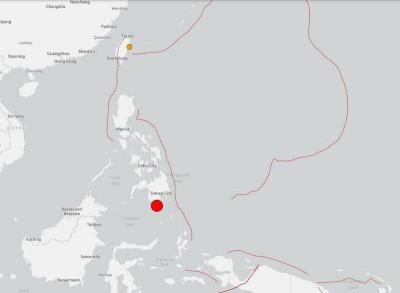
A magnitude 7.8 earthquake struck off the southern coast of Mindanao in the Philippines at 7:38am today, prompting the US Tsunami Warning System to issue an alert for neighboring countries, including Taiwan. The system issued a purple alert indicating a "tsunami threat." The potential threat zone includes Taiwan, the Philippines, Papua New Guinea, Yap and Palau. Philippine authorities were assessing the damage from the quake, with the office of civil defense seeking to verifying initial reports that 15 people had been killed and 129 injured in the region, mostly from falling debris. Arlene Hollero, disaster chief of Maasim town in the Philippines' Sarangani Province,

‘GRAY ZONE’ PRESSURE: Beijing’s activities are intended to create the deceitful impression that China has jurisdiction over the area around Taiwan, the CGA said Taiwan’s rights over its territorial waters and exclusive economic zone must not be violated by any country, the Mainland Affairs Council said yesterday, adding that it will not accept any unprovoked actions. The council issued the remarks in response to the China Coast Guard conducting maritime enforcement drills near eastern Taiwan and claiming to fully exercise China’s maritime administrative law enforcement authority. The Coast Guard Administration (CGA) has been closely monitoring the situation and is taking concrete steps to defend the nation’s sovereignty and secure its waters, the council said. China has no sovereign rights over the waters off eastern
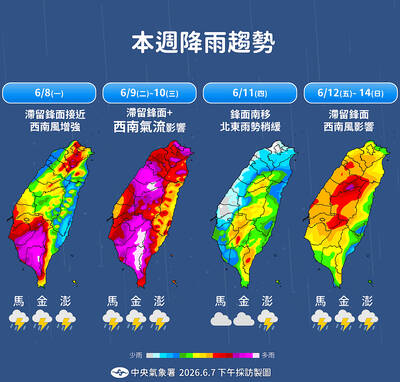
Heavy rain is expected to affect parts of Taiwan this week, the Central Weather Administration (CWA) said yesterday as a meteorologist said the active part of the annual plum rain season has started. A stationary plum rain front and southwesterly winds would bring unstable weather and abundant moisture to Taiwan from today for about a week, with the heaviest rainfall forecast for tomorrow and Wednesday, the CWA said. The agency said western and northeastern Taiwan, and mountainous areas in the east and southeast, could expect showers or thunderstorms on those two days, with localized heavy rain possible. Other parts of


 RSS
RSS