


Ilan Hornstein used to download his favorite tunes from the Inter-net, but he stopped several years ago, cowed by threats from the recording industry to sue high-tech music lovers who swap files.
He's still infuriated that he can't download music as he once did, and that the industry has the weight of the law behind it. An outcry by music listeners would take away the industry's clout, he said, and put music back in the public domain -- and onto his hard drive.
"Why should the law protect the record industry?" said Hornstein, who works for Raytheon Co. "It seems a lot like the Mafia."
Hornstein, 27, was among 100 scholars, industry representatives, music lovers and privacy advocates who gathered Thursday at Harvard Law School to discuss the future of digital media and online file-sharing, the bugaboo that has delighted music fans and aggravated the music industry.
"There was a time that to make a copy, you needed a monk, and a desk, and months," said Harvard law professor Charles Nesson, the faculty co-director of Harvard's Berkman Center, a sponsor of the gathering.
"And then Shawn Fanning hit the scene," he said, referring to the college dropout who created the wildly popular music-trading Web site Napster, which was shut down in 2001 after battling the music industry over copyright infringement.
The speed of digital media technology, which can put a pirated movie onto the Internet in hours, pirated CDs and DVDs on street corners around the world in days, and allows home computer users to swap music using "peer-to-peer" file-sharing software, is fundamentally changing the entertainment industry.
"Clearly, we need a solution to the issue. Everyone would agree to that," said Richard Conlon, vice president of BMI, an organization that collects license fees for 300,000 songwriters, composers and music publishers whose tunes are played in public.
The Recording Industry Association of America (RIAA) has been on the offensive against song swappers. Last week the RIAA sued 261 people, including a 12-year-old girl, in federal court for allegedly distributing on average more than 1,000 copyrighted music files each.
But several participants at the Harvard meeting said they doubted that tactic would stop the millions of people using file sharing to download music.
Thursday's discussion sparked strong reactions and outbursts of dismay from some participants, particularly to one proposal that the government treat the music industry like a public utility, and regulate it as such.
"Are you seriously considering the regulation of artists?" asked John Perry Barlow, a Grateful Dead lyricist and a co-founder of the Electronic Frontier Foundation. "That is so Orwellian. I'm astonished this is even on the screen."
Ivan Reidel, a student at Harvard Law School, said he's studying ways to get rid of licensing organizations like BMI and ASCAP altogether, and instead create an organization of artists who would opt out of the licensing system and deal directly with consumers.
Asked the odds of such a scenario coming to fruition, he said with a smile: "I'm working on that."

ROLLER-COASTER RIDE: More than five earthquakes ranging from magnitude 4.4 to 5.5 on the Richter scale shook eastern Taiwan in rapid succession yesterday afternoon Back-to-back weather fronts are forecast to hit Taiwan this week, resulting in rain across the nation in the coming days, the Central Weather Administration said yesterday, as it also warned residents in mountainous regions to be wary of landslides and rockfalls. As the first front approached, sporadic rainfall began in central and northern parts of Taiwan yesterday, the agency said, adding that rain is forecast to intensify in those regions today, while brief showers would also affect other parts of the nation. A second weather system is forecast to arrive on Thursday, bringing additional rain to the whole nation until Sunday, it

LANDSLIDES POSSIBLE: The agency advised the public to avoid visiting mountainous regions due to more expected aftershocks and rainfall from a series of weather fronts A series of earthquakes over the past few days were likely aftershocks of the April 3 earthquake in Hualien County, with further aftershocks to be expected for up to a year, the Central Weather Administration (CWA) said yesterday. Based on the nation’s experience after the quake on Sept. 21, 1999, more aftershocks are possible over the next six months to a year, the agency said. A total of 103 earthquakes of magnitude 4 on the local magnitude scale or higher hit Hualien County from 5:08pm on Monday to 10:27am yesterday, with 27 of them exceeding magnitude 5. They included two, of magnitude
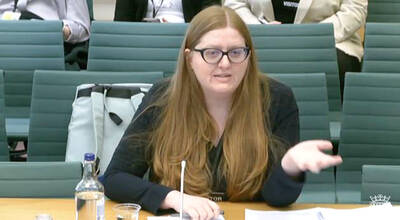
CONDITIONAL: The PRC imposes secret requirements that the funding it provides cannot be spent in states with diplomatic relations with Taiwan, Emma Reilly said China has been bribing UN officials to obtain “special benefits” and to block funding from countries that have diplomatic ties with Taiwan, a former UN employee told the British House of Commons on Tuesday. At a House of Commons Foreign Affairs Committee hearing into “international relations within the multilateral system,” former Office of the UN High Commissioner for Human Rights (OHCHR) employee Emma Reilly said in a written statement that “Beijing paid bribes to the two successive Presidents of the [UN] General Assembly” during the two-year negotiation of the Sustainable Development Goals. Another way China exercises influence within the UN Secretariat is

Taiwan’s first drag queen to compete on the internationally acclaimed RuPaul’s Drag Race, Nymphia Wind (妮妃雅), was on Friday crowned the “Next Drag Superstar.” Dressed in a sparkling banana dress, Nymphia Wind swept onto the stage for the final, and stole the show. “Taiwan this is for you,” she said right after show host RuPaul announced her as the winner. “To those who feel like they don’t belong, just remember to live fearlessly and to live their truth,” she said on stage. One of the frontrunners for the past 15 episodes, the 28-year-old breezed through to the final after weeks of showcasing her unique


 RSS
RSS