


Japan embarked on a big spending spree yesterday after Osaka's passionate but erratic baseball club won its first league championship in 18 years helping to lift a national mood of stagnation.
After 5,300 people dived into a filthy downtown canal here in a ritual of celebration overnight, thousands others packed a department store, affiliated to the Hanshin Tigers club, for its week-long memorial bargain sales.
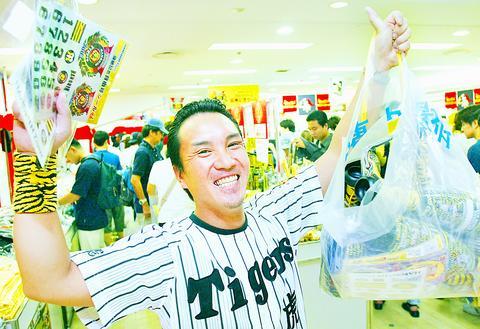
PHOTO: REUTERS
More than 10,000 department and supermarket stores across this baseball-crazy nation are also expected to join the Tigers bandwagon with sales estimated to reach as high as ¥25 billion (US$200 million).
"I feel happy from the bottom of the heart with the dream come true," Bank of Japan governor Toshihiko Fukui, an avid Tigers fan, told reporters. "This will perk up public sentiment and give a positive impact on economic activity."
The Tigers has won the title of the six-team Central League, one of Japan's two professional leagues, only four times in 50 years under the current system.
In many seasons, it has squandered a sparkling early lead and faded away to earn a nickname, "Da-me Tora [Bad News Tigers]," as something of a problem child in this second Japanese city, a commercial hub in the west of the country.
Despite all the frustration, Tigers fans with pockets of loyalists in other big cities are always game with their black-and-yellow colors.
This year, the team soared into a huge lead as early as April and never looked back. Senichi Hoshino, in his second year as Tigers manager, brought in many new players, including former New York Yankee pitcher Hideki Irabu.
They have snatched 128 matches for a winning rate of 64 percent, with a dozen left in the season.
"The Hanshin mania will prevail until the end of this year at least, focused in the Kansai [western Japan] area. Hanshin goods will keep on selling well," said Koichi Kunisada, an Osaka-based economist and Tigers fan.
The fever will continue with the Japan Series, a showdown between the champion clubs of the two leagues in October, and camp training in February, he predicted.
"I can't really estimate economic spin-off effects because they are awesome," he said.
A private think tank estimated that ¥185 billion would be spent on merchandise, parties and tourism related to the Tigers magic, generating demand in other industries with combined effects at ¥636 billion at most.
An estimated 40,000 shoppers flocked to the Hanshin Department Store outside Osaka's central station in the first three hours of business to hunt for bargains with 30 to 50 percent discounts.
They snapped up memorial goods with a "V" for victory logo, including fountain pens, wines and neckties.
Makinori Sugimoto, wearing a Tigers uniform and a Tigers bandana, emerged from the store with a bag full of memorial bull-horns, towels, plaques and signature sheets, worth ¥20,000.
"They are for my friends who could not come to watch the match yesterday," said the 39-year-old television cameraman from Tokyo, who had drunk all night here at a bar for Tigers fans. "I cannot feel any better."
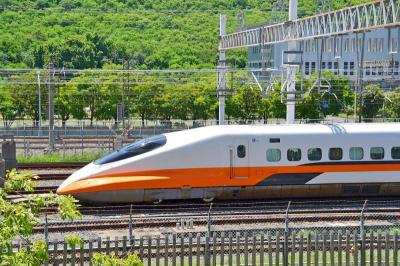
A signaling system malfunction disrupted high-speed rail (HSR) services beginning at 8am today, with trains temporarily reduced to three northbound and three southbound trains per hour as authorities conduct inspections. The malfunction occurred on a section of track in Miaoli County during pre-operation checks early this morning, forcing northbound and southbound trains to use a single track, the HSR operator said. The regular schedule has been replaced with three hourly trains offering only nonreserved seating in each direction, stopping at every station, it said, adding that business class cars would still have reserved seating. Departures from terminal stations are scheduled at the top
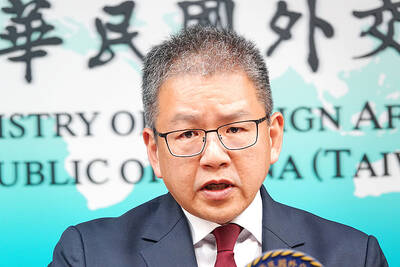
Taiwan is still in the process of assessing the possibility of recruiting workers from Eswatini, the Ministry of Foreign Affairs said yesterday, adding that its goal is to help Eswatini upgrade its vocational training centers. If there are plans to recruit workers from Eswatini, safeguarding national security, protecting public health and ensuring the employment rights of Taiwanese would be prerequisites, Department of West Asian and African Affairs Director-General Yen Chia-liang (顏嘉良) told a news conference. Key considerations would also include filling labor shortages in specific industries, and fostering bilateral professional and technical exchanges, he said. Yen was asked about the progress of labor

A US uncrewed surface vessel (USV) encountered multiple Chinese warships during an autonomous transit of the Taiwan Strait, US defense company Seasats said in a statement on Wednesday. Seasats announced that a Lightfish USV had completed the first autonomous transit of the Taiwan Strait. Over five days, the USV traversed the entire length of the Strait while constantly monitoring surface vessel traffic, the company said. The Lightfish encountered multiple Chinese warships, one of which was a Chinese People’s Liberation Army Navy (PLAN) Type 056 corvette, it said. The Chinese vessels were operating “well within Taiwan’s exclusive economic zone without transmitting their identity via the

VERBOSE VESSELS: A CGA cutter and a China Coast Guard exchanged verbal barbs for more than a day in Taiwanese-controlled waters before the Chinese vessel left The Taiwanese and Chinese coast guards had a standoff near the strategically located Pratas Islands (Dongsha Islands, 東沙群島) in the north of the South China Sea, the Coast Guard Administration (CGA) said yesterday. The two sides engaged in intense radio exchanges over sovereignty claims during the 33-hour standoff. China Coast Guard vessel 3501 eventually left the restricted waters, 26.6 nautical miles (49.2km) west of the Pratas Islands, at 5pm yesterday, the CGA said. Lying approximately between southern Taiwan and Hong Kong, the Taiwan-controlled Pratas are seen by some security experts as vulnerable to Chinese attack due to their distance — more than


 RSS
RSS