


Poor nations within the WTO banded together Tuesday, pushing rich countries to make big cuts to farm subsidies as ministers prepared for a five-day meeting in this Mexican resort.
The meeting, which started yesterday, includes 4,700 delegates from the WTO's 146 member nations and is aimed at breaking the deadlock in the current round of trade liberalization negotiations.
The so-called Group of 21, which includes India, China, Brazil and Argentina, came together in an unprecedented campaign in support of their common goals.

PHOTO: AP
"It is a historic event, the first time that such a large group of developing countries has been able to come up with such a paper," said Brazilian Foreign Minister Celso Amorim.
"We all agreed that the fundamental aspect of this endeavor is keeping our unity, and our unity will be tested at every moment in this conference," he said.
In the past, developing countries have complained that they have little clout in the WTO, where powerful traders like the US and EU dominate negotiations.
The 21 countries together represent more than half the world's population and two-thirds of the world's agricultural producers.
Their proposal calls for substantial reductions in subsidies paid to farmers by the richest nations, primarily the EU and the US.
Earlier, EU Trade Commissioner Pascal Lamy said he could not accept the proposal because richer developing countries also should have to open their markets.
"We cannot see how everything ... should be done only by developed countries whereas developing countries considered as a bloc would be sheltered from any effort. This is just not on the cards," he said.
But South Africa's Trade Minister Alec Erwin said the developing countries' proposal -- which his government supports -- is the way forward.
"We believe the balance that we have struck in our paper for the first time meets the needs of a new and fair agricultural trading system," he said. "The main burden of adjustment lies where it should lie, with the big economies, but will allow too for the developing countries to begin the process of reform."
Ministers from the 17-nation Cairns Group of agricultural exporting nations, led by Australia, said their goals are identical to those of developing nations like India.
"We face a common enemy -- the enemy is the dumped surpluses, the subsidized exports,'' said New Zealand trade minister Jim Sutton. "They undermine developing countries and the subsistence farmers in the poorest countries."
Ministers also will consider whether to open their economies to more foreign investment -- which some say will drive local producers out of business. Another issue will be how to cut tariffs on industrial goods without shuttering factories and spurring unemployment.
The talks are supposed to lead to a binding treaty on reducing tariffs and subsidies. Governments have given themselves until the end of next year to complete the work.

NO-LIMITS PARTNERSHIP: ‘The bottom line’ is that if the US were to have a conflict with China or Russia it would likely open up a second front with the other, a US senator said Beijing and Moscow could cooperate in a conflict over Taiwan, the top US intelligence chief told the US Senate this week. “We see China and Russia, for the first time, exercising together in relation to Taiwan and recognizing that this is a place where China definitely wants Russia to be working with them, and we see no reason why they wouldn’t,” US Director of National Intelligence Avril Haines told a US Senate Committee on Armed Services hearing on Thursday. US Senator Mike Rounds asked Haines about such a potential scenario. He also asked US Defense Intelligence Agency Director Lieutenant General Jeffrey Kruse
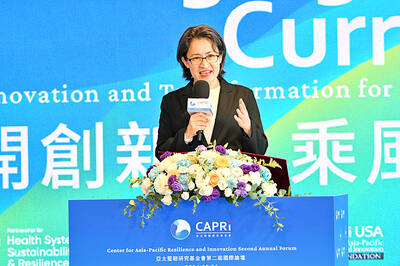
INSPIRING: Taiwan has been a model in the Asia-Pacific region with its democratic transition, free and fair elections and open society, the vice president-elect said Taiwan can play a leadership role in the Asia-Pacific region, vice president-elect Hsiao Bi-khim (蕭美琴) told a forum in Taipei yesterday, highlighting the nation’s resilience in the face of geopolitical challenges. “Not only can Taiwan help, but Taiwan can lead ... not only can Taiwan play a leadership role, but Taiwan’s leadership is important to the world,” Hsiao told the annual forum hosted by the Center for Asia-Pacific Resilience and Innovation think tank. Hsiao thanked Taiwan’s international friends for their long-term support, citing the example of US President Joe Biden last month signing into law a bill to provide aid to Taiwan,
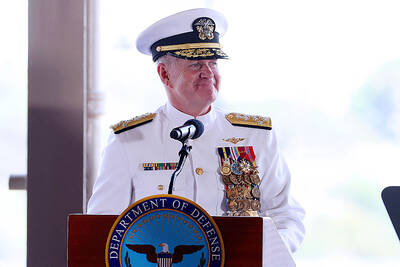
China’s intrusive and territorial claims in the Indo-Pacific region are “illegal, coercive, aggressive and deceptive,” new US Indo-Pacific Commander Admiral Samuel Paparo said on Friday, adding that he would continue working with allies and partners to keep the area free and open. Paparo made the remarks at a change-of-command ceremony at Joint Base Pearl Harbor-Hickam in Hawaii, where he took over the command from Admiral John Aquilino. “Our world faces a complex problem set in the troubling actions of the People’s Republic of China [PRC] and its rapid buildup of forces. We must be ready to answer the PRC’s increasingly intrusive and
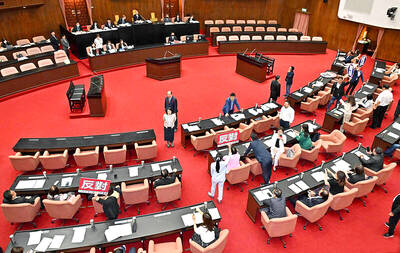
STATE OF THE NATION: The legislature should invite the president to deliver an address every year, the TPP said, adding that Lai should also have to answer legislators’ questions The Chinese Nationalist Party (KMT) yesterday proposed inviting president-elect William Lai (賴清德) to make a historic first state of the nation address at the legislature following his inauguration on May 20. Lai is expected to face many domestic and international challenges, and should clarify his intended policies with the public’s representatives, KMT caucus secretary-general Hung Meng-kai (洪孟楷) said when making the proposal at a meeting of the legislature’s Procedure Committee. The committee voted to add the item to the agenda for Friday, along with another similar proposal put forward by the Taiwan People’s Party (TPP). The invitation is in line with Article 15-2


 RSS
RSS