


Japan yesterday expressed its immediate opposition to a draft declaration on freeing up agricultural and other areas of trade, and called for its revision ahead of WTO talks in Cancun next month.
Tokyo made the remarks a day after the WTO's top official in Geneva circulated the draft of a declaration to be issued at a crucial ministerial trade summit in the Mexican resort city in two weeks.
"Although we can detect a certain flexibility, our stance explained in documents is not reflected" in the draft, Japanese farm minister Yoshiyuki Kamei said.
Kamei claims the draft's call for the introduction of a ceiling for tariff rates on imports would hurt Japan's rice industry which is currently effectively protected by a tariff of 490 percent imposed on imported rice.
"We regard [the draft] as the one that contains considerable problems." Kamei said.
"We are going to continue demanding its revision." he said. "We will do our best to let our voice be reflected."
The highly anticipated, 21-page revised outline text covers key areas in the current Doha round of free trade negotiations, including agricultural subsidies and market access for industrial products.
Although its contents are not yet agreed, it suggests frameworks, mostly without figures, for ministers of the 146-strong WTO to agree on at the meeting in the Mexican resort of Cancun to be held Sept.10 to Sept. 14.
On agriculture, the draft text reflects some elements of a joint EU and US plan, released on Aug. 13, but gives more detail on special provisions for developing countries.
It calls for an elimination of export subsidies for products "of particular interest to developing countries."
For remaining products, it proposes reductions "with a view to phasing out, budgetary and quantity allowances for export subsidies," although it adds that the target phasing-out date is still open for negotiation.
Tariff reductions by developed countries should be managed under a "blended" formula involving gentler average cuts for some products, as well as steeper cuts on higher tariffs for others.
The draft text offers alternative solutions for developing countries, but states that they should benefit from "lower tariff reductions and longer implementation periods."
Concerning state aid for farmers, meanwhile, the text calls for limits on certain types of support.
Brazil, India and China last week led a group of 17 developing countries in calling for a substantial reduction of all subsidies to farmers in what amounted to more far-reaching demands than those contained in the EU-US proposal, and for the elimination of all export subsidies.
The draft text addresses another highly controversial area, rules on investment policy, in an apparently contradictory fashion -- at once proposing that ministers decide to begin negotiations, while also stating that the "situation does not provide a basis for the commencement of negotiations in this area."
The 15-nation EU and Japan are among the leading proponents for the negotiations on investment, among them the four Singapore issues, so called after they were first tackled at the WTO Singapore ministerial meeting in 1996.
Ground rules for competition, ensuring transparency in government bidding processes and facilitating trade make up the other three issues -- which have met with opposition from African countries.
No draft proposals are offered in the outline text on the longstanding and controversial problem of ensuring that patent rules do not bar poor countries without their own pharmaceutical manufacturing capacity from access to cheaper medicines.
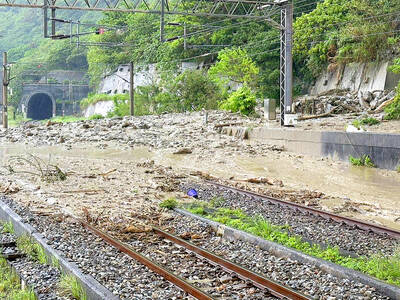
ROLLER-COASTER RIDE: More than five earthquakes ranging from magnitude 4.4 to 5.5 on the Richter scale shook eastern Taiwan in rapid succession yesterday afternoon Back-to-back weather fronts are forecast to hit Taiwan this week, resulting in rain across the nation in the coming days, the Central Weather Administration said yesterday, as it also warned residents in mountainous regions to be wary of landslides and rockfalls. As the first front approached, sporadic rainfall began in central and northern parts of Taiwan yesterday, the agency said, adding that rain is forecast to intensify in those regions today, while brief showers would also affect other parts of the nation. A second weather system is forecast to arrive on Thursday, bringing additional rain to the whole nation until Sunday, it
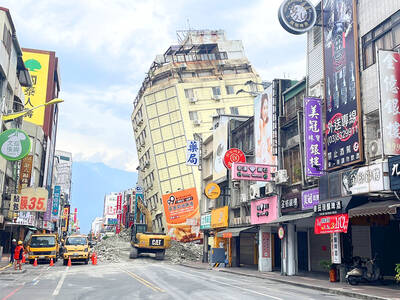
LANDSLIDES POSSIBLE: The agency advised the public to avoid visiting mountainous regions due to more expected aftershocks and rainfall from a series of weather fronts A series of earthquakes over the past few days were likely aftershocks of the April 3 earthquake in Hualien County, with further aftershocks to be expected for up to a year, the Central Weather Administration (CWA) said yesterday. Based on the nation’s experience after the quake on Sept. 21, 1999, more aftershocks are possible over the next six months to a year, the agency said. A total of 103 earthquakes of magnitude 4 on the local magnitude scale or higher hit Hualien County from 5:08pm on Monday to 10:27am yesterday, with 27 of them exceeding magnitude 5. They included two, of magnitude

CONDITIONAL: The PRC imposes secret requirements that the funding it provides cannot be spent in states with diplomatic relations with Taiwan, Emma Reilly said China has been bribing UN officials to obtain “special benefits” and to block funding from countries that have diplomatic ties with Taiwan, a former UN employee told the British House of Commons on Tuesday. At a House of Commons Foreign Affairs Committee hearing into “international relations within the multilateral system,” former Office of the UN High Commissioner for Human Rights (OHCHR) employee Emma Reilly said in a written statement that “Beijing paid bribes to the two successive Presidents of the [UN] General Assembly” during the two-year negotiation of the Sustainable Development Goals. Another way China exercises influence within the UN Secretariat is

Taiwan’s first drag queen to compete on the internationally acclaimed RuPaul’s Drag Race, Nymphia Wind (妮妃雅), was on Friday crowned the “Next Drag Superstar.” Dressed in a sparkling banana dress, Nymphia Wind swept onto the stage for the final, and stole the show. “Taiwan this is for you,” she said right after show host RuPaul announced her as the winner. “To those who feel like they don’t belong, just remember to live fearlessly and to live their truth,” she said on stage. One of the frontrunners for the past 15 episodes, the 28-year-old breezed through to the final after weeks of showcasing her unique


 RSS
RSS