


For the first time in years, Japan is looking forward to a visit by a US Secretary of the Treasury.
John Snow arrives here in Tokyo next week amid growing optimism about the world's second-biggest economy.
It's a far cry from a year ago, when Japanese officials still relished trips to the dentist more than meetings with US Department of the Treasury people. Tokyo received myriad Washington tongue-lashings for not contributing more to global growth.
With stocks up 20 percent this year and some economists predicting an end to deflation, Tokyo couldn't be happier to welcome Snow. Yet there's a bigger reason Tokyo can't wait to see Snow: to plot strategy on China's currency policy.
Snow and Japanese Finance Minister Masajuro Shiokawa have been urging Beijing to abandon its eight-year policy of fixing the yuan at 8.277 to the US dollar. Both Washington and Tokyo think the dollar's 9 percent slide in the past year is making Chinese exports artificially cheap.
Japan is especially keen on seeing the yuan rise because it would lessen China's competitive advantage in Asia. But neither fin-ance officials nor investors should get ahead of themselves. A Plaza Accord-like move to strengthen the yuan isn't afoot, and might not be for some time.
China should indeed widen its trading band for the yuan. If Beijing trusted markets to set the currency's value, perhaps markets would have more confidence in its policies.
The government talks a great deal about free-market approaches toward its economy, but here is a way to act on that talk.
Revaluing the yuan could catapult China's economy past some of the world's biggest. Overnight, it could arguably become larger than France's or the UK's, giving Beijing the increase in global stature it desires. Also, a firmer currency would make it cheaper for China to amass oil reserves and other commodities.
But Beijing isn't likely to budge. To understand why, look no further than recent comments by Jin Renqing (
Just as "some of the major economies are experiencing a sort of destabilization of their economic development, it is of utmost importance that China maintain a stable growth," Jin said in Manila earlier this month.
Five years ago, then-US Treasury Secretary Robert Rubin lauded Beijing for not devaluing, a step many thought would worsen the Asian crisis. Rubin routinely called China an "island of stability."
After preaching the merits of currency stability, the US and Tokyo are now trying to sell Beijing on the merits of flexibility.
It's not working. For Beijing, the yuan is a control issue.
Remember that for all the excitement and hype over China's 8 percent growth, it's still a developing economy and a centrally planned one at that. A stable yuan is the cornerstone of it all.
If there are two taboos in the Chinese political psyche, they are change and uncertainty. Freeing the yuan would mean embracing both. Before that happens, Beijing (a) needs to feel certain a stronger yuan won't slam growth, and (b) that the global economy really is recovering.
It all comes down to confidence and it's not clear how much of it Beijing really has in its economy. We all know the spin about China's booming population, soaring wealth and vibrant cities. What's less clear is how a change in currency policy would affect its underlying financial system, which is more rickety than many investors appreciate.
Its banking system is harboring a bad-loan problem that could be worse than Japan's. China figures it can grow its way out of the problem, but that's a dubious plan when you consider Tokyo has been trying it for 13 years now. It's also the best reason to expect Beijing to move first to re-peg the yuan at a less competitive rate than letting it float freely.
That China's financial system isn't ready to withstand a free-floating currency can be seen in the breakdown of investment flowing there.
When it comes to foreign direct investment on the part of multinational companies, China's success is indisputable.
Last year it was the world's biggest recipient of it. Less impressive is its success in attracting institutional investors.
Concerns about corporate governance have kept many investors away.
So have uncertainties about whether China can maintain the 7 percent plus growth needed to create jobs for the millions who will be displaced during the transition from socialism to capitalism.
Just as many investors are taking a wait-and-see approach, Beijing is taking the same attitude toward altering its currency policy.
And the US and Japan need to tread carefully here and avoid jawboning China at next week's summit of Asia-Pacific finance ministers in Phuket, Thailand.
The last thing Beijing wants is to appear to be buckling to demands from the economic elites.
Each time Washington and Tokyo call on China to let the yuan rise they make such an outcome less likely.
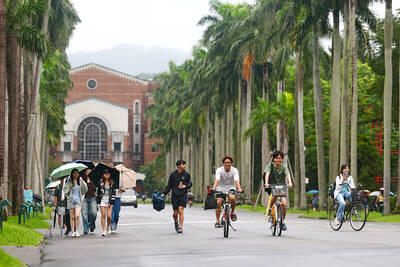
National Taiwan University (NTU) yesterday said it disqualified a person from an entrance examination for using AI smart glasses to cheat, along with two others for making untruthful statements in their curriculum vitae. The three applicants were given null scores, Taiwan’s highest-ranked university said, calling on prospective students to be honest in the admissions process. NTU registrar Lee Hung-sen (李宏森) said that the cheating applicant wore a hat and thick-rimmed glasses to the second written exam for medical school, claiming that they felt cold. Suspicions were aroused when the applicant stared oddly at the test for long stretches while steadily bringing the paper
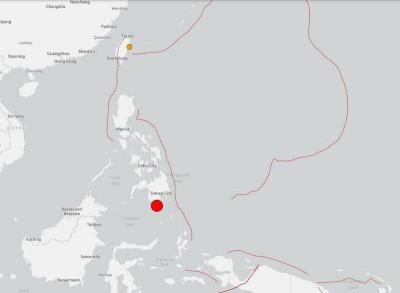
A magnitude 7.8 earthquake struck off the southern coast of Mindanao in the Philippines at 7:38am today, prompting the US Tsunami Warning System to issue an alert for neighboring countries, including Taiwan. The system issued a purple alert indicating a "tsunami threat." The potential threat zone includes Taiwan, the Philippines, Papua New Guinea, Yap and Palau. Philippine authorities were assessing the damage from the quake, with the office of civil defense seeking to verifying initial reports that 15 people had been killed and 129 injured in the region, mostly from falling debris. Arlene Hollero, disaster chief of Maasim town in the Philippines' Sarangani Province,

‘GRAY ZONE’ PRESSURE: Beijing’s activities are intended to create the deceitful impression that China has jurisdiction over the area around Taiwan, the CGA said Taiwan’s rights over its territorial waters and exclusive economic zone must not be violated by any country, the Mainland Affairs Council said yesterday, adding that it will not accept any unprovoked actions. The council issued the remarks in response to the China Coast Guard conducting maritime enforcement drills near eastern Taiwan and claiming to fully exercise China’s maritime administrative law enforcement authority. The Coast Guard Administration (CGA) has been closely monitoring the situation and is taking concrete steps to defend the nation’s sovereignty and secure its waters, the council said. China has no sovereign rights over the waters off eastern
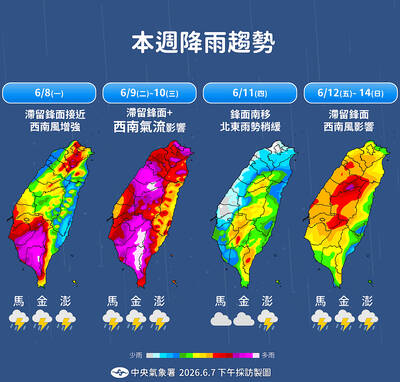
Heavy rain is expected to affect parts of Taiwan this week, the Central Weather Administration (CWA) said yesterday as a meteorologist said the active part of the annual plum rain season has started. A stationary plum rain front and southwesterly winds would bring unstable weather and abundant moisture to Taiwan from today for about a week, with the heaviest rainfall forecast for tomorrow and Wednesday, the CWA said. The agency said western and northeastern Taiwan, and mountainous areas in the east and southeast, could expect showers or thunderstorms on those two days, with localized heavy rain possible. Other parts of


 RSS
RSS