


Despite sabotage, looting and other setbacks, Iraq began pumping crude oil from its northern oil fields on Wednesday to export facilities in Turkey for the first time since the war.
Analysts said it was unclear how reliable the flow of oil from fields near the city of Kirkuk might prove to be, but the renewed use of the pipeline to Ceyhan, Turkey, marked a milestone in the restoration of Iraq's oil industry and augured well for thirsty world markets.
Iraq began pumping oil from its northern oil fields at around 4:30pm, a Turkish oil official at the Ceyhan terminal said, speaking on condition of anonymity.
Turkey's semiofficial Anatolia news agency quoted Energy Ministry officials as saying the first Iraqi oil reached the Mediterranean port at 9:30pm.
"In a couple of weeks, you should be able to start inviting tankers to come on down," said Peter Gignoux, head of the petroleum desk at Salomon Smith Barney in London.
Iraq sits atop the world's second-largest proven crude reserves, and oil exports are vital to its postwar reconstruction and the success of US efforts to implant democracy in the country.
Before the war halted Iraq's oil production, the country pumped around 2.1 million barrels a day, most of it for export.
However, it managed to export a paltry 300,000 barrels a day last month, said Michael Rothman, chief energy strategist at Merrill Lynch in New York.
"The reality is that the export program has been stymied by unfortunate but continuing acts of sabotage. This is still the issue," Rothman said.
Iraqi Oil Ministry officials could not immediately confirm that crude was flowing into the pipeline.
Iraq began exporting from its giant southern oil fields last month, sending fresh crude to ships waiting offshore in the Gulf at the export terminal of Mina el-Bakr. These southern exports have been intermittent, due to power outages at the terminal and other interruptions.
Although Iraq's big northern fields also resumed production after the US-British invasion, crude from the north was unavailable for export until now. Saboteurs and looters dogged efforts to rehabilitate the 950km pipeline from Kirkuk to Ceyhan. The lack of storage and export facilities forced the Iraqis to reinject much of the northern crude left over after refining for domestic use back into the natural underground reservoirs.
"Our problem was not with the production of oil but with the security of the pipeline. It was really mainly sabotage. That is all. Otherwise we could have continued exporting crude oil in sizable quantities," said an official at Iraq's State Oil Marketing Organization, which controls Iraqi oil exports.
The official spoke from Baghdad on condition of anonymity.
Iraq was expected to pump between 300,000 and 400,000 barrels a day to Ceyhan. No oil tankers are currently booked to load there, and oil was expected to flow for about 10 days before any vessels would be sent for loading.
"We have to wait for the storage tanks to be filled before exports can begin," the Turkish official said.
Ceyhan already holds about 500,000 barrels of Iraqi crude in storage and has room for around 7.5 million more barrels. Turkish energy officials said Iraq previously stopped pumping crude to Ceyhan on March 23.
The pipeline from Kirkuk is actually two parallel lines, one of which hasn't been used for years. The operable pipeline has a capacity of about 1 million barrels a day.
"It had been unclear whether oil would be flowing through there at all. Without it, you were bottling up half of Iraq's export capacity," said Jan Stuart, head of energy research at FIMAT USA, the New York brokerage unit of Societe Generale.
Delays in Iraqi exports have helped lift US oil prices to well above US$30 per barrel. Despite historically low inventories of crude in major importing countries, OPEC members agreed on July 31 to keep output steady -- a decision that provided no comfort to consumers.
"At the end of the day, the oil coming out of Iraq is something the market needs right now," Rothman said.
Iraq's oil exports resumed after the UN Security Council lifted sanctions on Iraq in May and recognized the US-led coalition's authority over the country and its oil revenue.
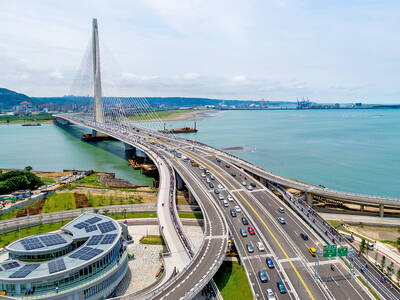
The Ministry of Transportation and Communications yesterday inaugurated the Danjiang Bridge across the Tamsui River in New Taipei City, saying that the structure would be an architectural icon and traffic artery for Taiwan. Feted as a major engineering achievement, the Danjiang Bridge is 920m long, 211m tall at the top of its pylon, and is the longest single-pylon asymmetric cable-stayed bridge in the world, the government’s Web site for the structure said. It was designed by late Iraqi-British architect Zaha Hadid. The structure, with a maximum deck of 70m, accommodates road and light rail traffic, and affords a 200m navigation channel for boats,
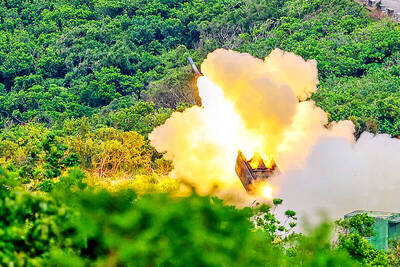
PRECISION STRIKES: The most significant reason to deploy HIMARS to outlying islands is to establish a ‘dead zone’ that the PLA would not dare enter, a source said A High Mobility Artillery Rocket System (HIMARS) would be deployed to Penghu County and Dongyin Island (東引) in Lienchiang County (Matsu) to force the Chinese military to retreat at least 100km from the coastline, a military source said yesterday. Taiwan has been procuring HIMARS and Army Tactical Missile Systems (ATACMS) from the US in batches. Once all batches have been delivered, Taiwan would possess 111 HIMARS units and 504 ATACMS, which have a range of 300km. Considering that “offense is the best defense,” the military plans to forward-deploy the systems to outlying islands such as Penghu and Dongyin so that
Taiwan Semiconductor Manufacturing Co (TSMC, 台積電), the world’s largest foundry service provider, yesterday said that global semiconductor revenue is projected to hit US$1.5 trillion in 2030, after the figure exceeds US$1 trillion this year, as artificial intelligence (AI) demand boosts consumption of token and compute power. “We are still at the beginning of the AI revolution, but we already see a significant impact across the whole semiconductor ecosystem,” TSMC deputy cochief operating officer Kevin Zhang (張曉強) said at the company’s annual technology symposium in Hsinchu City. “It is fair to say that in the past decade, smartphones and other mobile devices were

‘CLEAR MESSAGE’: The bill would set up an interagency ‘tiger team’ to review sanctions tools and other economic options to help deter any Chinese aggression toward Taiwan US Representative Young Kim has introduced a bill to deter Chinese aggression against Taiwan, calling for an interagency “tiger team” to preplan coordinated sanctions and economic measures in response to possible Chinese military or political action against Taiwan. “[Chinese President] Xi Jinping [習近平] has directed the People’s Liberation Army to be ready to invade Taiwan by 2027. China has a plan. America should have one too,” Kim said in a news release on Thursday last week. She introduced the “Deter PRC [People’s Republic of China] aggression against Taiwan act” to “ensure the US has a coordinated sanctions strategy ready should


 RSS
RSS