


For Nicholas Tang, the deluge of work-related e-mail messages became overwhelming.
"It got to the point where I was getting hundreds of e-mails a day, sometimes more than a thousand," said Tang, director of operations at Community Connect, a company in New York that operates AsianAvenue.com and other online communities with an ethnic focus.
For several years Tang viewed this daily surge of e-mail messages as an unpleasant but necessary part of his job managing a team of eight engineers. Then, a few months ago, he began using an alternative to e-mail, a Web log.
Web logs, or blogs as they are known, are a type of frequently updated online journal, often featuring excerpts from news articles and links to other blogs.
So far, Web logs are best known as a medium for communicating with the general public -- like the blog by the noted journalist Andrew Sullivan (www.andrewsullivan.com), which is devoted to culture and politics, and sites such as the Veg Blog (www.vegblog.org), which is about all things vegetarian.
In the corporate context, some chief executives, for better or worse, have adopted blogs as a way to share their personal wisdom with the wider world. But a growing number of businesses, government organizations and educational institutions are using Web logs to manage and improve the flow of information among their employees.
These blogs, not accessible to the public, typically allow many people to contribute entries that can be read by others in the organization. It may be too soon to tell whether the corporate blog will emerge as a genuinely useful tool for business communications or simply another way for bores and blowhards to blather. But a growing circle of adopters, like Tang, swear by their blogs.
At Community Connect, Tang's engineers use a service called LiveJournal to post updates about tasks such as fixing server computers or configuring software. Hitting the upload button sends the text to a private site, which is viewable by the authors and their managers, including the date and time of the postings and, often, links to relevant Web pages.
"When I want to know something I check the Web log," Tang said. "It saves me the trouble of e-mailing people or yelling across the room to get a status update."
Tang has also used blogs to coordinate group projects, like the recent process of interviewing job candidates for a programming position. The various people at the company who spoke to each candidate posted their comments on a password-protected Web log.
"One person wrote that a candidate was `quiet,"' Tang recalled. "There was a whole discussion about this. `What does that mean? Is it a bad thing? There was more back and forth with the interview process. It helped everyone to get on the same page more quickly."
Because of their informal nature, blogs can lead to digressions. Shirley Palma, a Community Connect administrator, said that after meeting one job candidate, a woman posted this message on the interview blog: "I think he's so cute! I want to take him home!" Palma noted that "it was in a motherly way; she didn't mean anything by it."

PROVOCATIVE: Chinese Deputy Ambassador to the UN Sun Lei accused Japan of sending military vessels to deliberately provoke tensions in the Taiwan Strait China denounced remarks by Japan and the EU about the South China Sea at a UN Security Council meeting on Monday, and accused Tokyo of provocative behavior in the Taiwan Strait and planning military expansion. Ayano Kunimitsu, a Japanese vice foreign minister, told the Council meeting on maritime security that Tokyo was seriously concerned about the situation in the East China and South China seas, and reiterated Japan’s opposition to any attempt to change the “status quo” by force, and obstruction of freedom of navigation and overflight. Stavros Lambrinidis, head of the EU delegation to the UN, also highlighted South China Sea

The final batch of 28 M1A2T Abrams tanks purchased from the US arrived at Taipei Port last night and were transported to the Armor Training Command in Hsinchu County’s Hukou Township (湖口), completing the military’s multi-year procurement of 108 of the tanks. Starting at 12:10am today, reporters observed more than a dozen civilian flatbed trailers departing from Taipei Port, each carrying an M1A2T tank covered with black waterproof tarps. Escorted by military vehicles, the convoy traveled via the West Coast Expressway to the Armor Training Command, with police implementing traffic control. The army operates about 1,000 tanks, including CM-11 Brave Tiger
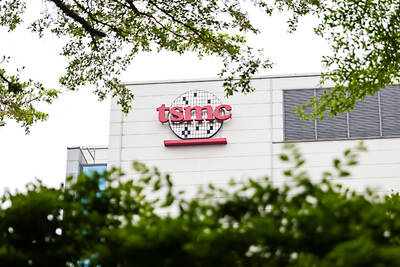
Taiwan Semiconductor Manufacturing Co (TSMC, 台積電), the world’s largest contract chipmaker, said it expects its 2-nanometer (2nm) chip capacity to grow at a compound annual rate of 70 percent from this year to 2028. The projection comes as five fabs begin volume production of 2-nanometer chips this year — two in Hsinchu and three in Kaohsiung — TSMC senior vice president and deputy cochief operating officer Cliff Hou (侯永清) said at the company’s annual technology symposium in Silicon Valley, California, last week. Output in the first year of 2-nanometer production, which began in the fourth quarter of last year, is expected to

Taiwan’s drone exports surged past US$100 million in the first quarter, exceeding last year’s full-year total, with the Czech Republic emerging as the largest buyer, the Ministry of Economic Affairs said. Exports of complete drones reached US$115.85 million in the period, about 1.2 times the total recorded for all of last year, the ministry said in a report. Exports to the Czech Republic accounted for about US$100 million, far outpacing other markets. Poland, last year’s top destination, recorded about US$11.75 million in the first quarter. Taiwan’s drone exports have expanded rapidly in the past few years, with last year’s total


 RSS
RSS