


US executives, coping with the worst three years of growth since the early 1990s, say an end to war in Iraq won't mean a quick rebound in the economy.
As Iraqis welcomed US troops into central Baghdad, executives at companies from Lehman Brothers Holdings Inc to Hooker Furniture Corp warned that inventories are too high, capacity too great and orders too slow for them to be optimistic.
"Nobody is basing any of their investment plans on growth at this point," said Curtis Wozniak, chief executive of Electroglas Inc, a San Jose, California, maker of semiconductor-testing equipment. "The CEOs I talk to are saying these kinds of business conditions are going to continue on, war or no war."
Corporate leaders are more pessimistic than economists about the outlook for the world's largest economy. The Business Roundtable, a group of chief executive officers from 150 of the largest US companies, including International Paper Co, Boeing Co, and Allstate Corp, projects that the economy will grow 2.2 percent this year.
That's less than the 2.4 percent average of 53 economists surveyed by Blue Chip Economic Indicators and would be the slowest growth since 1991, except for a 0.3 percent rise in the recession year of 2001.
"They're in as much of a fog as others as to where the economy goes postwar," said Avery Shenfeld, senior economist at CIBC World Markets Inc in Toronto. "I think the economic disappointments are going to outlast the war."
US growth from 2000 through last year averaged 2.2 percent, the lowest for a three-year period since 1.4 percent from 1990 through 1992. Federal Reserve Chairman Alan Greenspan and other policy-makers have predicted that growth would accelerate once the outcome and duration of the war became clear.
At its most recent meeting on March 18, central bankers left the overnight bank lending rate at 1.25 percent and said that as "uncertainties" surrounding the Iraq war lift, low interest rates and productivity increases will "provide support to economic activity sufficient to engender an improving economic climate over time."
There have been some encouraging recent signs. The price of crude oil has fallen 25 percent from a high of US$37.83 a barrel on March 12 and the Standard & Poor's 500 Index has increased 8 percent since March 11.
Such improvements have yet to alter the attitudes of executives, many of whom aren't spending or hiring. The economy has lost 465,000 jobs over the past two months.
Saddam Hussein's statue may have been toppled in Baghdad, but "the phones didn't immediately start ringing off the hook with people saying bring us 10,000 more people tomorrow," said Carl Camden, chief operating officer at Kelly Services Inc, the second-largest US temporary employment company, based in Troy, Michigan.
One obstacle to faster growth is that many companies already have more than enough equipment and factory space to meet demand.
The nation's plant-use rate was at 75.6 percent in February, close to the 18-year low of 74.6 percent in December 2001.
"Frankly, the fundamentals that we're talking about here are largely not war-related and therefore we continue to be very concerned," said John Dillon, chief executive of International Paper Co and chairman of the Business Roundtable. "It's not just about whether business leaders feel encouraged or not about the economy."
Because consumers until recently continued to spend, there isn't the pent-up demand to spur the economy that has existed after previous slowdowns. So companies haven't been encouraged to boost production. Factory orders fell 1.5 percent in February, the most in five months.
Now the consumer may be pulling back. Personal spending stalled during the first two months of the year, the first time spending has failed to rise for two straight months since December 1990 and January 1991, when the US was in recession.
Even executives at companies such as Hooker Furniture, who are optimistic that sales will rebound later this year, say they would be slow to react to rising consumer spending. The company had US$60.2 million worth of inventory as of Feb. 28, twice as much as a year earlier.
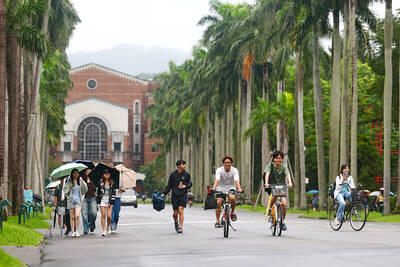
National Taiwan University (NTU) yesterday said it disqualified a person from an entrance examination for using AI smart glasses to cheat, along with two others for making untruthful statements in their curriculum vitae. The three applicants were given null scores, Taiwan’s highest-ranked university said, calling on prospective students to be honest in the admissions process. NTU registrar Lee Hung-sen (李宏森) said that the cheating applicant wore a hat and thick-rimmed glasses to the second written exam for medical school, claiming that they felt cold. Suspicions were aroused when the applicant stared oddly at the test for long stretches while steadily bringing the paper
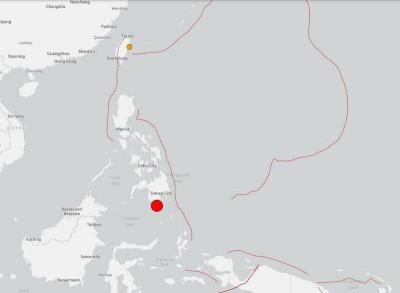
A magnitude 7.8 earthquake struck off the southern coast of Mindanao in the Philippines at 7:38am today, prompting the US Tsunami Warning System to issue an alert for neighboring countries, including Taiwan. The system issued a purple alert indicating a "tsunami threat." The potential threat zone includes Taiwan, the Philippines, Papua New Guinea, Yap and Palau. Philippine authorities were assessing the damage from the quake, with the office of civil defense seeking to verifying initial reports that 15 people had been killed and 129 injured in the region, mostly from falling debris. Arlene Hollero, disaster chief of Maasim town in the Philippines' Sarangani Province,
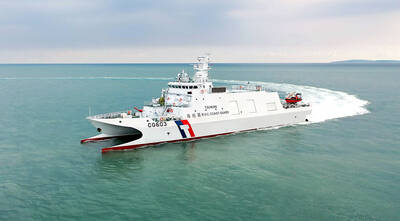
‘GRAY ZONE’ PRESSURE: Beijing’s activities are intended to create the deceitful impression that China has jurisdiction over the area around Taiwan, the CGA said Taiwan’s rights over its territorial waters and exclusive economic zone must not be violated by any country, the Mainland Affairs Council said yesterday, adding that it will not accept any unprovoked actions. The council issued the remarks in response to the China Coast Guard conducting maritime enforcement drills near eastern Taiwan and claiming to fully exercise China’s maritime administrative law enforcement authority. The Coast Guard Administration (CGA) has been closely monitoring the situation and is taking concrete steps to defend the nation’s sovereignty and secure its waters, the council said. China has no sovereign rights over the waters off eastern
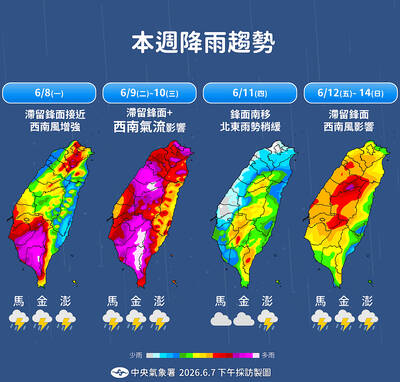
Heavy rain is expected to affect parts of Taiwan this week, the Central Weather Administration (CWA) said yesterday as a meteorologist said the active part of the annual plum rain season has started. A stationary plum rain front and southwesterly winds would bring unstable weather and abundant moisture to Taiwan from today for about a week, with the heaviest rainfall forecast for tomorrow and Wednesday, the CWA said. The agency said western and northeastern Taiwan, and mountainous areas in the east and southeast, could expect showers or thunderstorms on those two days, with localized heavy rain possible. Other parts of


 RSS
RSS