


The war in Iraq might just determine the fate of a little-known Houston company, Boots & Coots International Well Control, which put out about a third of the oil-well fires set in Kuwait in 1991 and earned perhaps as much as US$100 million in the process.
Barring some drastic shift in the pattern of the war so far, the company could well go under.
As recently as mid-February, the company acknowledged that creditors were pressuring it to file for bankruptcy, but its fortunes seemed to take a positive swing on March 6, when the Pentagon announced that it had a plan for fighting oil-well fires. Its plan was drafted by a unit of Halliburton, Vice President Dick Cheney's former employer, which has an agreement to subcontract oil-well firefighting to Boots & Coots.
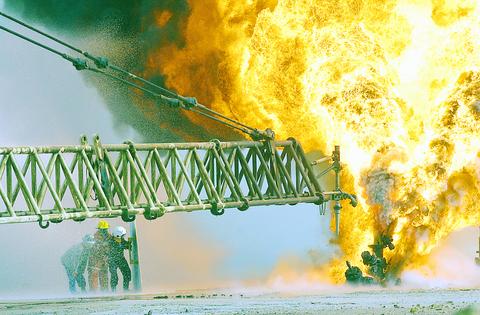
PHOTO: AFP
But its fortunes looked bleak again when, contrary to many expectations, the first days of the war produced only a relative handful of fires, compared with more than 700 in 1991. Danny Clayton, the operations manager of Boots & Coots, said on Monday that he was surprised that relatively few oil-well fires had started in Iraq so far.
"It's as easy to destroy 90 wells as it is to destroy nine," said Clayton, who ran the company's oil-well firefighting operations in Kuwait after the 1991 war. "But there's still a good chance. They have several more oil fields, and I'm sure that they are not all secured yet."
Perverse as it may sound, then, the company's fortunes -- indeed, its very existence -- seem to depend on a good many Iraqi oil wells being put to the torch.
Boots & Coots was founded by Boots Hansen and Coots Matthews in 1978, when they left the employ of Red Adair, the legendary oil-well fire fighter who inspired the late 1960s John Wayne film Hellfighters. The company, which began trading in 1997, was once a thriving concern. But accidental oil-well fires have become much less common as engineering has improved.
If there are more fires, Boots & Coots might have a larger share of the work this time, said Jerry L. Winchester, the chief executive and chief operating officer, who worked for Halliburton 12 years ago coordinating the firefighting teams in Kuwait. In 1991, firefighters were sent in from China, Russia, Iran, Romania, Hungary and elsewhere. This time, the Pentagon has said it will favor American companies.
There are two other oil-well firefighters in the US: Wild Well Control, a subsidiary of Superior Energy Services of Harvey, Louisiana, which also has a Halliburton contract in Iraq, and Cudd Pressure Control, a unit of RPC Inc in Atlanta.
Shares of Boots & Coots have been swinging wildly. They vacillated from US$0.47 to US$0.70 until the start of war sent them as high as US$2.55. On Friday they closed at US$0.83. A filing in November with the Securities and Exchange Commission covering the quarter ended Sept. 30 said, "The company does not have sufficient funds to meet its immediate obligations," and there is "substantial doubt about the ability of the company to continue as a going concern."
At the end of September, current assets totaled US$4.1 million and current liabilities were US$19.9 million.
Clayton, the operations manager, estimates that it will take four to five days to extinguish each well fire, possibly less. Boots & Coots might bill roughly US$40,000 to US$50,000 a day for its services, he said. That yields a very rough estimate of US$160,000 to US$250,000 a well. As of Friday, nine wells had been set on fire, with six of those already extinguished, a Pentagon spokesman said. Kuwaiti firefighters worked with crews from Boots & Coots to put out those fires, according to a spokesman for the Army Corps of Engineers.
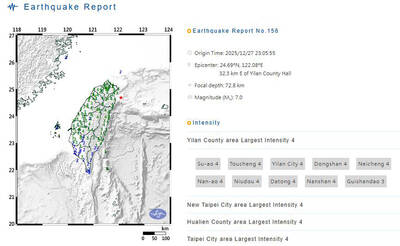
A magnitude 7.0 earthquake struck off Yilan at 11:05pm yesterday, the Central Weather Administration (CWA) said. The epicenter was located at sea, about 32.3km east of Yilan County Hall, at a depth of 72.8km, CWA data showed There were no immediate reports of damage. The intensity of the quake, which gauges the actual effect of a seismic event, measured 4 in Yilan County area on Taiwan’s seven-tier intensity scale, the data showed. It measured 4 in other parts of eastern, northern and central Taiwan as well as Tainan, and 3 in Kaohsiung and Pingtung County, and 2 in Lienchiang and Penghu counties and 1

A car bomb killed a senior Russian general in southern Moscow yesterday morning, the latest high-profile army figure to be blown up in a blast that came just hours after Russian and Ukrainian delegates held separate talks in Miami on a plan to end the war. Kyiv has not commented on the incident, but Russian investigators said they were probing whether the blast was “linked” to “Ukrainian special forces.” The attack was similar to other assassinations of generals and pro-war figures that have either been claimed, or are widely believed to have been orchestrated, by Ukraine. Russian Lieutenant General Fanil Sarvarov, 56, head
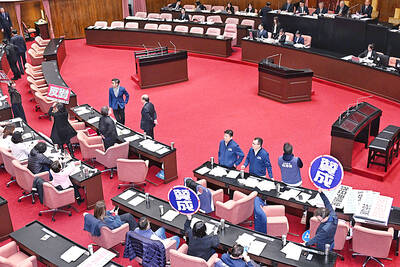
‘POLITICAL GAME’: DPP lawmakers said the motion would not meet the legislative threshold needed, and accused the KMT and the TPP of trivializing the Constitution The Legislative Yuan yesterday approved a motion to initiate impeachment proceedings against President William Lai (賴清德), saying he had undermined Taiwan’s constitutional order and democracy. The motion was approved 61-50 by lawmakers from the main opposition Chinese Nationalist Party (KMT) and the smaller Taiwan People’s Party (TPP), who together hold a legislative majority. Under the motion, a roll call vote for impeachment would be held on May 19 next year, after various hearings are held and Lai is given the chance to defend himself. The move came after Lai on Monday last week did not promulgate an amendment passed by the legislature that

FOREIGN INTERFERENCE: Beijing would likely intensify public opinion warfare in next year’s local elections to prevent Lai from getting re-elected, the ‘Yomiuri Shimbun’ said Internal documents from a Chinese artificial intelligence (AI) company indicated that China has been using the technology to intervene in foreign elections, including propaganda targeting Taiwan’s local elections next year and presidential elections in 2028, a Japanese newspaper reported yesterday. The Institute of National Security of Vanderbilt University obtained nearly 400 pages of documents from GoLaxy, a company with ties to the Chinese government, and found evidence that it had apparently deployed sophisticated, AI-driven propaganda campaigns in Hong Kong and Taiwan to shape public opinion, the Yomiuri Shimbun reported. GoLaxy provides insights, situation analysis and public opinion-shaping technology by conducting network surveillance


 RSS
RSS