


Gold prices will outperform those of other precious metals such as silver and platinum as political tensions, a weakening dollar and concerns of stagnant economic growth spur demand, analysts said.
The gold price will average US$336 an ounce this year, a gain of more than 8 percent from last year, according to the average expectations of 18 analysts contacted by Bloomberg. Silver will rise almost 7 percent to US$4.92 an ounce, while platinum should add almost 6 percent to US$571 an ounce. Palladium will sink 23 percent to US$260 an ounce, the survey found.
Gold last year had its biggest gain since 1979 as investors sought a haven from declining stock markets, a weakening dollar, terrorism and the threat of a war against Iraq. Fifteen out of 18 respondents in the survey predicted an increase in gold prices, while only one expected a decline.
"The factors that drew gold higher in 2002 shall continue to prevail in 2003," said Frederic Panizzutti, a director at Geneva-based GoldAvenue, a trading and marketing service. "There is a threat of further terrorism and the risk for a military intervention in Iraq combined with volatile stock and currency markets."
Platinum will continue to benefit, after a 26 percent gain last year, from growth in demand that is outpacing supplies from mines, the analysts said. Demand was expected to rise 2.9 percent last year to 6.37 million ounces, almost half a million ounces more than mine production, according to Johnson Matthey Plc, the world's biggest precious-metals marketer.
Platinum, mined mostly in South Africa and Russia, is used in jewelry and by carmakers to make exhaust systems.
"The inability for new mine supply to meet this growing demand will produce several years of deficit," said Ingrid Sternby, an analyst at Barclays Capital in London. "We expect strong end-use demand from key sectors to keep prices firm."
Rival metal palladium is also used by carmakers in auto catalysts. They cut their purchases last year, leading to a drop in demand that meant consumption last year was probably its lowest since 1994, according to Johnson Matthey. The metal last year lost 46 percent of its value, prompting Russia, the biggest producer in 2001, to embargo sales to the open market.
Palladium is also used by dentists and by manufacturers of electronics, chemicals and jewelry.
"It is difficult to make a bullish case for palladium," said Ross Norman, a director at TheBullionDesk.com, a research company. "Car stocks are high, car sales are forecast to decline, the shift to platinum is gathering momentum and electronics demand looks terminal."
Silver is likely to be buoyed by the gains in gold, analysts said. A mean price of US$4.91 this year would be its highest yearly average since 2000, when it averaged US$4.96 an ounce.
* The gold price will average US$336 an ounce this year, a gain of more than 8 percent from last year, according to expectations of 18 analysts.
* Silver will rise almost 7 percent to US$4.92 an ounce.
* Platinum should add almost 6 percent to US$571 an ounce.
* Palladium will sink 23 percent to US$260 an ounce, the survey found.
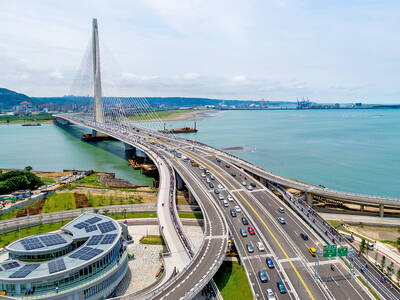
The Ministry of Transportation and Communications yesterday inaugurated the Danjiang Bridge across the Tamsui River in New Taipei City, saying that the structure would be an architectural icon and traffic artery for Taiwan. Feted as a major engineering achievement, the Danjiang Bridge is 920m long, 211m tall at the top of its pylon, and is the longest single-pylon asymmetric cable-stayed bridge in the world, the government’s Web site for the structure said. It was designed by late Iraqi-British architect Zaha Hadid. The structure, with a maximum deck of 70m, accommodates road and light rail traffic, and affords a 200m navigation channel for boats,
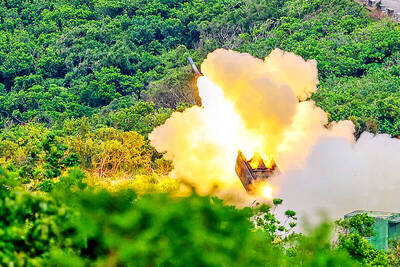
PRECISION STRIKES: The most significant reason to deploy HIMARS to outlying islands is to establish a ‘dead zone’ that the PLA would not dare enter, a source said A High Mobility Artillery Rocket System (HIMARS) would be deployed to Penghu County and Dongyin Island (東引) in Lienchiang County (Matsu) to force the Chinese military to retreat at least 100km from the coastline, a military source said yesterday. Taiwan has been procuring HIMARS and Army Tactical Missile Systems (ATACMS) from the US in batches. Once all batches have been delivered, Taiwan would possess 111 HIMARS units and 504 ATACMS, which have a range of 300km. Considering that “offense is the best defense,” the military plans to forward-deploy the systems to outlying islands such as Penghu and Dongyin so that
Taiwan Semiconductor Manufacturing Co (TSMC, 台積電), the world’s largest foundry service provider, yesterday said that global semiconductor revenue is projected to hit US$1.5 trillion in 2030, after the figure exceeds US$1 trillion this year, as artificial intelligence (AI) demand boosts consumption of token and compute power. “We are still at the beginning of the AI revolution, but we already see a significant impact across the whole semiconductor ecosystem,” TSMC deputy cochief operating officer Kevin Zhang (張曉強) said at the company’s annual technology symposium in Hsinchu City. “It is fair to say that in the past decade, smartphones and other mobile devices were
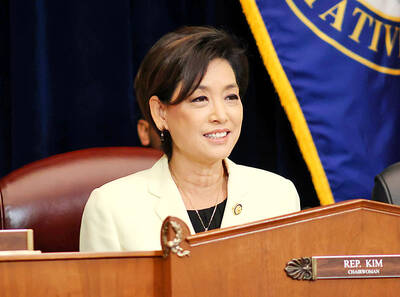
‘CLEAR MESSAGE’: The bill would set up an interagency ‘tiger team’ to review sanctions tools and other economic options to help deter any Chinese aggression toward Taiwan US Representative Young Kim has introduced a bill to deter Chinese aggression against Taiwan, calling for an interagency “tiger team” to preplan coordinated sanctions and economic measures in response to possible Chinese military or political action against Taiwan. “[Chinese President] Xi Jinping [習近平] has directed the People’s Liberation Army to be ready to invade Taiwan by 2027. China has a plan. America should have one too,” Kim said in a news release on Thursday last week. She introduced the “Deter PRC [People’s Republic of China] aggression against Taiwan act” to “ensure the US has a coordinated sanctions strategy ready should


 RSS
RSS