


Severe stress in global markets has nerve-wracked investors fearful that one big shock could jam the gears of the financial system -- much like the crisis days of 1998.
"People feel like gasoline has been dumped on the floor and it wouldn't take much to ignite it," said James Glassman, senior US economist at JP Morgan Chase.
Plunging stocks and multibillion-dollar bankruptcies the past month have investors assessing the widespread damage to banks and insurers. If more scandals or failures come to light further straining capital markets, it could force central banks to jump to the rescue, pumping money into the system through lower interest rates.
Fear is starting to hurt economies as well. The financial market squeeze in both the US and Europe is depriving businesses of crucial capital and sharply increasing their cost of borrowing at a time when global growth, led by the US$10 trillion US economy, appears to be losing steam.
"The Fed has to get concerned about the capital markets effectively tightening for the Fed at a time when it wants policy to remain accommodative," said Brad Stone, chief US market strategist at Barclays Capital.
"The Fed may need to lean against that. Some weeks ago that looked like a very low risk. Now it's definitely a real risk," he said.
Interest rates charged on high-quality corporate debt right now stand at near-record levels -- 2.2 percentage points above risk-free Treasuries, up more than half a percentage point since early June.
Investors, scared they cannot trust corporate balance sheets, have proven reluctant to lend money. Corporate bond issuance by investment grade companies sank in July to US$22 billion, down 63 percent from its January to June average. Last week investment grade debt suffered its worst week since at least 1997, and junk bonds are set for their worst year ever.
Funding through the short-term commercial paper market also has become very difficult, with total outstanding issuance for nonfinancial and financial firms falling a hefty US$93 billion this year. Banks have turned skittish about lending. Initial public offerings have dried up.
"The way the events are unfolding right now for the near term, dealing with these many financial constraints is going to impinge and impinge and impinge on economic activity," said prominent Wall Street economist Henry Kauffman, who has argued the Fed should cut interest rates.
Swap spreads -- a measure of banking sector risk that signaled the systemic distress in 1998 -- popped out last week on the credit anxiety about JP Morgan before stabilizing. Investors are even raising risk premiums on assets usually considered very safe like mortgage-backed securities.
With markets so stretched, harried traders are looking anxiously for the one trigger that could set off an explosion.
"The markets continue to scan for a `smoking gun' to justify some emergency policy response," said Michael Wallace, an economist at Standard & Poor's MMS.
Rattled markets showed their heightened state of anxiety on Friday when rumors of an emergency central bank meeting in Europe to help a failing bank or insurance company swept through trading desks, sparking selling of stocks and powering gains in safe-haven short-term Treasuries.
Banking trouble fears hit a fever pitch on July 24 when rumors spread of liquidity problems at JP Morgan Chase -- the largest US bank -- and Citigroup after congressional revelations of their dealings with failed energy trader Enron Corp. The impact across credit markets was harsh and swift.
Later that day ratings agency Standard & Poor's said such talk was unfounded and reaffirmed the ratings of both banks, but investors remain shaken and the damage to market conditions has not improved much.
Europe has also seen its fair share of worries about the quality of its banks and insurance companies on the asset losses, providing fodder for the rumor mill.
On July 25 Germany's second-largest bank, HVB Group, posted a second-quarter loss and described business conditions as among the worst since World War II.
Economists are quick to point to the differences between this episode and the late summer of 1998, when Russia's debt default sent investors rushing out of risky assets globally and nearly brought the financial system to its knees when the hedge fund Long-Term Capital Management almost collapsed.
Conditions were so bad then that even the massive US government bond market -- considered the most liquid in the world and a refuge from turmoil -- nearly froze as dealers demanded higher and higher premiums to execute trades.
Eventually the Fed cut rates to restore investor confidence, even though the economy was in good shape.
The current pain in capital markets has yet to reach those extreme levels of distress, said JP Morgan's Glassman.
But he said the market sees conditions as deteriorating to the point where a crisis could happen "at any moment."
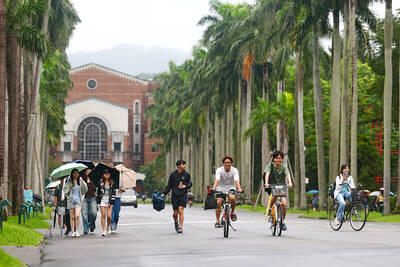
National Taiwan University (NTU) yesterday said it disqualified a person from an entrance examination for using AI smart glasses to cheat, along with two others for making untruthful statements in their curriculum vitae. The three applicants were given null scores, Taiwan’s highest-ranked university said, calling on prospective students to be honest in the admissions process. NTU registrar Lee Hung-sen (李宏森) said that the cheating applicant wore a hat and thick-rimmed glasses to the second written exam for medical school, claiming that they felt cold. Suspicions were aroused when the applicant stared oddly at the test for long stretches while steadily bringing the paper
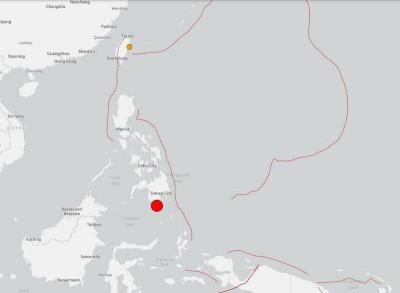
A magnitude 7.8 earthquake struck off the southern coast of Mindanao in the Philippines at 7:38am today, prompting the US Tsunami Warning System to issue an alert for neighboring countries, including Taiwan. The system issued a purple alert indicating a "tsunami threat." The potential threat zone includes Taiwan, the Philippines, Papua New Guinea, Yap and Palau. Philippine authorities were assessing the damage from the quake, with the office of civil defense seeking to verifying initial reports that 15 people had been killed and 129 injured in the region, mostly from falling debris. Arlene Hollero, disaster chief of Maasim town in the Philippines' Sarangani Province,
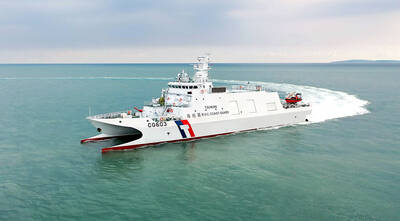
‘GRAY ZONE’ PRESSURE: Beijing’s activities are intended to create the deceitful impression that China has jurisdiction over the area around Taiwan, the CGA said Taiwan’s rights over its territorial waters and exclusive economic zone must not be violated by any country, the Mainland Affairs Council said yesterday, adding that it will not accept any unprovoked actions. The council issued the remarks in response to the China Coast Guard conducting maritime enforcement drills near eastern Taiwan and claiming to fully exercise China’s maritime administrative law enforcement authority. The Coast Guard Administration (CGA) has been closely monitoring the situation and is taking concrete steps to defend the nation’s sovereignty and secure its waters, the council said. China has no sovereign rights over the waters off eastern
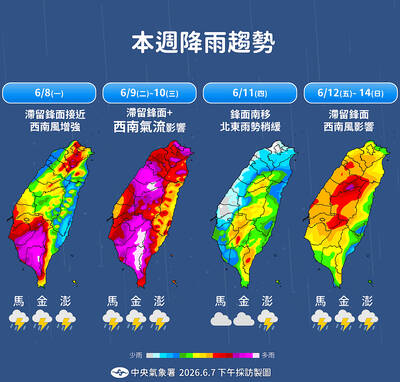
Heavy rain is expected to affect parts of Taiwan this week, the Central Weather Administration (CWA) said yesterday as a meteorologist said the active part of the annual plum rain season has started. A stationary plum rain front and southwesterly winds would bring unstable weather and abundant moisture to Taiwan from today for about a week, with the heaviest rainfall forecast for tomorrow and Wednesday, the CWA said. The agency said western and northeastern Taiwan, and mountainous areas in the east and southeast, could expect showers or thunderstorms on those two days, with localized heavy rain possible. Other parts of


 RSS
RSS