


The US is leading the world out of last year's economic downturn, but global policy makers will have to raise interest rates and curb government spending to avoid rising inflation, the OECD (Organization for Economic Cooperation and Development) said yesterday.
In its twice annual economic outlook, the Organization for Economic Cooperation and Development said the economies of its 30 members -- including the world's most developed nations -- will grow by 2 percent this year and 3 percent in 2003.
The Paris-based research organization said that growth is reviving as inventories fall to normal levels and investment in information and communication technologies rebounds.
The recovery has been aided by low interest rates and supportive fiscal policy, and central banks will now have to take difficult decisions about when they start to raise interest rates.
"The possible inflationary consequences of ... faster growth make the timing of the withdrawal of stimulus a critical policy consideration. As slack in the product and labor markets dissipates, monetary policy should steadily be moved back to a neutral and ultimately to a restrictive stance," the OECD said.
However, with economic activity in the euro-zone "likely to remain sluggish" in the first half, the OECD said the European Central Bank should be more cautious than the US Federal Reserve about raising interest rates. The OECD expects the euro-zone economy to grow by 1.3 percent this year and 2.9 percent in 2003.
The report said that activity in the Asia-Pacific region as a whole is likely to pick up, while the Argentine crisis is yet to have a serious negative impact on the other economies of Latin America.
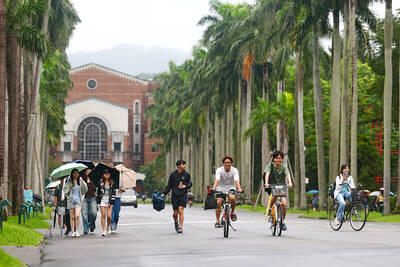
National Taiwan University (NTU) yesterday said it disqualified a person from an entrance examination for using AI smart glasses to cheat, along with two others for making untruthful statements in their curriculum vitae. The three applicants were given null scores, Taiwan’s highest-ranked university said, calling on prospective students to be honest in the admissions process. NTU registrar Lee Hung-sen (李宏森) said that the cheating applicant wore a hat and thick-rimmed glasses to the second written exam for medical school, claiming that they felt cold. Suspicions were aroused when the applicant stared oddly at the test for long stretches while steadily bringing the paper
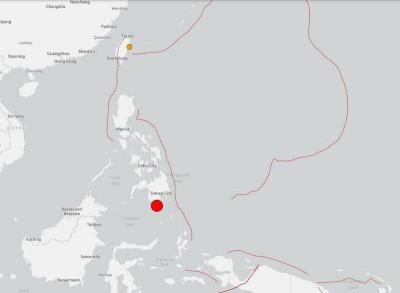
A magnitude 7.8 earthquake struck off the southern coast of Mindanao in the Philippines at 7:38am today, prompting the US Tsunami Warning System to issue an alert for neighboring countries, including Taiwan. The system issued a purple alert indicating a "tsunami threat." The potential threat zone includes Taiwan, the Philippines, Papua New Guinea, Yap and Palau. Philippine authorities were assessing the damage from the quake, with the office of civil defense seeking to verifying initial reports that 15 people had been killed and 129 injured in the region, mostly from falling debris. Arlene Hollero, disaster chief of Maasim town in the Philippines' Sarangani Province,

‘GRAY ZONE’ PRESSURE: Beijing’s activities are intended to create the deceitful impression that China has jurisdiction over the area around Taiwan, the CGA said Taiwan’s rights over its territorial waters and exclusive economic zone must not be violated by any country, the Mainland Affairs Council said yesterday, adding that it will not accept any unprovoked actions. The council issued the remarks in response to the China Coast Guard conducting maritime enforcement drills near eastern Taiwan and claiming to fully exercise China’s maritime administrative law enforcement authority. The Coast Guard Administration (CGA) has been closely monitoring the situation and is taking concrete steps to defend the nation’s sovereignty and secure its waters, the council said. China has no sovereign rights over the waters off eastern
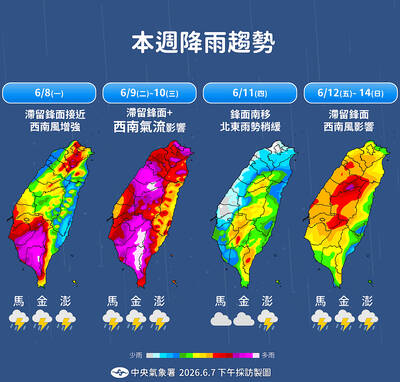
Heavy rain is expected to affect parts of Taiwan this week, the Central Weather Administration (CWA) said yesterday as a meteorologist said the active part of the annual plum rain season has started. A stationary plum rain front and southwesterly winds would bring unstable weather and abundant moisture to Taiwan from today for about a week, with the heaviest rainfall forecast for tomorrow and Wednesday, the CWA said. The agency said western and northeastern Taiwan, and mountainous areas in the east and southeast, could expect showers or thunderstorms on those two days, with localized heavy rain possible. Other parts of


 RSS
RSS