


Despite all the fretting about a new style of synchronized world slowdown, the global economy is actually on a well-worn path dating back to the 1890s, the IMF said Tuesday.
Seeking to put the global deceleration in context, the IMF analysis scotches many widely-held beliefs about the unique nature of the current cycle.
"Contrary to the impression one gets from much of the public discussion, the tendency of recessions in one country to occur at the same time as recessions in other countries -- synchronization -- has been a persistent feature of the historical record," it said.
The IMF analysis is contained within its World Economic Outlook, a report scheduled for release in its entirety on April 18, two days before a semi-annual gathering here of the IMF and World Bank.
The IMF released the analytical section in advance, saying it was frustrated that months of scholarly work in the semi-annual report were often skipped over by journalists.
The report's highlight -- the latest IMF world economic growth forecasts -- remains under wraps.
But the analysis does shed a new historical light on the nature of the worldwide slowdown, which some commentators have described as being of a unique, globalized nature. "Since the late 19th century, most recessions have been synchronized," the IMF said.
Before World War I, the global economy turned down in the early 1890s, the early 1900s and 1907-8; between the wars it headed south again in 1920-21 and the Great Depression of 1929-1933.
And in recent decades, the world suffered widespread slowdowns in the mid-1970s, the early 1980s and the early 1990s.
In fact, recessions were becoming more synchronized over time, it said. IMF experts -- James Morsink, Thomas Helbing and Stephen Tokarick -- also scoffed at suggestions that the key role played by shrinking investment in the current slowdown marked a return to 19-century style recessions.
"The role of investment in recessions has, if anything, increased over time," their report said.
Almost all recessions since 1972 had been accompanied by a contraction in investment, compared to about 60 percent before World War II, the analysis said.
Over the same time period, deflation had almost been eradicated from the modern economic map, it said.
"About 40 percent of recessions before World War II were accompanied by deflation but only one -- Japan in the late 1990s -- since then," the IMF said.
Examining 93 business cycles since 1973, the analysts said a typical modern cycle lasts six years.
It starts with a one-year recession in which output falls slightly less than 3 percent, followed by a five-year expansion period with growth of a little more than 3 percent a year.
"Hence, despite the initial recession, the level of output at the end of a cycle is about 14 percent higher than at the beginning."
Business cycles have become longer and shallower over time, it said. More surprisingly, perhaps, the speed of an economic recovery does not appear to depend on the depth of the recession.
"In other words, output does not on average recover significantly more quickly after a short and mild recession than after a medium-length and moderate recession."
The IMF report debunked many suppositions about the world slowdown, IMF economic counsellor and research department director Kenneth Rogoff told reporters.
"Many people have written that the current recession is very different from past recessions, different because of the synchronicity, different because of the drop in business investment, etcetera, etcetera," he said.
* The tendency of recessions in one country to occur at the same time as recessions in other countries, or synchronization, has been a persistent feature of the historical record, IMF researcher say. Analysts had said the last recession was unique because it was a synchronized pullback.
* The speed of an economic recovery does not appear to depend on the depth of the recession. Analysts have been hoping for a quick recovery because the last recession was mild.
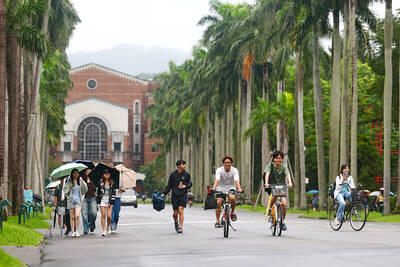
National Taiwan University (NTU) yesterday said it disqualified a person from an entrance examination for using AI smart glasses to cheat, along with two others for making untruthful statements in their curriculum vitae. The three applicants were given null scores, Taiwan’s highest-ranked university said, calling on prospective students to be honest in the admissions process. NTU registrar Lee Hung-sen (李宏森) said that the cheating applicant wore a hat and thick-rimmed glasses to the second written exam for medical school, claiming that they felt cold. Suspicions were aroused when the applicant stared oddly at the test for long stretches while steadily bringing the paper
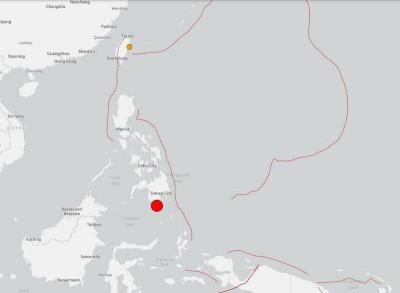
A magnitude 7.8 earthquake struck off the southern coast of Mindanao in the Philippines at 7:38am today, prompting the US Tsunami Warning System to issue an alert for neighboring countries, including Taiwan. The system issued a purple alert indicating a "tsunami threat." The potential threat zone includes Taiwan, the Philippines, Papua New Guinea, Yap and Palau. Philippine authorities were assessing the damage from the quake, with the office of civil defense seeking to verifying initial reports that 15 people had been killed and 129 injured in the region, mostly from falling debris. Arlene Hollero, disaster chief of Maasim town in the Philippines' Sarangani Province,

‘GRAY ZONE’ PRESSURE: Beijing’s activities are intended to create the deceitful impression that China has jurisdiction over the area around Taiwan, the CGA said Taiwan’s rights over its territorial waters and exclusive economic zone must not be violated by any country, the Mainland Affairs Council said yesterday, adding that it will not accept any unprovoked actions. The council issued the remarks in response to the China Coast Guard conducting maritime enforcement drills near eastern Taiwan and claiming to fully exercise China’s maritime administrative law enforcement authority. The Coast Guard Administration (CGA) has been closely monitoring the situation and is taking concrete steps to defend the nation’s sovereignty and secure its waters, the council said. China has no sovereign rights over the waters off eastern
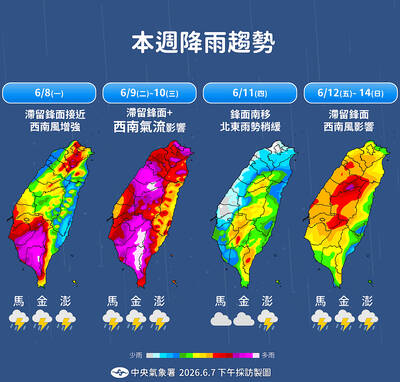
Heavy rain is expected to affect parts of Taiwan this week, the Central Weather Administration (CWA) said yesterday as a meteorologist said the active part of the annual plum rain season has started. A stationary plum rain front and southwesterly winds would bring unstable weather and abundant moisture to Taiwan from today for about a week, with the heaviest rainfall forecast for tomorrow and Wednesday, the CWA said. The agency said western and northeastern Taiwan, and mountainous areas in the east and southeast, could expect showers or thunderstorms on those two days, with localized heavy rain possible. Other parts of


 RSS
RSS