


Internet companies that sell airplane tickets? In this economy? It might seem to be a business trapped in a vortex of negative trends.
But here's a surprise: Despite the Internet malaise, economic slowdown and fears of terrorism and airline crashes, online travel companies are doing rather well.
The big public ones -- Travelocity, Expedia and Priceline -- had operating profits in the third quarter and expect the same in this quarter, too. Sales are down, of course, from what had been expected before Sept. 11. But the online companies seem to have gained a bigger slice of the smaller travel pie. That is good news for those companies and their investors, as Thanksgiving opens what could be the most uncertain holiday travel season in memory.
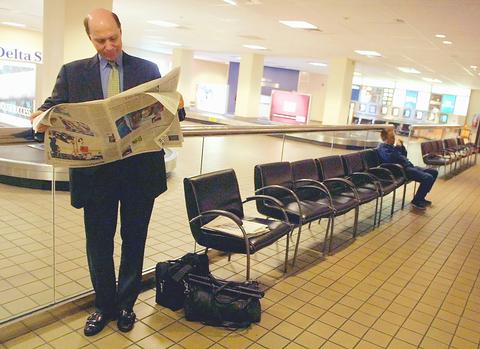
PHOTO: NY TIMES
Online travel, in fact, has been bucking the trend all year, growing much faster than other forms of electronic commerce as customers are lured by the convenience and, often, the lower prices offered by the travel Web sites. Airlines and other travel-oriented companies have encouraged this shift, because selling online is cheaper for them than using traditional travel agents or telephone reservation centers.
If anything, the travel turmoil since Sept. 11 has actually accelerated the transition. Airlines are no longer merely eager to cut costs -- they are desperate to do so. And consumers see the Web as the best way to find the deep discounts that tour and travel companies are offering to lure travelers back.
"Travel was the bright spot on the Internet before," said Rick Braddock, chief executive of Priceline. "And guess what? It's still the bright spot on the Internet."
Even the crash of American Airlines Flight 587 last Monday seemed to slow online bookings for only about a day. ComScore Networks, a company that monitors the Web activity of 1.5 million home and small-business Internet users worldwide, said that purchases at travel sites fell 29 percent last Tuesday, the day after the crash, compared with a week earlier. But by Thursday, bookings were actually 5 percent above the previous week's level.
"As the evidence has mounted that Monday's crash was not a terrorist attack but rather a mechanical accident, travelers' confidence has returned and they have resumed booking air travel," said Gian Fulgoni, the ComScore chief executive.
The travel impact of Sept. 11 does linger. ComScore's data showed a 48 percent decline in online airline bookings the week after the Sept. 11 attack. And volume has only slowly climbed back. In the week ended Sunday, Nov. 11, online travel purchases had reached US$399 million -- still about 7 percent below their level in the week ended Sept 9. Overall, the airline industry is operating at only about 70 percent of its normal volume, and hotel revenue is about 80 percent of pre-Sept. 11 levels.
Cruise and vacation packages doing well
Travelocity says its revenue is 70 percent to 80 percent of what it had previously expected for October and November. But cruise and vacation package sales are doing even better than expected before the terrorist attacks, because of the heavily reduced prices now being offered by travel companies.
At Expedia, sales are 80 percent to 85 percent of pre-Sept 11 levels. Expedia's revenue of US$80 million in the third quarter was less than the US$90 million it had been expecting, even though it was up 90 percent from a year earlier. This quarter, the company expects sales of US$65 million, up 47 percent from last year's fourth quarter.
Orbitz, a new online travel agent backed by a group of big airlines, is doing even better. While its sales fell 30 percent right after Sept. 11, its sales now are above the previous levels.
Orbitz, even more than other sites, is focused on offering low prices -- in part because it has access to airline sales that other travel agents do not. That puts Orbitz in an especially opportune position for the current market.
"After Sept. 11, people are hungry for a deal," said Jeffrey Katz, the Orbitz chief executive. "And they see the Internet as the way to get it."
Priceline -- the name-your-own-price travel site aimed at people so hungry for bargains that they will let the site pick their travel times, airline and routes -- so far is doing better than it had expected for the fourth quarter. Normally, the holiday travel season is a slow one for Priceline because the airlines have fewer unsold seats to sell at discounts. This year, of course, there are more seats, but with airlines running their own big sales, there is less room for Priceline to offer deeper discounts. Priceline and other online travel companies are having particular success selling hotel rooms, for which travelers have a harder time finding discounts on their own.
"There is a fire-sale mentality that has permeated the industry," said Priceline's Braddock.
To be sure, not every online travel company is prospering.
Take BizTravel.com, a 5-year-old site that closed on Sept. 25. Hal Rosenbluth, chief executive of Rosenbluth International, the big travel company that owned the majority stake in BizTravel, said that though the site had been struggling, it might have managed to stay in business if not for the events of Sept. 11.
"Our niche was to provide higher service for the business travel market," Rosenbluth said. "Unfortunately that was the wrong niche for the year 2001." Business travel has fallen off more sharply than leisure travel.
But Rosenbluth said that the Internet was helping Rosenbluth International lower costs in its traditional business of booking travel for big companies. Now 18 percent of its reservations are handled through online sites it runs for corporations, up three times from a year ago.
No bed of roses
Even the online travel companies that are doing relatively well have moved quickly to cut their costs since Sept. 11.
Orbitz has laid off 17 people, about 10 percent of its staff. USA Networks, which is buying control of Expedia from Microsoft, has delayed its plan to start a travel channel on cable television by at least three months.
Travelocity plans to close a call center with 300 employees by the end of the year. That is a risky move. While sales are lower, all the uncertainty over schedule changes and airport delays means that the company lately has been taking far more customer calls than usual. Indeed it had to contact 70,000 people, sending e-mail messages or placing phone calls, to alert them of schedule changes in the last two months.
Most of the companies are curtailing their marketing spending as well. "I'm not sure, no matter how much we advertised, that we could motivate people who have decided not to travel," said Terry Jones, chief executive of Travelocity.
Another issue for the online travel agents is that the airlines, which have been cutting commissions for the last year, are cutting them more. Continental Airlines, for example, recently said it would eliminate commissions altogether for tickets sold online, matching an earlier move by Northwest Airlines. But both airlines have cut deals with several of the biggest online travel agents, in which they still pay some sort of commission and also receive marketing support, such as the ability to send e-mail promotions to the sites' clients.
"We want more bang for our buck," said Jim Young, vice president for distribution strategy at Continental.

National Taiwan University (NTU) yesterday said it disqualified a person from an entrance examination for using AI smart glasses to cheat, along with two others for making untruthful statements in their curriculum vitae. The three applicants were given null scores, Taiwan’s highest-ranked university said, calling on prospective students to be honest in the admissions process. NTU registrar Lee Hung-sen (李宏森) said that the cheating applicant wore a hat and thick-rimmed glasses to the second written exam for medical school, claiming that they felt cold. Suspicions were aroused when the applicant stared oddly at the test for long stretches while steadily bringing the paper
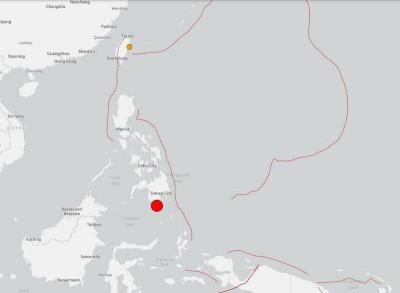
A magnitude 7.8 earthquake struck off the southern coast of Mindanao in the Philippines at 7:38am today, prompting the US Tsunami Warning System to issue an alert for neighboring countries, including Taiwan. The system issued a purple alert indicating a "tsunami threat." The potential threat zone includes Taiwan, the Philippines, Papua New Guinea, Yap and Palau. Philippine authorities were assessing the damage from the quake, with the office of civil defense seeking to verifying initial reports that 15 people had been killed and 129 injured in the region, mostly from falling debris. Arlene Hollero, disaster chief of Maasim town in the Philippines' Sarangani Province,

‘GRAY ZONE’ PRESSURE: Beijing’s activities are intended to create the deceitful impression that China has jurisdiction over the area around Taiwan, the CGA said Taiwan’s rights over its territorial waters and exclusive economic zone must not be violated by any country, the Mainland Affairs Council said yesterday, adding that it will not accept any unprovoked actions. The council issued the remarks in response to the China Coast Guard conducting maritime enforcement drills near eastern Taiwan and claiming to fully exercise China’s maritime administrative law enforcement authority. The Coast Guard Administration (CGA) has been closely monitoring the situation and is taking concrete steps to defend the nation’s sovereignty and secure its waters, the council said. China has no sovereign rights over the waters off eastern
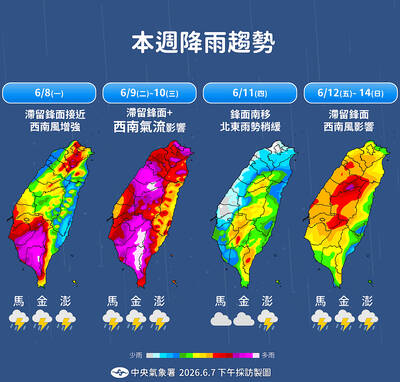
Heavy rain is expected to affect parts of Taiwan this week, the Central Weather Administration (CWA) said yesterday as a meteorologist said the active part of the annual plum rain season has started. A stationary plum rain front and southwesterly winds would bring unstable weather and abundant moisture to Taiwan from today for about a week, with the heaviest rainfall forecast for tomorrow and Wednesday, the CWA said. The agency said western and northeastern Taiwan, and mountainous areas in the east and southeast, could expect showers or thunderstorms on those two days, with localized heavy rain possible. Other parts of


 RSS
RSS