


Saudi Arabia, which pumps 10 percent of the world's oil, has plenty of potential targets for terrorists wishing to attack the country and its rulers: more than 50 oil fields, 20,000km of pipelines and dozens of related plants across a country larger than Mexico.
As the US and allies bomb Afghanistan in connection with the Sept. 11 terror attacks, some experts say that if Saudi exile Osama bin Laden strikes, he may act in his former homeland. He said on al-Jazeera TV that "the wind of change is blowing to remove evil from the peninsula" that includes Saudi Arabia.
"The oil installations are highly vulnerable to terrorist attacks," said Roger Tomkys, who chairs the Center for Middle Eastern & Islamic Studies at Cambridge University and served as a British diplomat in the region. "They must be very jumpy."
While no threats have been made against the country's oil infrastructure, security is "substantial" at all sites, said Stephen Sawyer, a spokesman for the state oil company, Saudi Aramco, who declined to be more specific.
Crude oil prices have fallen by about 20 percent since the strikes on New York and Washington, a reflection of oil traders' greater concern about slowing energy demand than the risk to Saudi oil.
That's not to say concern isn't rising. Bin Laden's group was planning attacks in Saudi Arabia that may have coincided with the US strikes that destroyed the World Trade Center and damaged the Pentagon, the Wall Street Journal reported, citing unidentified US officials.
Saturday, a bomb exploded at a shopping center in the eastern Saudi Arabian town of Al-Khobar, killing two people, including one American, and injuring four others, a Bush administration official said. The area is home to most expatriate employees of Aramco. The US official said it appeared to be an isolated incident.
Bin Laden's primary complaint has been the presence of US troops in Saudi Arabia. Saudi oil fields were found, financed and developed largely by US companies -- Chevron Corp, Texaco Inc, Exxon Corp and Mobil Corp -- from 1933 to 1973, when the government began to nationalize the industry.
The risk for the world economy is that the most exposed targets in the kingdom are the oil rigs, pipelines and other equipment that sit atop a quarter of the world's known supplies.
The Abqaiq processing hub just inland from the Persian Gulf handles 70 percent of the nation's oil supply.
Saudi Aramco pumps more than twice as much crude as Exxon Mobil Corp, the world's largest publicly traded oil company. No additional security steps have been taken since Sept. 11, the Aramco spokesman said.
"The company already had substantial security at all installations," Sawyer said, explaining why further measures haven't been taken.
CB Stevens, a former US military special forces officer who runs safety installations for oil companies in the Middle East, said pipelines are almost impossible to defend. Individual wells aren't worth bombing because a typical field has dozens if not hundreds of them, he said. The sites needing defense would be transport hubs and ports, he said.
Also exposed in Saudi Arabia is the expatriate community.
About 40,000 Americans live and work in Saudi Arabia, according to the US embassy. About 8,000 of Aramco's 54,000 staff are non-Saudi. Of those, about 3,000 are US, British or Canadian, and the rest are laborers from developing countries.
A Dhahran, Saudi Arabia-based shipping company, Namma Cargoes, said that over the last three weeks an increasing number of Americans and British from Aramco have packed valuables to send abroad.
In the last 10 years, Osama bin Laden's al-Qaeda network, a militant Islamic movement, has organized attacks against US facilities in Saudi Arabia, Yemen and East Africa, and planned last month's attacks on New York and Washington, US officials said.
Saudi experts say there's growing potential for violence in Saudi Arabia because the country's population is increasingly disaffected with the ruling royal family.
"If there is anyone bin Laden hates more than the US, it's the Saudi royal family," said James Akins, who was US ambassador to Saudi Arabia from 1973 to 1975. "There is an extremely real possibility of terrorism" in Saudi Arabia.
King Fahd, 79, is in bad health, and his next in line, Prince Abdullah, is only four years younger. Saudi Arabia's population has almost tripled during the last 20 years to close to 15 million nationals and 6 million foreign workers.
A population boom has outpaced economic growth for the last two decades, cutting per capita income to under US$7,000 last year from about US$25,000 in 1980.
The government is producing jobs for only an estimated 60 percent of the 200,000 young men entering the labor market each year.
An attack on Saudi Arabia's oil installations would be the best way to hurt the royal family, experts said. Oil accounts for 40 percent of the Saudi economy and provides 75 percent of government revenue, according to Central Intelligence Agency estimates.
"There's a growing population, and especially those of Yemeni descent have no loyalty to the [royal] family," said Loik le Floch-Prigent, a former head of French oil company Elf Aquitaine SA, now part of Total Fina Elf SA.
"Meanwhile, the family's supported by the Americans, who are increasingly unpopular. Something's got to explode."
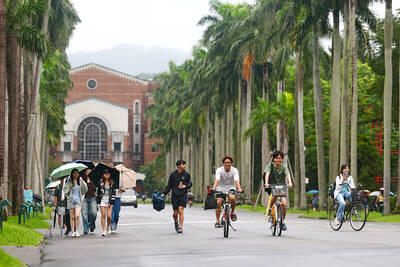
National Taiwan University (NTU) yesterday said it disqualified a person from an entrance examination for using AI smart glasses to cheat, along with two others for making untruthful statements in their curriculum vitae. The three applicants were given null scores, Taiwan’s highest-ranked university said, calling on prospective students to be honest in the admissions process. NTU registrar Lee Hung-sen (李宏森) said that the cheating applicant wore a hat and thick-rimmed glasses to the second written exam for medical school, claiming that they felt cold. Suspicions were aroused when the applicant stared oddly at the test for long stretches while steadily bringing the paper
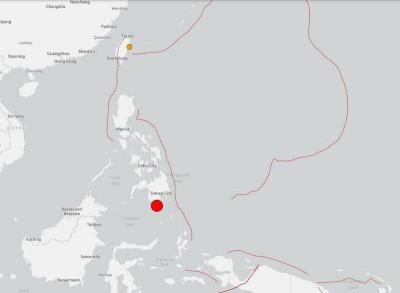
A magnitude 7.8 earthquake struck off the southern coast of Mindanao in the Philippines at 7:38am today, prompting the US Tsunami Warning System to issue an alert for neighboring countries, including Taiwan. The system issued a purple alert indicating a "tsunami threat." The potential threat zone includes Taiwan, the Philippines, Papua New Guinea, Yap and Palau. Philippine authorities were assessing the damage from the quake, with the office of civil defense seeking to verifying initial reports that 15 people had been killed and 129 injured in the region, mostly from falling debris. Arlene Hollero, disaster chief of Maasim town in the Philippines' Sarangani Province,
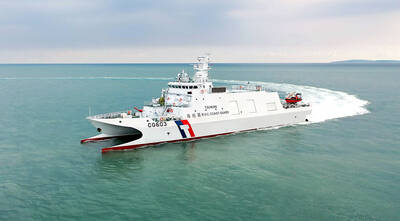
‘GRAY ZONE’ PRESSURE: Beijing’s activities are intended to create the deceitful impression that China has jurisdiction over the area around Taiwan, the CGA said Taiwan’s rights over its territorial waters and exclusive economic zone must not be violated by any country, the Mainland Affairs Council said yesterday, adding that it will not accept any unprovoked actions. The council issued the remarks in response to the China Coast Guard conducting maritime enforcement drills near eastern Taiwan and claiming to fully exercise China’s maritime administrative law enforcement authority. The Coast Guard Administration (CGA) has been closely monitoring the situation and is taking concrete steps to defend the nation’s sovereignty and secure its waters, the council said. China has no sovereign rights over the waters off eastern
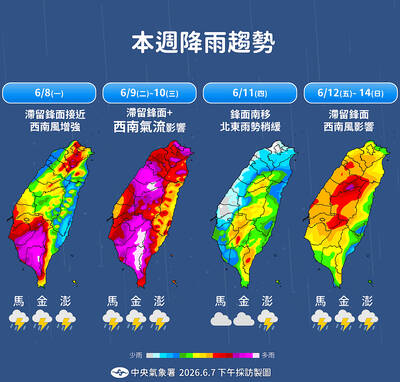
Heavy rain is expected to affect parts of Taiwan this week, the Central Weather Administration (CWA) said yesterday as a meteorologist said the active part of the annual plum rain season has started. A stationary plum rain front and southwesterly winds would bring unstable weather and abundant moisture to Taiwan from today for about a week, with the heaviest rainfall forecast for tomorrow and Wednesday, the CWA said. The agency said western and northeastern Taiwan, and mountainous areas in the east and southeast, could expect showers or thunderstorms on those two days, with localized heavy rain possible. Other parts of


 RSS
RSS