


In the last few years search engines have started to scan the Web not only for text but for pictures too. Today, with a few keywords, anyone on the Web can gain access to a trove of images, from cartoons and graphics to personal photographs and celebrity shots. So if you are one of the few Americans who have not yet passed judgment on Jennifer Lopez's risque dress from the 2000 Grammy Awards, you now have your chance.
But to make such gawking possible, search engines are taking a controversial step. Their technology, which uses Web searching tools called spiders, now makes copies of every image they come across, whether the search engines have permission to do so or not. Those images, many of which are reduced to thumbnail size, are then displayed in the search engine's results listings, again without explicit approval from the artists who created the images in the first place.
Leslie A. Kelly, a photographer in Huntington Beach, California, who maintains Web sites featuring his work, calls this blatant theft. To prove his point, he filed a lawsuit two years ago accusing Ditto.com, one of the earliest image-search engines, of copyright infringement.
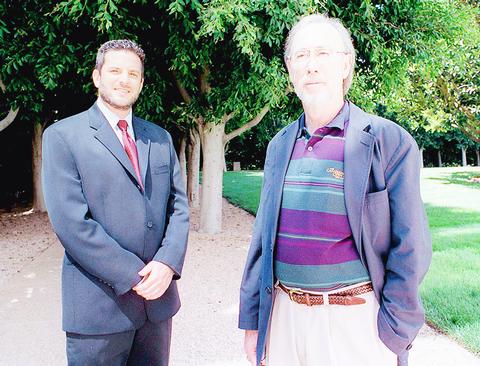
PHOTO: NY TIMES
"They take the work of artists, photographers and others and then use them for their own commercial benefit," Kelly said.
A federal judge ruled in Ditto.com's favor in late 1999. Next Monday, in Pasadena, the 9th Circuit US Court of Appeals will hear oral arguments in an appeal of that decision. Kelly -- and several artists' associations that have sided with him -- want the court to consider the harm that may come to them if search engines are allowed to copy and distribute their work without permission.
Think Napster, they say. The search engines, they argue, are enabling computer users to pilfer online art, since they can use the search sites to view and download images without setting foot on the artists' sites. The search engine essentially becomes a "clip-art service," Kelly says, that gives artists no credit and cheats them of revenue.
Search companies and Internet-based artists are watching closely. So are lawyers, since the dispute is yet another twist in the debate over how copyright laws should be applied on the Internet.
The case even has relevance for anyone who has copied an image from a Web site through no more effort than a right-mouse click.
Many people assume that anything on the Web is free for the taking. Not so, according to copyright experts. Almost any creative work that is posted on the Web is protected by copyright, even if it has not been registered with the copyright office. The exceptions are works for which copyrights have expired (like Huckleberry Finn or turn-of-the-century recordings) and works declared to be in the public domain by their creators.
But just because something is copyrighted does not mean it cannot be lawfully copied. So the real question is, are there images -- or any other works for that matter -- that can be legally copied without asking permission?
The answer, it turns out, varies depending on what the copy will be used for and who is doing the copying. Here is where the concept of "fair use" comes in, which holds that unauthorized copying is permissible if it is for educational use, for scholarship or to provide commentary.
Most lawyers, for example, agree that an individual is allowed to copy and post a photograph on a Web site if it accompanies a critical review of the photograph. But people who post unauthorized images on their Web sites simply to add splash, or even use them as wallpaper on their computer desktops, may be violating the law, even though it is unlikely that a company will go to the effort to sue them over such an infraction.
The issue becomes muddled, however, when a company, like a search engine, is indirectly making money from the copies it makes.
In the Ditto.com case, the result may hinge on how the court considers at least two tricky issues. The first is whether search engines are, in subtle ways, inviting people to copy images. Most artists do not want people copying images from their sites -- they want visitors who have an interest in hiring them for their services. Search engines, they say, expose their sites to people who are merely interested in finding a picture to copy and paste. When search engines display images without permission and out of context, they argue, they are paving the way for infringement.
At the very least, the artists say, a search engine should link people directly from a thumbnail image to the artist's Web page and should not provide any further versions of the image. (While Ditto.com does link searchers to Web sites, it also opens a window that displays a stand-alone copy of the full-size image, which the company says is designed to help searchers who might not find the image on a site that involves tedious searching or scrolling.)
The second issue centers on the nature of thumbnail images themselves. Does their reduced size exempt them from charges of a copyright infraction? Even in a smaller size, "I don't know how you can deny that this is a copy," said Jorge Contreras, vice chairman of the Internet law group at Hale & Dorr, an international law firm. "The gray area is whether it is OK to make that copy. And it is a good question."
Representatives of image-search engines argue that the copying is more than OK -- it is vital to the health of the Internet as it becomes an ever larger source of visual information. Searchers may include parents who want to show their children what a lemur looks like or golfers who want to see a photograph of a course before visiting. Search-engine companies argue that if search results were limited to descriptions of and links to online images -- but not the images themselves -- their search sites would be cumbersome and far less useful.
"This is not just about finding a picture," said Michael Lyons, the founder of Ditto.com. "This is getting information visually."
Supporting Ditto.com are representatives of several other search engines, including AltaVista, the first company to enable Web-wide image searching, and Google, which initiated a beta-test of image technology this summer. Those companies and others provide links from thumbnail images to the sites that include them.
Image-search technology, they argue in their defense, is designed to do far more than simply make and distribute copies. It analyzes and indexes the images by running them through various programs designed to detect their characteristics.
For example, most search engines typically discard images that are the size of banner advertisements and that include embedded advertising codes. They also try to get a sense of whether an image might be pornographic by analyzing the ratio of skin-tone colors, dark or light, to the the other colors in the image. If an image has a high skin-color ratio, it is either deleted or flagged so that it can be filtered by the searchers themselves. (A significant percentage of Google's users, company officials acknowledge, are looking for pornography.)
It was this act of indexing and analyzing that, in part, convinced Judge Gary L. Taylor of US District Court in the Central District of California that the images in the Ditto.com case were used fairly because the search engine's purpose was "significantly transformative." Lawyers have interpreted that to mean that copying is permissible because the search engine performs an entirely different service than that of Kelly's Web sites.
Kelly argues that the judge missed the point. For example, some of the images captured by the search engine are from a site that promotes California's Gold Rush Country, a book of nearly 500 color photographs that he took. Although he has not presented evidence that he has lost book sales or clients because of such instances, he argues that the potential is there.
Most search engine operators say that as soon as an artist complains, an image is taken off their servers, and that they have programmed their search spiders to avoid images on Web pages that are marked off limits for searching. In fact, Google officials say, most complaints that it receives are from Web site owners whose images or pages have not been included in search results and want to know why.
But such steps to avoid copyright infringement do not satisfy the artists' groups. "It totally violates the concept of prior permission," said Reid Stott, the editor of a Web log called PhotoDude. "These companies are saying, `We will take your copyrighted image until you specifically tell us we shouldn't.' I already do that on every page with a copyright disclaimer."
Without stronger protection, some artists have resolved to keep their work off the Web. "I've known many digital artists that have left the Internet completely," said Jann Johnson, a graphic artist in Phoenix who started a campaign called Rights, for Redistribution in Graphics Has to Stop. "Their work has been reproduced and blatantly stolen."
Perhaps artists can take heart that few people seem to be endorsing visual plagiarism. Siva Vaidhyanathan, for example, the author of a new book called Copyrights and Copywrongs, said he sided with the search engines in the Ditto.com case. But he does not believe that the law should protect someone who is clearly trying to undermine an artist by stealing images.
"The real villain in this case would be the person who decided to make his own gold rush Web site out of images that this photographer put up," he said. "That would be a real problem."?

National Taiwan University (NTU) yesterday said it disqualified a person from an entrance examination for using AI smart glasses to cheat, along with two others for making untruthful statements in their curriculum vitae. The three applicants were given null scores, Taiwan’s highest-ranked university said, calling on prospective students to be honest in the admissions process. NTU registrar Lee Hung-sen (李宏森) said that the cheating applicant wore a hat and thick-rimmed glasses to the second written exam for medical school, claiming that they felt cold. Suspicions were aroused when the applicant stared oddly at the test for long stretches while steadily bringing the paper
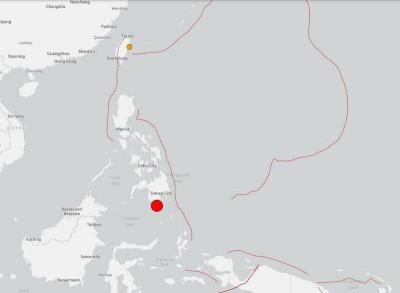
A magnitude 7.8 earthquake struck off the southern coast of Mindanao in the Philippines at 7:38am today, prompting the US Tsunami Warning System to issue an alert for neighboring countries, including Taiwan. The system issued a purple alert indicating a "tsunami threat." The potential threat zone includes Taiwan, the Philippines, Papua New Guinea, Yap and Palau. Philippine authorities were assessing the damage from the quake, with the office of civil defense seeking to verifying initial reports that 15 people had been killed and 129 injured in the region, mostly from falling debris. Arlene Hollero, disaster chief of Maasim town in the Philippines' Sarangani Province,

‘GRAY ZONE’ PRESSURE: Beijing’s activities are intended to create the deceitful impression that China has jurisdiction over the area around Taiwan, the CGA said Taiwan’s rights over its territorial waters and exclusive economic zone must not be violated by any country, the Mainland Affairs Council said yesterday, adding that it will not accept any unprovoked actions. The council issued the remarks in response to the China Coast Guard conducting maritime enforcement drills near eastern Taiwan and claiming to fully exercise China’s maritime administrative law enforcement authority. The Coast Guard Administration (CGA) has been closely monitoring the situation and is taking concrete steps to defend the nation’s sovereignty and secure its waters, the council said. China has no sovereign rights over the waters off eastern
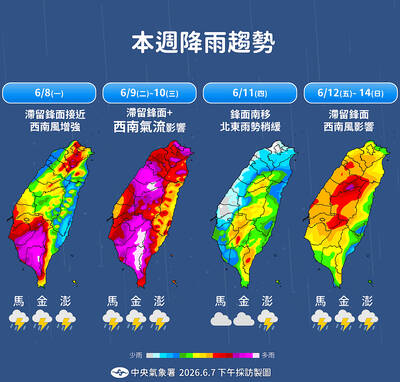
Heavy rain is expected to affect parts of Taiwan this week, the Central Weather Administration (CWA) said yesterday as a meteorologist said the active part of the annual plum rain season has started. A stationary plum rain front and southwesterly winds would bring unstable weather and abundant moisture to Taiwan from today for about a week, with the heaviest rainfall forecast for tomorrow and Wednesday, the CWA said. The agency said western and northeastern Taiwan, and mountainous areas in the east and southeast, could expect showers or thunderstorms on those two days, with localized heavy rain possible. Other parts of


 RSS
RSS