


That state-of-the-art MP3 audio player you bought two years ago may soon become outmoded.
Threatened by the ease of digital duplication, the music industry has paired with electronics companies to develop technologies that put digital locks on songs and limit how often they can be played or copied, and on which devices.
Some makers of electronics components are already building in the necessary microchips and software. These components will still allow the playing of unauthorized copies of digital content that hasn't been copy-protected, but eventually, machines not wired to unlock and play secured songs could go the way of the 8-track tape player.
"It's a very real possibility," said Mike McGuire, a Gartner Group analyst.
Options being considered by record labels include preventing consumers from burning a newly released CD more than once on a home computer, or restricting play of a song downloaded from the Internet to a single user's home and portable systems.
MusicNet and pressplay, two joint ventures set up by the world's major record labels to begin distributing music online later this year, are expected to restrict copying of downloaded songs.
Stopping musical overflow
It's all part of a concerted effort to block the unfettered copying of digital music -- consumer behavior spurred by music-sharing services like Napster and advances in recordable CD and compressed MP3 audio formats.
The recording industry and other content providers -- such as purveyors of audio books -- will have to proceed with caution as the new technology, known as digital rights management (DRM), is introduced. In choosing formats and deciding rules for distribution, playing and copying, they must be careful not to anger the music-loving masses.
"It's not an easy task," said Michael Aldridge, product manager for the Windows Digital Media Division of Microsoft, a leading provider of technology that is working closely with the recording and consumer electronics industries.
"While you're respecting the rights of the copyright holder, you have to create it so it doesn't get in the way of the consumer using the content," Aldridge said. "If it's incredibly secure and hard to use, then no one will buy it."
All the major makers of portable MP3 audio players have been DRM-ready since last year, said Susan Kevorkian, an International Data Corp analyst.
Home audio systems, including a new crop of digital entertainment receivers, are starting to do the same.
Computer hard drives and other kinds of storage devices, such as memory cards and minidiscs, may also soon come equipped with digital locking mechanisms.
Intel Corp, IBM Corp, Toshiba Corp and Matsushita Electric Industrial, which is known for its Panasonic brand, have jointly developed a technology for hard drives that can be used to make sure a copy of a music file plays only on the devices of the person who purchased the file.
SONICblue Inc's popular Rio MP3 players have had built-in copy-protection technology since late 1999, said the company's chief technology officer, Andy Wolfe. Like those of rival manufacturers, the players can also still play non-secured content.
Compatibility
At the moment, the Rio devices support Microsoft's copy-protection software and will soon support Intertrust's as well. Rio devices are designed so that they "all are upgradeable and will support multiple DRMs," Wolfe said.
Newer model Rio players also are among a dozen devices that can play audio books purchased online from Audible Inc.
Audible's copy-protection system gives customers unique identification codes and makes them register their PCs and portable MP3 devices with the company. If a customer buys a title, it would be playable only on the limited number of devices linked to the customer's account.
Analysts say many device makers will likely follow the Rio player's flexible approach, since it remains unclear which copy-protection standards will prevail.
There are about 10 DRM software formats for audio, and more are expected to surface, said Joshua Duhl, an International Data Corp analyst.
For now at least, components are being configured to support multiple copy-protection formats -- meaning consumers will not need to buy a different audio device for every different format. It's just a question of upgrading the software.
`Future proof' microchips
That's why Texas Instruments Inc, which along with Cirrus Logic Inc leads the audio chip market, is building "non-denominational" and "future-proof" programmable chips for audio players, freeing device makers from having to commit to a single format.
"DRMs are here to stay, but what you and I can do exactly with our content isn't defined yet," said Randy Cole, chief technologist for Internet audio at Texas Instruments.
Similarly, Reciprocal Inc has positioned itself as a "Switzerland of DRM technology," offering digital media distribution services to content providers and device makers who need DRM flexibility, said Matt Moynahan, the company's senior vice president of corporate development.
Reciprocal's client list has grown from one in 1998 to 138 today, including Sony Music Entertainment and Zomba Records, home of Britney Spears and the Backstreet Boys.

National Taiwan University (NTU) yesterday said it disqualified a person from an entrance examination for using AI smart glasses to cheat, along with two others for making untruthful statements in their curriculum vitae. The three applicants were given null scores, Taiwan’s highest-ranked university said, calling on prospective students to be honest in the admissions process. NTU registrar Lee Hung-sen (李宏森) said that the cheating applicant wore a hat and thick-rimmed glasses to the second written exam for medical school, claiming that they felt cold. Suspicions were aroused when the applicant stared oddly at the test for long stretches while steadily bringing the paper
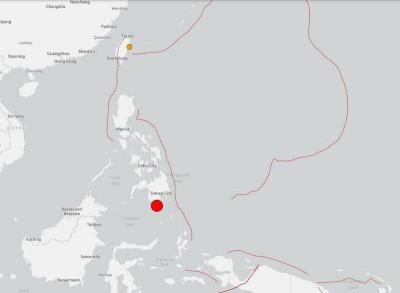
A magnitude 7.8 earthquake struck off the southern coast of Mindanao in the Philippines at 7:38am today, prompting the US Tsunami Warning System to issue an alert for neighboring countries, including Taiwan. The system issued a purple alert indicating a "tsunami threat." The potential threat zone includes Taiwan, the Philippines, Papua New Guinea, Yap and Palau. Philippine authorities were assessing the damage from the quake, with the office of civil defense seeking to verifying initial reports that 15 people had been killed and 129 injured in the region, mostly from falling debris. Arlene Hollero, disaster chief of Maasim town in the Philippines' Sarangani Province,

‘GRAY ZONE’ PRESSURE: Beijing’s activities are intended to create the deceitful impression that China has jurisdiction over the area around Taiwan, the CGA said Taiwan’s rights over its territorial waters and exclusive economic zone must not be violated by any country, the Mainland Affairs Council said yesterday, adding that it will not accept any unprovoked actions. The council issued the remarks in response to the China Coast Guard conducting maritime enforcement drills near eastern Taiwan and claiming to fully exercise China’s maritime administrative law enforcement authority. The Coast Guard Administration (CGA) has been closely monitoring the situation and is taking concrete steps to defend the nation’s sovereignty and secure its waters, the council said. China has no sovereign rights over the waters off eastern
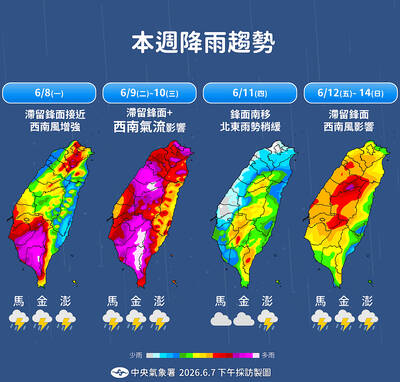
Heavy rain is expected to affect parts of Taiwan this week, the Central Weather Administration (CWA) said yesterday as a meteorologist said the active part of the annual plum rain season has started. A stationary plum rain front and southwesterly winds would bring unstable weather and abundant moisture to Taiwan from today for about a week, with the heaviest rainfall forecast for tomorrow and Wednesday, the CWA said. The agency said western and northeastern Taiwan, and mountainous areas in the east and southeast, could expect showers or thunderstorms on those two days, with localized heavy rain possible. Other parts of


 RSS
RSS