


The store is so self-aware that it doesn't even have its name on a sign. Instead, a glowing white apple with an iconic bite beckons shoppers in an upscale mall in this affluent Washington suburb.
Inside the white airy interior, black-clad salesclerks walk the bleached wood floor, past translucent computers, petite digital cameras and slim scanners.
With or without its name spelled out, the merchant's identity is unmistakable. The 1,800m2 store is part of a highly publicized foray by Apple Computer into the complex world of retailing, part of a campaign to create an Apple presence at 25 high-traffic shopping areas across the nation by the end of the year. Another store has opened in the Los Angeles area.
It is an aggressive move during an economic slowdown, with sales of personal computers sliding and hardware manufacturers stinging from price-cutting wars. Gateway, which only recently developed its own retail stores, is retrenching by closing underperforming ones and pulling out of OfficeMax outlets.
Apple's strategy is to do for computer shopping what Starbucks did for coffee and what Barnes & Noble superstores did for book browsing. It is a notion of consumerism that is less about the product than about a way of life.
Like the curvaceous iMac and the sleek Titanium PowerBook that it stocks, the McLean store is an emblem of the Apple aesthetic. But as Apple has learned --most recently with the decision to end production of the lauded but poor-selling G4 Cube -- design may stimulate sales, but it is no substitute. Apple has only a 5 percent share of the personal computer market.
On a recent Saturday afternoon, parents with strollers meandered through the crowded store at Tysons Corner Center while teenagers experimented with digital cameras. A wide-screen theater in the back offers presentations, but the entire store is the real show. Shoppers can make movies and audio tracks and burn them onto DVDs and CDs.
A knee-high kiosk of iMacs equipped with games is ostensibly for the elementary school set. But adults are just as likely to be found sitting on the bouncy ball stools, legs crimped, playing videogames. There is a help desk, dubbed the Genius Bar (below giant photos of Alfred Hitchcock and Amelia Earhart), with troubleshooters who can address technical problems.
Tony Watson, wearing running pants and a Nokia phone clipped to his waist, spent 20 minutes talking about the G4 computer with an animated salesman. He walked out impressed that he could run Windows software on the Macintosh. "In terms of digital information gathering, this is the Bloomingdale's of computer stores," said Watson, of Sterling, Virginia, who has never bought a Macintosh but is interested in using its film-editing software to create DVDs featuring his 4-month-old son.
Watson said he had become frustrated with salesclerks at larger retailers who were unable to answer his Mac-specific questions.
Customer service has long been cited as a source of tension in Apple's on-again off-again relationship with major retailers. Apple recently announced that it was pulling its products out of retail chains including Best Buy, Circuit City, OfficeMax and Sears, though it said it would keep its dedicated sections at CompUSA.
For Apple, the question is whether there will be enough Watsons to make the retail venture worthwhile. The rent at the Tysons Corner store is US$500,000 a year.
To break even, Apple will have to generate US$7 million in annual sales per store, estimated David Goldstein, president of the Channel Marketing Corp, a retail consulting firm that has worked with Apple in the past. Even then, the new stores may hurt relationships with traditional retailers by cutting into their sales. ComputerWare, a Macintosh retail chain in the San Francisco area, shut its doors in April, citing declining sales and the impact of Apple's online store.
No computer maker has successfully branched into retail stores, Goldstein said. "It's completely flawed," he said of Apple's venture. "They'll shut it down and write off the huge losses in two years."
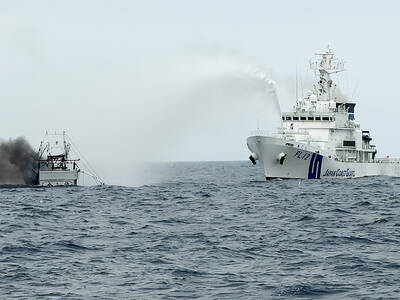
CREDIT-GRABBER: China said its coast guard rescued the crew of a fishing vessel that caught fire, who were actually rescued by a nearby Taiwanese boat and the CGA Maritime search and rescue operations do not have borders, and China should not use a shipwreck to infringe upon Taiwanese sovereignty, the Coast Guard Administration (CGA) said yesterday. The coast guard made the statement in response to the China Coast Guard (CCG) saying it saved a Taiwanese fishing boat. The Chuan Yu No. 6 (全漁6號), a fishing vessel registered in Keelung, on Thursday caught fire and sank in waters northeast of Diaoyutai Islands (釣魚台). The vessel left Keelung’s Badouzih Fishing Harbor (八斗子漁港) at 3:35pm on Sunday last week, with seven people on board — a 62-year-old Taiwanese captain surnamed Chang (張) and six

RISKY BUSINESS: The ‘incentives’ include initiatives that get suspended for no reason, creating uncertainty and resulting in considerable losses for Taiwanese, the MAC said China’s “incentives” failed to sway sentiment in Taiwan, as willingness to work in China hit a record low of 1.6 percent, a Ministry of Labor survey showed. The Directorate-General of Budget, Accounting and Statistics (DGBAS) also reported that the number of Taiwanese workers in China has nearly halved from a peak of 430,000 in 2012 to an estimated 231,000 in 2024. That marked a new low in the proportion of Taiwanese going abroad to work. The ministry’s annual survey on “Labor Life and Employment Status” includes questions respondents’ willingness to seek employment overseas. Willingness to work in China has steadily declined from

LEVERAGE: China did not ‘need to fire a shot’ to deny Taiwan airspace over Africa when it owns ‘half the continent’s debt,’ a US official said, calling it economic warfare The EU has raised concerns about overflight rights following the delay of President William Lai’s (賴清德) planned state visit to the Kingdom of Eswatini after three African nations denied overflight clearance for his charter at the last minute. Taiwanese allies Paraguay and Saint Kitts and Nevis, as well as several US lawmakers and the Inter-Parliamentary Alliance on China (IPAC) condemned China for allegedly pressuring the countries. Lai was scheduled to fly directly to Taiwan’s only African ally from yesterday to Sunday to celebrate the 40th anniversary of King Mswati III’s accession and his 58th birthday, but Seychelles, Mauritius and Madagascar suddenly revoked
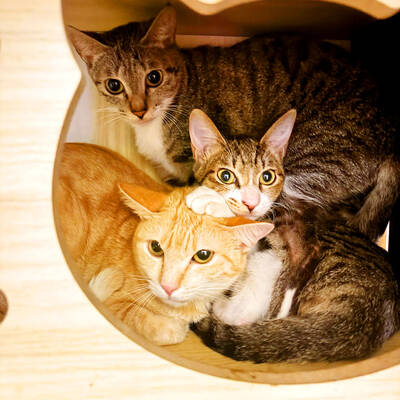
The number of pet cats in Taiwan surpassed that of pet dogs for the first time last year, reaching 1,742,033, a 32.8 percent increase from 2023, the Ministry of Agriculture said yesterday, citing a survey. By contrast, the number of pet dogs declined slightly by 1.2 percent over the same period to 1,462,528, the ministry said. Despite the shift, households with dogs still slightly outnumber those with cats by 1.2 percent. However, while the number of households with multiple dogs has remained relatively stable, households keeping more than two cats have increased, contributing to the overall rise in the feline population. The trend


 RSS
RSS