

Warren Buffett, the billionaire chief executive of Berkshire Hathaway Inc, said a 50 percent decline in Internet stocks in the past year hasn't made them more attractive as investments.
Buffett, returning to New York investment firm Allen & Co's annual, invitation-only meeting in Sun Valley, Idaho, said he still sees the shares of some Internet companies selling for unreasonably high prices, according to attendees.
In 1999, with the NASDAQ Composite Index about to break through 3,000 on the way to more than 5,200, Buffett warned the attendees that the stock market was overvalued and there was no way it would extend its meteoric rise. That theme was echoed again on Friday.
"His message hasn't changed much," said Philip Knight, chief executive of Nike Inc, who attended Buffett's presentation.
"It was vintage Warren. In his usual way, he was entertaining and insightful." Buffett, in a speech entitled "A Conversation with Warren Buffett, Part II," said used a slide show comparing the earnings of the Dow Jones Industrial average component companies over the past decade with the Gross Domestic Product of the US over the same period, to illustrate how the market remains overvalued by historical norms, said attendees.
"You basically have to listen to Warren," said Jeff Bezos, chairman of Amazon.com Inc, an Internet retailer whose stock has fallen to about 17 a share from a high of 113 in December 1999.
"Some things he said were quite painful, but, by god, the man is a genius and so far seems to be right." Buffett's comments, perhaps the most anticipated of the four-day meeting, wrapped up the day.
Terry Semel, chief executive of Yahoo Inc, is attending the conference with the company's co-founder Jerry Yang, who hired him in April.
"I don't think Yahoo's a dot-com," said Semel in an interview before Buffet spoke. "It's a big successful company, worldwide." Shares of Yahoo, the Internet's most-used search site, have plunged more than 90 percent from their all-time high of US$250 reached in January, 2000. They now trade under US$20.
Earlier in the day, Intel Corp Andy Grove, in a talk entitled "Internet Interrupted" said he believes the Internet sector will bounce back.
"Andrew gave a brilliant presentation," said AOL Time Warner president Gerald Levin in an interview. "He said he thinks the semiconductor and Internet business will bounce back, but not to the euphoric levels that so many expected." Grove discussed the high expectations for dozens of publicly traded railroad companies in the early 20th century as a reminder that common wisdom doesn't always translate into prudent investments, according to Levin.
Sandwiched in between the two Chairmen's talks was a panel discussion on the "Pulse of America: How do you find it." The panel included AOL Time Warner Inc. Chairman Stephen Case, ABC News, Diane Sawyer, Sony Corp of America Chairman Howard Stringer and EBay Inc CEO Meg Whitman.
Herb Allen's annual conference kicked off Wednesday with presentations by Home Depot Inc. Chief Executive Robert Nardelli and Amazon.com's Bezos.
On Thursday morning, Emilio Azcarraga, chairman and chief executive of Mexican broadcaster Grupo Televisa SA, and Walt Disney Co. CEO Michael Eisner gave broad overviews of their companies. Eisner showed movie clips from several upcoming releases, including ``Monster Inc,'' which opens in November.
Jeffrey Katzenberg and David Geffen, co-founders of the Dreamworks SKG movie studio with director Steven Spielberg, attended Eisner's presentation. Seated together outside an ice cream shop at the resort after Eisner spoke, Geffen said he thought the clip looked "terrific." Katzenberg, who departed as head of production at Disney in 1994, nodded in agreement.
Katzenberg left Disney after Eisner declined to promote him to president following the death of Frank Wells.
Attendees said the company presentations sought to avoid providing information that would violate Securities and Exchange rules against giving information to some shareholders and not others.
Bezos started his presentation with a slide photograph of the "Fair Disclosure" regulations, which were adopted by the Securities and Exchange Commission last year to bar companies from giving information to some shareholders and not others.
Eisner said he, too, didn't disclose anything new during his hour talk.
"I said nothing that we haven't said before," Eisner said. "You can go check all our press releases and see that clearly."
With little news to glean from the CEO meetings, attendees said that the real reason they convene here is for the opportunity to mingle with other powerful CEOs and influential investors.
Eisner, for example, hurried away from his meeting on Tuesday to lunch with Rupert Murdoch, Chairman of News Corp Ltd.
Steve Ballmer, Microsoft Corp's CEO, wasn't an invited guest. He flew in anyway for a few hours on Thursday for a private lunch meeting.

The Philippine Coast Guard yesterday said it has deployed its largest vessel and an aircraft to challenge a Chinese research ship operating off northern Batanes near Taiwan, adding that a Chinese coast guard vessel had also moved in. The Philippine operation “disrupted the vessel’s unauthorized marine scientific research and compelled it to leave its loitering position,” said Jay Tarriela, Philippine Coast Guard spokesperson on South China Sea issues. The Philippine Coast Guard said the BRP Teresa Magbanua and an aircraft were deployed to counter the Chinese vessel, which it said had remained about 37 nautical miles northwest of Itbayat Island since Monday. The
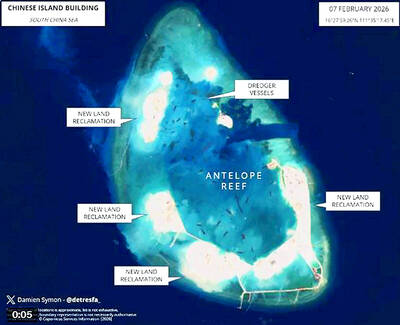
RUNWAY: Analysts said the first aircraft landing is expected by the middle of next year, while Chinese state media said it would serve civilian needs Chinese construction of a runway on Antelope Reef (Lingyang Reef, 羚羊礁) in the Paracel Islands (Xisha Islands, 西沙群島), is well under way with analysts estimating it could be completed by the middle of next year, strengthening Beijing’s military control over the disputed South China Sea. Satellite images reviewed by Reuters show grading work, piles of gravel and concrete, and compaction cranes in operation to build a full-scale runway that military attaches and security analysts say could be one of China’s most important offshore bases in the region. The images, taken on Friday last week by commercial satellite imagery provider Vantor, also show

SHIFTING COOPERATION: With the new arrangement, US representatives would be able to participate directly in defense discussions, including weapons procurement Taiwan-US military cooperation is deepening, with the Pentagon expected to station personnel at the Ministry of National Defense (MND), sources said. The NT$470 million (US$14.77 million) joint program is scheduled to run from this year through 2028, under which the Pentagon would dispatch representatives from the Office of the Under Secretary of Defense for Policy and the Institute for Defense Analyses, a senior military official said on condition of anonymity, adding that one representative from each organization would be stationed at the ministry’s headquarters. The Office of the Under Secretary of Defense for Policy is one of the US’ bodies responsible for

DEFENSE: The US House speaker dismissed speculation that Trump is using arms sales as a negotiating tactic with Beijing amid concern over delayed deliveries Taiwan is a partner whose “stability and independence” are important to US national security and the economy, US House of Representatives Speaker Mike Johnson said on Monday when asked about arms sales to Taipei in an interview with Fox Business. Asked whether US President Donald Trump was using a long-delayed US$14 billion arms deal as a negotiating tactic for trade with Beijing, Johnson said that he “wouldn’t read too much into that.” The delayed arms package is “related to the Iran conflict” and the need for missile stocks in the Middle East, he said. “If you look over [Trump’s] two terms, he will


 RSS
RSS