


Investor concern about inflation is showing up in the bond market.
US notes and bonds whose return is linked to the consumer price index have outpaced other Treasuries this year, and more gains may follow, as Federal Reserve interest-rate cuts stoke concern inflation is gaining speed.
Treasury inflation protection securities, or TIPS, generated returns of as much as 5.9 percent since Dec. 31, compared with a 0.7 percent composite return for Treasuries due in more than a year, according to Bloomberg data. The figures include reinvested interest plus or minus any change in price.
"The best environment for TIPS is what we've seen lately, and that's when inflation is ticking up," said David Schroeder, who manages the American Century Inflation-Adjusted Treasury Fund in Mountain View, California.
Gains in the securities suggest some investors may be paying more heed to inflation than they have at any time during the past four years. The Treasury sold its first TIPS in January 1997, as inflation eased to its slowest pace in more than a decade.
For all but one of the past 15 months, the consumer price index's year-over-year increase has been more than 3 percent, up from 1.4 percent in 1998.
Add worry that Fed interest-rate cuts may spur an economic rebound that will quicken inflation even more, and the result may be further gains in inflation-linked bonds, money managers said.
"TIPS will continue to do well, as the Fed brings rates down," said Marc Seidner, a money manager at Standish Ayer & Wood Inc in Boston.
Inflation-linked securities are a way around the risk that bond interest and principal payments will be worth less, after adjusting for inflation, than initially anticipated.
The Treasury allows that protection by boosting principal amounts on the securities semi-annually to keep pace with the CPI. The growing face value means semi-annual interest payments rise although interest rates on the debt are fixed. Other notes and bonds have set principal payments.
TIPS are a better safeguard than gold, which investors have long bought as a hedge against inflation, said Lehman Brothers Inc. metals analyst Peter Ward.
The securities "maintain their value and pay a rate of return. Gold does neither," Ward wrote in report Monday. "Even if current inflation fears prove justified, we doubt many investors will run to gold." For those who expect slowing inflation, TIPS may not look attractive. Bill Hornbarger, a fixed-income strategist at Saint Louis-based AG Edwards & Sons Inc., expects the securities to fall as the rate of consumer price inflation drops to 2.5 percent later this year.
What's more, he calls the US$135 billion market for the new securities "inefficient" compared with the US$3 trillion of non-indexed Treasuries.
"It's not the most robust, liquid market," he said. "Individual investors just aren't interested. It's confusing to them." Some of the biggest mutual fund companies, nevertheless, have formed funds to focus on the securities. If the inflation rate does creep up, funds run by Vanguard Group, PIMCO Funds and Brown Brothers Harriman & Co. may attract more customers.
That may already be happening. Schroeder said his fund has tripled its assets to US$70 million in the past year, and now there are "worrisome trends" in electricity and other service costs.
"Out here, power bills are up big-time," he said.
Rising health-care and housing costs may also encourage more individual investors and money managers to seek bonds that aren't vulnerable to inflation.
One aspect that may make TIPS harder to assess is a lower coupon, or specified interest rate. The eight inflation-indexed issues' coupons range from 3 3/8 percent to 4 1/4 percent, versus 4 percent to 5 3/8 for current non-indexed Treasuries.
Yields, calculated using the coupon and any difference between a bond's current price and face amount, are also lower on TIPS, until inflation is factored in. For example, 10-year TIPS yield 3.29 percent versus 5.5 percent for non-indexed Treasuries.
Factoring in inflation, TIPS yield about 6.5 percent.
As long as inflation is more than the difference between the yields on the two types of securities, it's probably a good time to buy TIPS, analysts say. The latest CPI report showed the government index rose 3.3 percent in the year ended last month.
That's more than the 2 percentage point gap in yield between non- indexed Treasury yields and comparable indexed securities.
``Above all else, today I'd pick TIPS,'' said John Hollyer, who runs Vanguard's US$300 million Inflation-Protected Securities Fund. The fund has generated a 6 percent return this year.

National Taiwan University (NTU) yesterday said it disqualified a person from an entrance examination for using AI smart glasses to cheat, along with two others for making untruthful statements in their curriculum vitae. The three applicants were given null scores, Taiwan’s highest-ranked university said, calling on prospective students to be honest in the admissions process. NTU registrar Lee Hung-sen (李宏森) said that the cheating applicant wore a hat and thick-rimmed glasses to the second written exam for medical school, claiming that they felt cold. Suspicions were aroused when the applicant stared oddly at the test for long stretches while steadily bringing the paper
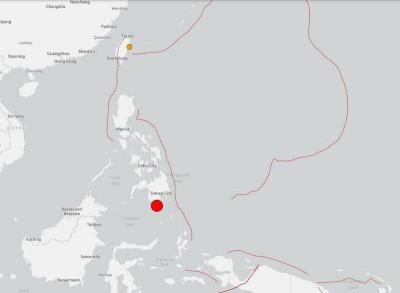
A magnitude 7.8 earthquake struck off the southern coast of Mindanao in the Philippines at 7:38am today, prompting the US Tsunami Warning System to issue an alert for neighboring countries, including Taiwan. The system issued a purple alert indicating a "tsunami threat." The potential threat zone includes Taiwan, the Philippines, Papua New Guinea, Yap and Palau. Philippine authorities were assessing the damage from the quake, with the office of civil defense seeking to verifying initial reports that 15 people had been killed and 129 injured in the region, mostly from falling debris. Arlene Hollero, disaster chief of Maasim town in the Philippines' Sarangani Province,

‘GRAY ZONE’ PRESSURE: Beijing’s activities are intended to create the deceitful impression that China has jurisdiction over the area around Taiwan, the CGA said Taiwan’s rights over its territorial waters and exclusive economic zone must not be violated by any country, the Mainland Affairs Council said yesterday, adding that it will not accept any unprovoked actions. The council issued the remarks in response to the China Coast Guard conducting maritime enforcement drills near eastern Taiwan and claiming to fully exercise China’s maritime administrative law enforcement authority. The Coast Guard Administration (CGA) has been closely monitoring the situation and is taking concrete steps to defend the nation’s sovereignty and secure its waters, the council said. China has no sovereign rights over the waters off eastern
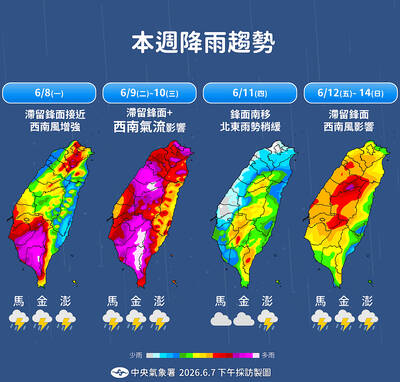
Heavy rain is expected to affect parts of Taiwan this week, the Central Weather Administration (CWA) said yesterday as a meteorologist said the active part of the annual plum rain season has started. A stationary plum rain front and southwesterly winds would bring unstable weather and abundant moisture to Taiwan from today for about a week, with the heaviest rainfall forecast for tomorrow and Wednesday, the CWA said. The agency said western and northeastern Taiwan, and mountainous areas in the east and southeast, could expect showers or thunderstorms on those two days, with localized heavy rain possible. Other parts of


 RSS
RSS