


Nearly 90 percent of the 200 cities beset by the world’s highest levels of deadly micro-pollution are in China and India, with most of the rest in Pakistan and Indonesia, researchers said yesterday.
Taking population into account, Bangladesh emerged as the country with the worst PM2.5 pollution, followed by Pakistan, Mongolia, Afghanistan and India, according to the 2019 World Air Quality Report, jointly released by IQAir Group and Greenpeace.
China ranked 11th.
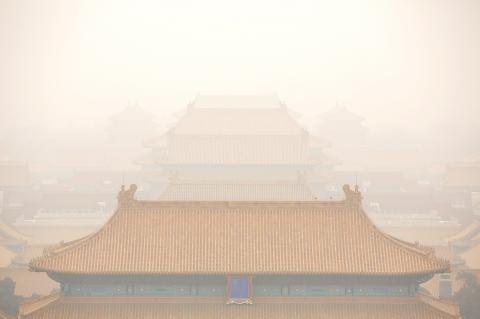
Photo: AP
Particulate matter of 2.5 micrometers or less in diameter — about one-30th the width of a human hair — is the most dangerous type of airborne pollution. Microscopic flecks are small enough to enter the bloodstream via the respiratory system, leading to asthma, lung cancer and heart disease.
Among the world’s megacities of 10 million or more people, the most PM2.5-toxic last year was the Indian capital, New Delhi, followed by Lahore in Pakistan, Dhaka in Bangladesh, Kolkata in India, Linyi and Tianjin in China, and Jakarta, Indonesia.
Next on the list were Wuhan — epicenter of the COVID-19 outbreak — along with Chengdu and Beijing.
In the capital city ranking, Taipei was 56th, compared with Jakarta in 5th place, Hanoi 7th, Beijing 9th, Seoul 27th, Singapore 44th, Manila 47th and Tokyo 63rd.
The report is based on data from nearly 5,000 cities worldwide.
Most of the 7 million premature deaths attributed by the WHO to air pollution are caused by PM2.5 particles, which originate in sandstorms, agriculture, industry, wildfires and especially the burning of fossil fuels.
“Air pollution is the world’s leading environmental health threat,” IQAir chief executive officer Frank Hammes said. “Ninety percent of the global population is breathing unsafe air.”
China’s average urban PM2.5 concentration dropped 20 percent in 2018 and last year, but last year it still counted 117 of the 200 most polluted cities in the world.
All but 2 percent of China’s cities exceeded WHO guidelines for PM2.5 levels, while 53 percent exceeded less stringent national limits.
The UN has said that PM2.5 density should not top 25 micrograms per cubic meter (mcg/m3) of air in any 24-hour period. China has set the bar at 35 mcg/m3.
More than 1 million premature deaths in China each year are caused by air pollution, the WHO has said.
Recent calculations put the toll at up to twice that figure.
Across a large swathe of northern India and north-central China, meeting WHO standards year-round for PM2.5 pollution would increase life expectancy up to six or seven years, according to the Air Quality Life Index, developed by researchers at the Energy Policy Institute of Chicago.
In India, small particle pollution exceeds WHO limits by 500 percent, even if air pollution in general declined significantly last year, with 98 percent of cities monitored showing improvements.
Among Organisation for Economic Co-operation and Development nations, South Korea was the most polluted for PM2.5, counting 105 of the worst 1,000 cities on the index. In Europe, Poland and Italy counted 39 and 31 cities respectively in the tranche.
Other parts of the world, such as Africa and the Middle East, lacked data.
“What cannot be measured cannot be managed,” Hammes said. “Africa, a continent of 1.3 billion people, currently has less than 100 monitoring stations that make PM2.5 data available to the public in real time.”
As of 2018, China alone had more than 1,000 such stations in 200 cities.
Climate change has begun to amplify the health risk of PM2.5 pollution, especially through more intense forest fires and sandstorms made worse by spreading desertification, the report found.
Global warming and PM2.5 also have the same primary driver: the burning of coal, oil and gas.
While the link with lung cancer was well-established, a study has shown that most excess deaths from air pollution are caused by heart attacks, strokes and other types of cardiovascular disease.
Small and larger particulate matter, nitrogen dioxide, sulphur dioxide and ozone have likewise been linked to drops in cognitive performance, labor productivity and educational outcomes.
Additional reporting by staff writer
A coalition of civil rights groups on Tuesday asked a New York State judge to order one of its largest suburban counties to stop its deployment of nearly 600 license plate readers, calling it a warrantless and “indiscriminate surveillance system” that violates the state constitution. The class action lawsuit also alleged that Westchester County never got proper authorization to launch the program, which has amassed a database of 1.6 billion plate scans that has been shared with more than 50 outside law enforcement agencies. The complaint said the network “records the long-term travel patterns, daily habits, and intimate information of millions of

Pope Leo XIV on Wednesday blessed a giant new tower at Barcelona’s famed Sagrada Familia Basilica after celebrating mass inside what is now the world’s tallest church. A fireworks and light show illuminated the exterior of the temple at the end of the ceremony, bathing the unfinished basilica in shifting colours that highlighted its towering spires. A choir of 600 singers performed at the service which lasted around 90 minutes and was attended by Spanish Prime Minister Pedro Sanchez as well as King Felipe VI and Queen Letizia. The stained-glass windows in various colours shone brightly in between the tree-like

Voters in Switzerland yesterday cast their ballots on an initiative championed by the top right-wing party to cap the Alpine country’s population at 10 million. As of press time last night, early results showed that Swiss voters were leaning against it. The populist Swiss People’s Party, which has the most seats in parliament, has stirred up and fostered anti-migration sentiment over the years, notably about an influx of workers from the neighboring EU. Critics called the bid a self-inflicted wound, saying the boom in migration over the past generation has brought foreign labor and skills to sectors such as healthcare, finance, pharmaceuticals

Scientists have discovered communities of marine life — including jellyfish, tubeworms and brittle stars — thriving on a whale graveyard. The graveyards form when whale carcasses fall to the sea floor, becoming a sustaining snack for nearby critters. This one, which is up to 7km below the surface of the southeastern Indian Ocean, spans the largest area, and is so far the deepest found. A whale’s sheer size and the unique chemistry of its bones are the keys to forming these unique underwater neighborhoods, said Song Xikun (宋希坤), a biologist with the Chinese Academy of Sciences’ Institute of Deep-sea Science and Engineering


 RSS
RSS