


The US-European Solar Orbiter probe on Sunday night launched from Florida on a voyage to deepen our understanding of the sun and how it shapes the space weather that affects technology on Earth.
The mission, a collaboration between the European Space Agency (ESA) and NASA, blasted off from the Kennedy Space Center in Cape Canaveral, Florida, at 11:03pm and could last up to nine years or more.
At 12:24am yesterday the European Space Operations Centre in Darmstadt, Germany, received a signal from the spacecraft indicating that its solar panels had successfully deployed.
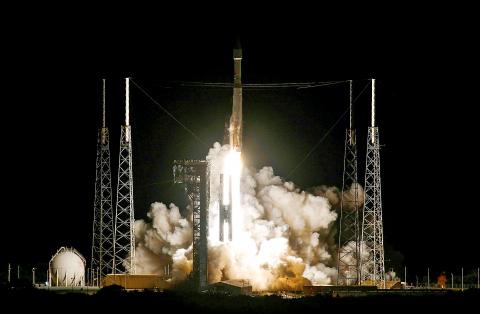
Photo: Reuters
Space Orbiter is expected to provide unprecedented insights into the sun’s atmosphere, winds and magnetic fields, including how it shapes the heliosphere, the vast swath of space that encompasses the solar system.
By journeying out of the ecliptic plane — the belt of space roughly aligned with the sun’s equator, through which the planets orbit — it is to acquire the first-ever images of our star’s uncharted polar regions.
Drawing on gravity assists from Earth and Venus, Solar Orbiter is to slingshot itself into a bird’s eye view of the sun’s poles, reaching its primary science orbit in two years’ time.
“I think it was picture perfect, suddenly you really feel like you’re connected to the entire solar system,” ESA project scientist Daniel Muller said shortly after the launch. “You’re here on Earth and you’re launching something that will go close to the sun.”
“We have one common goal and that is to get the good science out of this mission. I think we’re going to succeed,” added Holly Gilbert, director of NASA’s heliophysics science division.
Ten state-of-the-art instruments on board are to record myriad observations to help scientists unlock clues about what drives solar winds and flares.
These emit billions of highly charged particles that impact the Earth, producing the spectacular northern lights.
However, they can also disrupt radar systems, radio networks and even, though rarely, render satellites useless.
The largest solar storm on record hit North America in September 1859, knocking out much of the continent’s telegraph network and bathing the skies in an aurora viewable as far away as the Caribbean.
“Imagine if just half of our satellites were destroyed,” said Matthieu Berthomier, a researcher at the Paris-based Plasma Physics Laboratory. “It would be a disaster for mankind.”
At its closest approach, Solar Orbiter is to be nearer to the sun than Mercury, a mere 42 million kilometers away.
With a custom-designed titanium heat shield, it is built to withstand temperatures as high as 500°C.
Its heat-resistant structure is coated in a thin, black layer of calcium phosphate, a charcoal-like powder that is similar to pigments used in prehistoric cave paintings.
The shield will protect the instruments from extreme particle radiation emitted from solar explosions.
All but one of the spacecraft’s telescopes will peep out through holes in the heat shield that open and close in a carefully orchestrated dance, while other instruments will work behind the shadow of the shield.

A plan by Switzerland’s right-wing People’s Party to cap the population at 10 million has the backing of almost half the country, according to a poll before an expected vote next year. The party, which has long campaigned against immigration, argues that too-fast population growth is overwhelming housing, transport and public services. The level of support comes despite the government urging voters to reject it, warning that strict curbs would damage the economy and prosperity, as Swiss companies depend on foreign workers. The poll by newspaper group Tamedia/20 Minuten and released yesterday showed that 48 percent of the population plan to vote

PARLIAMENT CHAOS: Police forcibly removed Brazilian Deputy Glauber Braga after he called the legislation part of a ‘coup offensive’ and occupied the speaker’s chair Brazil’s lower house of Congress early yesterday approved a bill that could slash former Brazilian president Jair Bolsonaro’s prison sentence for plotting a coup, after efforts by a lawmaker to disrupt the proceedings sparked chaos in parliament. Bolsonaro has been serving a 27-year term since last month after his conviction for a scheme to stop Brazilian President Luiz Inacio Lula da Silva from taking office after the 2022 election. Lawmakers had been discussing a bill that would significantly reduce sentences for several crimes, including attempting a coup d’etat — opening up the prospect that Bolsonaro, 70, could have his sentence cut to

A powerful magnitude 7.6 earthquake shook Japan’s northeast region late on Monday, prompting tsunami warnings and orders for residents to evacuate. A tsunami as high as three metres (10 feet) could hit Japan’s northeastern coast after an earthquake with an estimated magnitude of 7.6 occurred offshore at 11:15 p.m. (1415 GMT), the Japan Meteorological Agency (JMA) said. Tsunami warnings were issued for the prefectures of Hokkaido, Aomori and Iwate, and a tsunami of 40cm had been observed at Aomori’s Mutsu Ogawara and Hokkaido’s Urakawa ports before midnight, JMA said. The epicentre of the quake was 80 km (50 miles) off the coast of
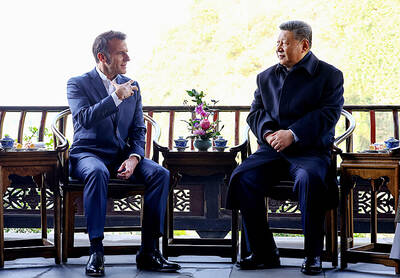
RELAXED: After talks on Ukraine and trade, the French president met with students while his wife visited pandas, after the pair parted ways with their Chinese counterparts French President Emmanuel Macron concluded his fourth state visit to China yesterday in Chengdu, striking a more relaxed note after tough discussions on Ukraine and trade with Chinese President Xi Jinping (習近平) a day earlier. Far from the imposing Great Hall of the People in Beijing where the two leaders held talks, Xi and China’s first lady, Peng Liyuan (彭麗媛), showed Macron and his wife Brigitte around the centuries-old Dujiangyan Dam, a World Heritage Site set against the mountainous landscape of Sichuan Province. Macron was told through an interpreter about the ancient irrigation system, which dates back to the third century


 RSS
RSS