


Britain’s new ambassador to the US on Friday said that she looks forward to expanding the traditional security and economic partnership between the two nations to new areas such as artificial intelligence and to having talks with US President Donald Trump, who has always been “gracious and friendly” to her.
Karen Pierce, a veteran diplomat who is Britain’s ambassador to the UN, was named to the new post on Friday.
She said she thinks that the “special relationship” between the UK and the US will stay the same following Britain’s departure from the EU, “because some of what binds us together, particularly on the security side, is deep and enduring and it’s also two-way.”
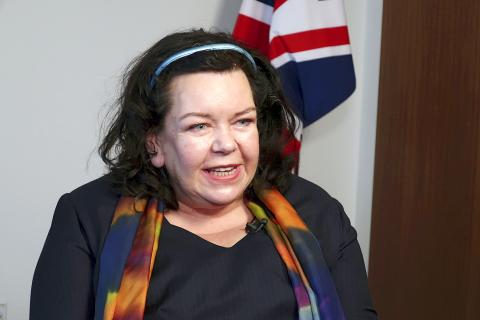
Photo: AP
She recalled US Secretary of State Mike Pompeo’s recent statement in London that British intelligence has helped prevent attacks on US soil.
Pierce, 60, replaces Kim Darroch, whose critical portrayal of the Trump administration led to an embarrassing trans-Atlantic spat and his resignation from the Washington ambassadorial post in July.
Trump expressed fury when leaked diplomatic documents from Darroch, published in Britain’s Mail on Sunday newspaper, called the US administration’s policy toward Iran “incoherent,” said the president might be indebted to “dodgy Russians” and questioned whether the White House “will ever look competent.”
Trump tweeted that Darroch was “wacky” and “a very stupid guy.”
Pierce said in an interview at Britain’s UN mission in New York after her appointment was announced in London that she has been “lucky” to have met the president several times, with the prime minister and the UN Security Council, stressing how “gracious” he was.
While “one would always be nervous meeting a head of state,” Pierce said she looks forward to conversations with Trump about all the areas “our countries care about so much.”
One critical issue would be Britain’s need to strike a trade deal with the US following its EU exit.
Pierce said there are also areas “where we disagree,” some where disagreements are “quite deep — but I don’t think that affects the overall health of the relationship.”
Britain and the US disagree about the Iran nuclear deal that Trump pulled the US out of, the Paris climate agreement that the US also exited and Chinese tech giant Huawei’s 5G network, which the UK opted not to ban as the Trump administration sought.
Pierce recalled that when she served at the British embassy in Washington in the 1990s, there was “a big gulf” between the US and Europe over Bosnia and the Balkan Wars, saying the rift “did leak into all different aspects of relations.”
“I’m not seeing that now,” she said. “Obviously I will do my best to put the British point of view across and do my best to narrow differences, but I think it’s also about exploiting opportunities for both America and for Britain in this relationship.”
In the announcement of her appointment, British Secretary of Foreign and Commonwealth Affairs Dominic Raab said: “It is a time of huge opportunity for the friendship between the UK and US and I am delighted that Karen Pierce will take forward this exciting new chapter in our relationship.”
Pierce, who was the first woman to be Britain’s UN ambassador and will be the first woman to be its US ambassador, said she does not think Trump will be disappointed she was chosen rather than Nigel Farage, the Brexit Party leader who is Britain’s leading champion of Trump.
The US president had said that Farage would make a “great ambassador.”
Pierce said she is looking ahead to expanding UK-US relations.
“It’s a huge honor anywhere to represent your country, but to be able to do that in Washington ... at a really important time in Britain’s development of the nation, I have to say I’m slightly overwhelmed, but I am really, really looking forward to it,” she said.
The US is really “a land of opportunity,” Pierce said, “and now we’ve left the European Union I want to find out those new opportunities and exploit them, use them, develop them for the benefit of the UK but also for the benefit of America.”
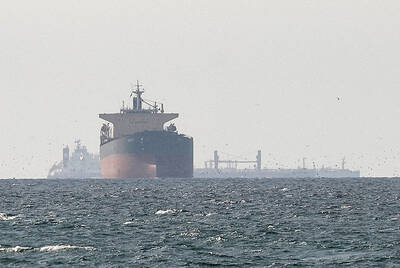
A ship that appears to be taking on the identity of a scrapped gas carrier exited the Strait of Hormuz on Friday, showing how strategies to get through the waterway are evolving as the Middle East war progresses. The vessel identifying as liquefied natural gas (LNG) carrier Jamal left the Strait on Friday morning, ship-tracking data show. However, the same tanker was also recorded as having beached at an Indian demolition yard in October last year, where it is being broken up, according to market participants and port agent’s reports. The ship claiming to be Jamal is likely a zombie vessel that

German Chancellor Friedrich Merz’s conservative Christian Democratic Union (CDU) yesterday faced a regional election battle in Rhineland-Palatinate, now held by the center-left Social Democratic Party (SPD). Merz’s CDU has enjoyed a narrow poll lead over the SPD — their coalition partners at the national level — who have ruled the mid-sized state for 35 years. Polling third is the far-right Alternative for Germany (AfD), which spells a greater threat to the two centrist parties in several state elections in September in the country’s ex-communist east. The picturesque state of Rhineland-Palatinate, bordering France, Belgium and Luxembourg and with a population of about 4 million,
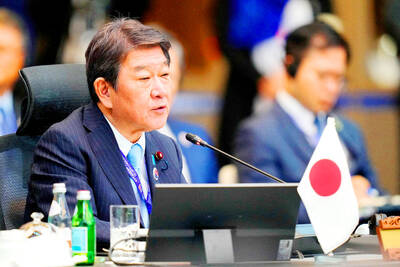
LAW CONSTRAINTS: The US has been pressing allies to send warships to open the Strait, but Tokyo’s military actions are limited under its postwar pacifist constitution Japan could consider deploying its military for minesweeping in the Strait of Hormuz if a ceasefire is reached in the war on Iran, Japanese Minister of Foreign Affairs Toshimitsu Motegi said yesterday. “If there were to be a complete ceasefire, hypothetically speaking, then things like minesweeping could come up,” Motegi said. “This is purely hypothetical, but if a ceasefire were established and naval mines were creating an obstacle, then I think that would be something to consider.” Japan’s military actions are limited under its postwar pacifist constitution, but 2015 security legislation allows Tokyo to use its Self-Defense Forces overseas if an attack,

Ugandan wildlife authorities have reintroduced rhinos into a remote protected area where they were once poached into extinction, an event seen by conservationists as a milestone in efforts to support the recovery of a species threatened by poaching. On Tuesday, two southern white rhinos from a private ranch in the East African country were reintroduced into Kidepo Valley National Park in the country’s northeast. Two more rhinos in metallic crates arrived on Thursday. There have been no rhinos in the park since 1983, the result of poaching. However, a private ranch in central Uganda — the Ziwa Rhino Sanctuary — has been


 RSS
RSS