


The German state of Brandenburg has erected about 120km of electric fencing to prevent wild boars infected with African swine fever from straying across the border from Poland and infecting its pig herd.
Hans-Christian Daniels does not think the barrier will work.
“It looks rather inevitable that swine fever will come,” said Daniels, whose farm near Tauche, close to the Polish border, has 11,000 pigs. “This could cause a dramatic fall in prices.”
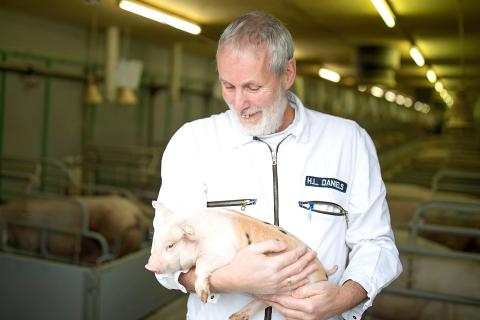
Photo: Reuters
African swine fever , which has led to the deaths of a quarter of the world’s pigs in China and roiled the global meat industry, is dangerously close to Germany, Europe’s largest pork producer.
A case of the viral disease was discovered in a wild boar in Poland just 12km from the German border last month.
A confirmed case in Germany could prompt an import ban, ending the boom times for local pig farmers, who have seen exports to China, the world’s biggest consumer of pork, jump due to the viral outbreaks in Asia. It could also have knock-on effects in the Netherlands and Denmark, where the main suppliers of piglets for Germany are based.
Farmers such as Daniels have taken strict steps to ward off the disease, but the biggest risk factor is from wild boars that roam the fields and forests along the German-Polish border feeding on nuts and acorns. They have already helped infect about 10 countries in eastern Europe, with Poland recording 55 outbreaks in wild boars in December alone.
“We do not know exactly how many wild boar we have in Brandenburg, but their numbers have been increasing in recent years,” said Anja Semmele of the Brandenburg hunting association. “Our region is something of a paradise for wild boar, with a mix of forests and farming.”
“They run very quickly and hunters need a good level of marksmanship to hit and kill the animal humanely,” she said.
African swine fever is a highly contagious viral disease that kills almost all the pigs it infects, but does not harm humans. It has been spreading across eastern Europe but is doing the greatest damage in Asia and has devastated pig farms in China in the past year.
China’s pork output has slumped to a 16-year low, as herds were culled to stamp out the disease, leading to a surge in imports of pork, beef and chicken to fill the gap.
Germany’s pork exports to China rose 43 percent year-on-year in the first seven months of last year and it was Germany’s single biggest foreign market.
Asian countries, including China, regularly impose import bans on pork from regions where African swine fever has been discovered and German pig farmers could face huge losses from both the drop in exports and costs arising from methods to combat the disease if it is found in Germany, farmers’ association DBV said.
“It is difficult to estimate how high the damage will be for German pig farmers,” DBV secretary-general Bernhard Kruesken said. “But we estimate at least a triple-digit million euro sum.”
Any export ban on German pork would also have knock-on effects for other European countries.
“The main suppliers of piglets for Germany in the EU are Denmark and the Netherlands. That means there will be effects in the Dutch and Danish markets quite immediately,” said Thomas Sanchez, a policy adviser with responsibility for pigmeat at EU farmers group Copa Cogeca.
To help deal with the threat of African swine fever, the German and Polish agriculture ministries are considering creating a fenced corridor on both sides of their border and a “drastic” reduction in wild boar numbers by relaxing rules on shooting them.
The Brandenburg fence was built in December and is designed to be temporary. Another fence is being built in Saxony.
“There are hopes that the fence is effective, but these animals are remarkably strong,” Gabriel Hesse of Brandenburg’s state health and consumer protection ministry said.

A plan by Switzerland’s right-wing People’s Party to cap the population at 10 million has the backing of almost half the country, according to a poll before an expected vote next year. The party, which has long campaigned against immigration, argues that too-fast population growth is overwhelming housing, transport and public services. The level of support comes despite the government urging voters to reject it, warning that strict curbs would damage the economy and prosperity, as Swiss companies depend on foreign workers. The poll by newspaper group Tamedia/20 Minuten and released yesterday showed that 48 percent of the population plan to vote

PARLIAMENT CHAOS: Police forcibly removed Brazilian Deputy Glauber Braga after he called the legislation part of a ‘coup offensive’ and occupied the speaker’s chair Brazil’s lower house of Congress early yesterday approved a bill that could slash former Brazilian president Jair Bolsonaro’s prison sentence for plotting a coup, after efforts by a lawmaker to disrupt the proceedings sparked chaos in parliament. Bolsonaro has been serving a 27-year term since last month after his conviction for a scheme to stop Brazilian President Luiz Inacio Lula da Silva from taking office after the 2022 election. Lawmakers had been discussing a bill that would significantly reduce sentences for several crimes, including attempting a coup d’etat — opening up the prospect that Bolsonaro, 70, could have his sentence cut to

A powerful magnitude 7.6 earthquake shook Japan’s northeast region late on Monday, prompting tsunami warnings and orders for residents to evacuate. A tsunami as high as three metres (10 feet) could hit Japan’s northeastern coast after an earthquake with an estimated magnitude of 7.6 occurred offshore at 11:15 p.m. (1415 GMT), the Japan Meteorological Agency (JMA) said. Tsunami warnings were issued for the prefectures of Hokkaido, Aomori and Iwate, and a tsunami of 40cm had been observed at Aomori’s Mutsu Ogawara and Hokkaido’s Urakawa ports before midnight, JMA said. The epicentre of the quake was 80 km (50 miles) off the coast of
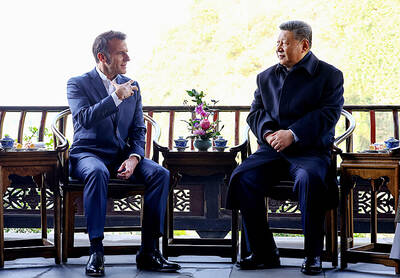
RELAXED: After talks on Ukraine and trade, the French president met with students while his wife visited pandas, after the pair parted ways with their Chinese counterparts French President Emmanuel Macron concluded his fourth state visit to China yesterday in Chengdu, striking a more relaxed note after tough discussions on Ukraine and trade with Chinese President Xi Jinping (習近平) a day earlier. Far from the imposing Great Hall of the People in Beijing where the two leaders held talks, Xi and China’s first lady, Peng Liyuan (彭麗媛), showed Macron and his wife Brigitte around the centuries-old Dujiangyan Dam, a World Heritage Site set against the mountainous landscape of Sichuan Province. Macron was told through an interpreter about the ancient irrigation system, which dates back to the third century


 RSS
RSS