

Voters backing Bougainville’s independence from Papua New Guinea have won a landslide referendum victory, according to results released yesterday — a major step toward the troubled isles becoming the world’s newest nation.
Chairman of the Bougainville Referendum Commission Bertie Ahern declared that 176,928 people — about 98 percent of voters — had backed independence, with just 3,043 supporting the option of remaining part of Papua New Guinea with more autonomy.
The announcement prompted loud cheers, applause and tears as dignitaries burst into song, with strains of the islands’ anthem My Bougainville ringing out.
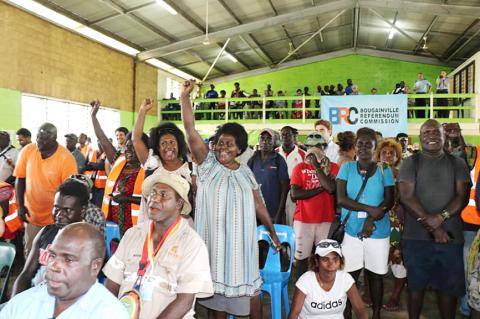
Photo: AP
“Happy is an understatement” nursing graduate Alexia Baria told reporters. “You see my tears, this is the moment we have been waiting for.”
The historic vote caps a decades-long peace process and a long recovery from a brutal civil war between Bougainville rebels, Papua New Guinean security forces and foreign mercenaries that ended in 1998 and left up to 20,000 people dead — 10 percent of the population.
“Now, at least psychologically, we feel liberated,” said John Momis, the priest-turned-leader of the autonomous region’s government.
However, independence would not be immediate, a long political process lies ahead and leaders face formidable financial and administrative challenges to turn a cluster of poor Pacific islands into a fully fledged nation.
The result must first be ratified by Papua New Guinea’s parliament — where there is opposition to the move for fear it might spark other independence movements in a nation defined by disparate linguistic and tribal groups.
However, the scale of the victory for the pro-independence side would heap pressure on Port Moresby to endorse the outcome.
“There’s no misinterpreting this result — Bougainville wants independence” said Shane McLeod of Sydney’s Lowy Institute. “The strength of the vote would seem to make it all but inevitable.”
“Port Moresby will need to quickly digest the result,” he said. “They’ll need to be ready to talk about the timetable for independence.”
Speaking in Buka, Papua New Guinea, Ahern urged all sides to recognize a vote that was about “your peace, your history and your future,” and showed “the power of the pen over weapons.”
Papua New Guinean Minister for Bougainville Affairs Puka Temu said “the outcome is a credible one,” but asked that voters “allow the rest of Papua New Guinea sufficient time to absorb this result.”
In stark contrast to past internecine bloodshed, voting began on Nov. 23 with ecstatic residents — some festooned in grass garlands — forming makeshift choirs that stomped through the streets, waving independence flags, blowing bamboo pipes and chanting in chorus.
The vote ended on Saturday and according to the Bougainville Referendum Commission it passed off without major incident.
Many Bougainvilleans were realistic about the difficulties ahead.
Gerald Dising, a store owner who traveled from the far south of Bougainville to witness the result, described it as a “first hurdle” being passed.
Politicians “now have a huge task to implement the wishes of our people,” he said.

US President Donald Trump on Wednesday threatened to take action against the EU if it moves forward with European Commission President Ursula von der Leyen’s proposal to make Canada the bloc’s first associate member. “If they do that, if I think it’s at all a hostile act; I will put very serious tariffs or stop trading with Europe on many things,” Trump told reporters en route to an event in North Carolina, calling the proposal “laughable.” “If it’s a good intention, that’s fine. If it’s a bad intention, we’ll put very heavy tariffs on Europe,” he said. Von der Leyen made the proposal
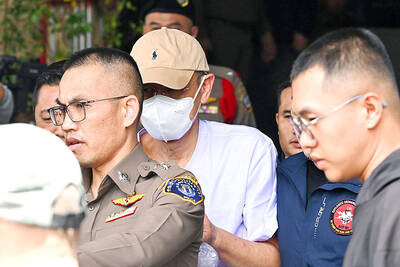
Thai police yesterday said that they arrested a senior Buddhist monk on suspicion of embezzling US$2.8 million intended for his monastery, alongside a suspected female accomplice he was having sex with. The case is the latest scandal to hit the clergy in Buddhist-majority Thailand after a sex and extortion case involving senior monks last year prompted public outrage and calls for greater scrutiny of temple finances. Phra Wachirayan Wi, the 66-year-old abbot of the 14th-century Wat Phutthaisawan in the ancient capital of Ayutthaya, was arrested on Thursday on charges including embezzlement and money laundering, lead police investigator Pattanasak Bupphasuwan said. A 47-year-old woman

SECRET FOOTAGE: A 17-year-old girl told British broadcaster Channel 4 that she had been approached by a man who covertly recorded her and their interaction Calls are growing louder in Europe for action against “pervert” smart glasses after secretly filmed footage of girls and women appeared online — with a petition in Britain demanding a ban on their sale. Anyone wearing smart glasses can take photos, film videos, listen to music, make phone calls, translate text or interact with an artificial intelligence (AI) assistant, with sales now hitting millions. The devices grabbed attention this summer after a marketing tie-up between Kylie Jenner, beauty mogul and member of the Kardashian dynasty, and tech giant Meta. Since smartphones are now embedded in daily life, “big tech” is
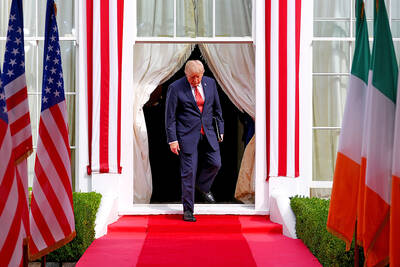
FROSTY RECEPTION: ‘I conveyed the strong view of the Irish people that the normalization of war and genocide can never be accepted,’ the Irish president said US President Donald Trump on Saturday said that he would “love to see” a united Ireland, wading into a politically sensitive subject as he embarked on a two-day Irish visit that blurs the lines between his presidency and personal business interests. After meeting Irish Prime Minister Micheal Martin in Dublin, Trump said reunification of the Republic of Ireland and Northern Ireland — split for more than a century — would be “a fantastic thing.” “It’s going to happen eventually. It may as well happen now,” he told reporters, adding that “the UK will have something to say about it, obviously.”


 RSS
RSS