


The future of German Chancellor Angela Merkel’s coalition was thrown into question on Saturday as her deputy chancellor and finance minister lost the leadership race of his center-left Social Democratic Party (SPD).
The humiliating defeat for German Minister of Finance Olaf Scholz marks another sign of discontent within the Social Democrats over their partnership with Merkel’s center-right party.
It was also a prelude to expected high drama in the coming week with the party poised to vote on whether to stay in the coalition as delegates meet for their annual congress, starting on Friday.
Scholz and his running mate Klara Geywitz, who back staying in the coalition until 2021, obtained only 45.33 percent of the vote of the party’s rank and file.
They were soundly beaten by challengers Norbert Walter-Borjans and Saskia Esken, who won with 53.06 percent, and who have been highly critical of the alliance with the conservatives.
Scholz said the party must now “stand behind the new leadership.”
For the business-friendly Free Democratic Party (FDP), the shock result means that “Germany stands before new elections or a minority government.”
The far-right Alternative for Germany (AfD) party also predicted an end of the coalition, with its coleader Joerg Meuthen forecasting that “it will break up.”
Anxious to calm jitters, Christian Democratic Union (CDU) General Secretary Paul Ziemiak came out to say that “the decision today has changed nothing” about the alliance — a message echoed by the Christian Social Union in Bavaria.
Wounded by an election rout in 2017, the SPD had initially sought to go into opposition, but allowed itself reluctantly to be coaxed into renewing an alliance with Merkel.
However, many in the SDP are wary of continuing to govern in Merkel’s shadow, and the coalition has lurched from crisis to crisis.
The SPD has also been battered by a series of regional and European election setbacks this year.
After voters handed the party its worst outcome in European elections in May, the party’s then-leader Andreas Nahles threw in the towel, triggering the leadership contest.
In an attempt to shake up its image, the SPD has turned to a new leadership format — a male-female duo for the first time since its founding in 1890 — a model copied from the surging Greens.
In the latest opinion polls, the SPD, which came second in the 2017 federal election, is struggling for third place with the AfD, behind the CDU and the Greens.
Relatively unknown in Germany’s political scene, the SPD’s new leaders Esken and Walter-Borjans stand further left on the spectrum within the party.
They have been critical of the government’s “black zero” policy of not taking on new debt — something that Scholz has championed — and its perceived timidity in tackling climate change.
The duo has said they will push the coalition to agree to billions more in investments on the climate and infrastructure. Failing that, they have threatened to pull the plug on the coalition.
Analysts say the SPD needs to quit the government if it wants to survive.
“The SPD cannot renew itself unless it is in opposition and has new people,” political expert Klaus Schroeder said.

PARLIAMENT CHAOS: Police forcibly removed Brazilian Deputy Glauber Braga after he called the legislation part of a ‘coup offensive’ and occupied the speaker’s chair Brazil’s lower house of Congress early yesterday approved a bill that could slash former Brazilian president Jair Bolsonaro’s prison sentence for plotting a coup, after efforts by a lawmaker to disrupt the proceedings sparked chaos in parliament. Bolsonaro has been serving a 27-year term since last month after his conviction for a scheme to stop Brazilian President Luiz Inacio Lula da Silva from taking office after the 2022 election. Lawmakers had been discussing a bill that would significantly reduce sentences for several crimes, including attempting a coup d’etat — opening up the prospect that Bolsonaro, 70, could have his sentence cut to

A plan by Switzerland’s right-wing People’s Party to cap the population at 10 million has the backing of almost half the country, according to a poll before an expected vote next year. The party, which has long campaigned against immigration, argues that too-fast population growth is overwhelming housing, transport and public services. The level of support comes despite the government urging voters to reject it, warning that strict curbs would damage the economy and prosperity, as Swiss companies depend on foreign workers. The poll by newspaper group Tamedia/20 Minuten and released yesterday showed that 48 percent of the population plan to vote

A powerful magnitude 7.6 earthquake shook Japan’s northeast region late on Monday, prompting tsunami warnings and orders for residents to evacuate. A tsunami as high as three metres (10 feet) could hit Japan’s northeastern coast after an earthquake with an estimated magnitude of 7.6 occurred offshore at 11:15 p.m. (1415 GMT), the Japan Meteorological Agency (JMA) said. Tsunami warnings were issued for the prefectures of Hokkaido, Aomori and Iwate, and a tsunami of 40cm had been observed at Aomori’s Mutsu Ogawara and Hokkaido’s Urakawa ports before midnight, JMA said. The epicentre of the quake was 80 km (50 miles) off the coast of
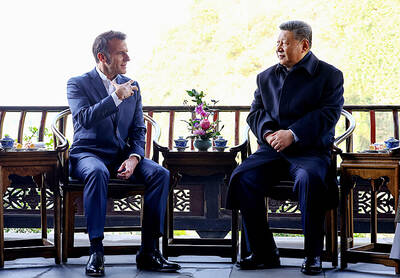
RELAXED: After talks on Ukraine and trade, the French president met with students while his wife visited pandas, after the pair parted ways with their Chinese counterparts French President Emmanuel Macron concluded his fourth state visit to China yesterday in Chengdu, striking a more relaxed note after tough discussions on Ukraine and trade with Chinese President Xi Jinping (習近平) a day earlier. Far from the imposing Great Hall of the People in Beijing where the two leaders held talks, Xi and China’s first lady, Peng Liyuan (彭麗媛), showed Macron and his wife Brigitte around the centuries-old Dujiangyan Dam, a World Heritage Site set against the mountainous landscape of Sichuan Province. Macron was told through an interpreter about the ancient irrigation system, which dates back to the third century


 RSS
RSS