


Iraqis across the country yesterday marched to mourn protesters killed in anti-government rallies, even turning out in Sunni areas where people were previously too afraid to join in.
Demonstrators have hit the streets since early October in Baghdad and the Shiite-majority south to demand the ouster of a government they accuse of being corrupt, inefficient and beholden to foreign powers.
After a spike in deaths this week raised the toll to more than 420 killed, Iraqi Prime Minister Adel Abdel Mahdi on Friday said he would submit his resignation to parliament.
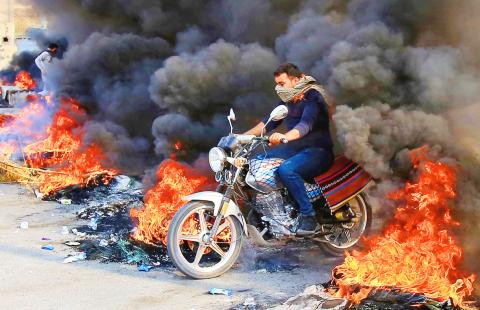
Photo: AFP
The chamber was due to convene later yesterday, but no agenda had yet been published.
In the past few weeks, most Sunni-majority areas refrained from protesting, fearing that opposing the central government would earn them the labels of being “terrorists” or supporters of former Iraqi president Saddam Hussein.
However, after a spike in violence days ago left nearly 70 people dead across three cities, Iraqis in nearly all provinces turned out in solidarity.
In yesterday’s marches, hundreds of students dressed in black organized a mourning march in the northern city of Mosul, on the city’s university campus.
“It’s the least Mosul can give to the martyrs of Dhi Qar and Najaf,” said Zahraa Ahmed, a dentistry student, naming the two provinces where most recent victims were from. “The protesters are asking for their basic rights so the government should have answered from the beginning.”
Another student, Hussein Kheder, carrying an Iraqi flag, said the whole country was now on the same page politically.
“Now the government needs to answer to the protesters’ demands,” he told reporters.
In Salahaddin, another northern Sunni province where no rallies had taken place so far, authorities had already declared on Friday three days of mourning for the victims.
Eight other Shiite-majority provinces have announced yesterday a mourning day during which government offices would remain shut.
More than 20 people were killed in the shrine city of Najaf, 40 people in Nasiriyah and three in the capital, Baghdad.
An Agence France-Presse correspondent reported calm in Nasiriyah yesterday after three consecutive days of violence.
The protest hotspot is the birthplace of Abdel Mahdi, who came to power just a year ago based on a shaky alliance between rival parties.
He had resisted protesters’ calls for him to step down over the past two months.
However, the crackdown turned the tide this week, as it prompted Iraq’s top cleric Grand Ayatollah Ali Sistani to call on parliament to drop its support for Abdel Mahdi.
In quick succession, political factions indicated they would support a no-confidence vote.
However, it was not certain whether that vote would take place yesterday afternoon.

PARLIAMENT CHAOS: Police forcibly removed Brazilian Deputy Glauber Braga after he called the legislation part of a ‘coup offensive’ and occupied the speaker’s chair Brazil’s lower house of Congress early yesterday approved a bill that could slash former Brazilian president Jair Bolsonaro’s prison sentence for plotting a coup, after efforts by a lawmaker to disrupt the proceedings sparked chaos in parliament. Bolsonaro has been serving a 27-year term since last month after his conviction for a scheme to stop Brazilian President Luiz Inacio Lula da Silva from taking office after the 2022 election. Lawmakers had been discussing a bill that would significantly reduce sentences for several crimes, including attempting a coup d’etat — opening up the prospect that Bolsonaro, 70, could have his sentence cut to

A plan by Switzerland’s right-wing People’s Party to cap the population at 10 million has the backing of almost half the country, according to a poll before an expected vote next year. The party, which has long campaigned against immigration, argues that too-fast population growth is overwhelming housing, transport and public services. The level of support comes despite the government urging voters to reject it, warning that strict curbs would damage the economy and prosperity, as Swiss companies depend on foreign workers. The poll by newspaper group Tamedia/20 Minuten and released yesterday showed that 48 percent of the population plan to vote

A powerful magnitude 7.6 earthquake shook Japan’s northeast region late on Monday, prompting tsunami warnings and orders for residents to evacuate. A tsunami as high as three metres (10 feet) could hit Japan’s northeastern coast after an earthquake with an estimated magnitude of 7.6 occurred offshore at 11:15 p.m. (1415 GMT), the Japan Meteorological Agency (JMA) said. Tsunami warnings were issued for the prefectures of Hokkaido, Aomori and Iwate, and a tsunami of 40cm had been observed at Aomori’s Mutsu Ogawara and Hokkaido’s Urakawa ports before midnight, JMA said. The epicentre of the quake was 80 km (50 miles) off the coast of
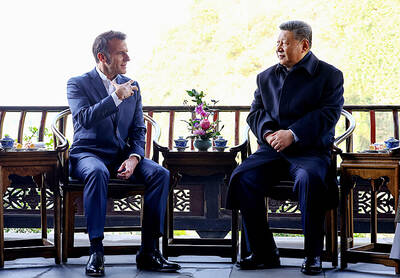
RELAXED: After talks on Ukraine and trade, the French president met with students while his wife visited pandas, after the pair parted ways with their Chinese counterparts French President Emmanuel Macron concluded his fourth state visit to China yesterday in Chengdu, striking a more relaxed note after tough discussions on Ukraine and trade with Chinese President Xi Jinping (習近平) a day earlier. Far from the imposing Great Hall of the People in Beijing where the two leaders held talks, Xi and China’s first lady, Peng Liyuan (彭麗媛), showed Macron and his wife Brigitte around the centuries-old Dujiangyan Dam, a World Heritage Site set against the mountainous landscape of Sichuan Province. Macron was told through an interpreter about the ancient irrigation system, which dates back to the third century


 RSS
RSS