


China wants to “take over” Australia’s political system with an “insidious” and systematic campaign of espionage and influence peddling, Canberra’s former spymaster warned in an interview published yesterday.
Duncan Lewis, who resigned in September after five years as director-general of the Australian Security Intelligence Organisation, said that China could target anyone in political office, with the effects potentially unknown for years.
“Espionage and foreign interference is insidious. Its effects might not present for decades and by that time it’s too late,” Lewis told the Sydney Morning Herald in his first interview since leaving office.
“You wake up one day and find decisions made in our country that are not in the interests of our country,” he said in unusually blunt comments from a former senior intelligence official.
“Not only in politics, but also in the community or in business. It takes over, basically, pulling the strings from offshore,” he added.
Lewis singled out incidents of Chinese agents making large contributions to Australian political parties as part of a wide-ranging influence-peddling campaign that also targeted media and the country’s universities.
He cited the case of Australian Labor Party powerbroker Sam Dastyari — dubbed “Shanghai Sam” — who was forced to resign after taking tens of thousands of dollars from a Chinese Communist Party-linked donor.
“It’s quite clear to me that any person in political office is potentially a target. I’m not trying to create paranoia, but there does need to be a level of sensible awareness,” Lewis said.
His comments are likely to stir already heated debate about Australia’s relations with China and be seen as a rebuke of vocal Sinophile figures like former Australian prime minister Paul Keating.
Keating has branded Australia’s security agencies “nutters” for their allegedly hawkish stance on China and slammed the “pious,” “do-gooder” media for sensationalist reporting on Chinese influence operations.
Officials have said that China’s growing efforts to influence politics overseas through donations, investment and “united front” community groups have grown apace since Chinese President Xi Jinping (習近平) took power.
The effects in Australia have long concerned the White House, which has repeatedly warned Canberra against being complacent.
However, Australian Prime Minister Scott Morrison — whose government has introduced a foreign agents register for lobbyists and expelled a prominent Chinese donor — said that he was confident Australia could “maintain the integrity of our system.”
“We have all the systems in place and we have the legal system in place to ensure that Australia’s interests are always protected,” he said.
Lewis said that the help of Australia’s large ethnic Chinese community was “vital in the work against foreign covert influence,” much like Muslim-Australians who have aided in the fight against terrorism.
While running the spy agency, Lewis, who also held senior military positions and served as Australia’s ambassador to Belgium and NATO, frequently warned of the dangers of foreign espionage, but avoided singling out China for criticism.
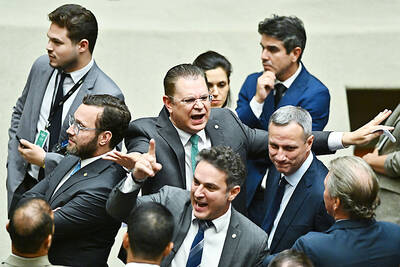
PARLIAMENT CHAOS: Police forcibly removed Brazilian Deputy Glauber Braga after he called the legislation part of a ‘coup offensive’ and occupied the speaker’s chair Brazil’s lower house of Congress early yesterday approved a bill that could slash former Brazilian president Jair Bolsonaro’s prison sentence for plotting a coup, after efforts by a lawmaker to disrupt the proceedings sparked chaos in parliament. Bolsonaro has been serving a 27-year term since last month after his conviction for a scheme to stop Brazilian President Luiz Inacio Lula da Silva from taking office after the 2022 election. Lawmakers had been discussing a bill that would significantly reduce sentences for several crimes, including attempting a coup d’etat — opening up the prospect that Bolsonaro, 70, could have his sentence cut to

A plan by Switzerland’s right-wing People’s Party to cap the population at 10 million has the backing of almost half the country, according to a poll before an expected vote next year. The party, which has long campaigned against immigration, argues that too-fast population growth is overwhelming housing, transport and public services. The level of support comes despite the government urging voters to reject it, warning that strict curbs would damage the economy and prosperity, as Swiss companies depend on foreign workers. The poll by newspaper group Tamedia/20 Minuten and released yesterday showed that 48 percent of the population plan to vote

A powerful magnitude 7.6 earthquake shook Japan’s northeast region late on Monday, prompting tsunami warnings and orders for residents to evacuate. A tsunami as high as three metres (10 feet) could hit Japan’s northeastern coast after an earthquake with an estimated magnitude of 7.6 occurred offshore at 11:15 p.m. (1415 GMT), the Japan Meteorological Agency (JMA) said. Tsunami warnings were issued for the prefectures of Hokkaido, Aomori and Iwate, and a tsunami of 40cm had been observed at Aomori’s Mutsu Ogawara and Hokkaido’s Urakawa ports before midnight, JMA said. The epicentre of the quake was 80 km (50 miles) off the coast of
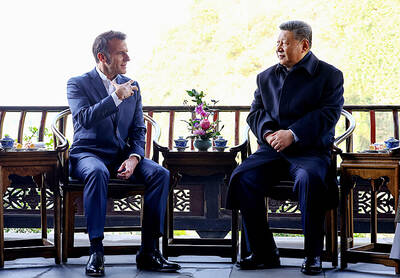
RELAXED: After talks on Ukraine and trade, the French president met with students while his wife visited pandas, after the pair parted ways with their Chinese counterparts French President Emmanuel Macron concluded his fourth state visit to China yesterday in Chengdu, striking a more relaxed note after tough discussions on Ukraine and trade with Chinese President Xi Jinping (習近平) a day earlier. Far from the imposing Great Hall of the People in Beijing where the two leaders held talks, Xi and China’s first lady, Peng Liyuan (彭麗媛), showed Macron and his wife Brigitte around the centuries-old Dujiangyan Dam, a World Heritage Site set against the mountainous landscape of Sichuan Province. Macron was told through an interpreter about the ancient irrigation system, which dates back to the third century


 RSS
RSS