


Exceptionally high tidal waters rolled relentlessly through Venice again on Friday, forcing the closure of St Mark’s Square to the public and flooding most of the lagoon city’s already devastated center before easing.
Forecasters warned that the danger for more wind-propelled high tides remained through the weekend.
The Italian government issued an international appeal for donations to help repair damage to the centuries-old city’s rich cultural heritage after Tuesday’s floods, which were the worst in decades.
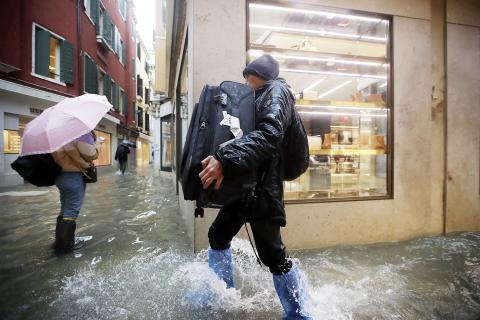
Photo: AP
People can donate 2 euros (US$2.21) by sending a text message to a special number Italian Minister of Culture Dario Franceschini said.
“All the world loves this splendid city, let them show it now,” he said in a statement.
A senior port authority official wrote to major cruise ship companies for donations.
Massive cruise liners disgorge thousands of day-trippers into Venice on a near-daily basis, boosting its economy but also risking accidents with smaller vessels.
Late Tuesday, Venice water levels reached 1.87m above sea level, the highest flooding since 1966.
On Friday, ten minutes before noon, the tide peaked at 1.54m above sea level. Six hours later, it had receded to about 60cm.
Built on a series of tiny islets amid a system of canals, Venice is particularly vulnerable to a combination of rising sea levels due to climate change coupled with the city’s well-documented sinking into the mud. The sea level in Venice is 10cm higher than it was 50 years ago, according to the city’s tide office.
More than 50 churches have reported damage from the tides, Franceschini said as he inspected the city. Carabinieri officers from the corps’ world-renowned and highly trained squad of art experts were being deployed to map damage to art treasures, a job that is expected to take some time.
“While the water is still there, it’s difficult to know what the [full] damage is,” Franceschini said.
The minister called on lawmakers of all political stripes to quickly approve extending tax breaks for those who donate to help restore state monuments and artworks and also for those who contribute for Venice’s damaged churches.
“There are so many churches which have suffered damage and were invaded by water,” Franceschini said.
Likely the most heavily damaged was St Mark’s Basilica, since it is in one of the lowest points of the city.
At the government’s request, the Italian Space Agency was gathering radar data from satellites to detect any signs that Venice bell towers may have shifted or that their foundations might have weakened after being buffeted countless times over the centuries by fast-rising waters.
On Thursday, the government declared a state of emergency, approving 20 million euros to help Venice repair the most urgent damage.
Venice Mayor Luigi Brugnaro has estimated damage at hundreds of millions of euros and blamed climate change for the city’s plight.
He also called for the speedy completion of the city’s long-delayed Moses flood defense project. Moses consists of a series of moveable barriers in the lagoon that could be raised when high winds and high tides combine, threatening to send acqua alta — or “high water,” as the uniquely Venetian phenomenon is known — rushing across the city.
Completion of the multibillion-euro project, under construction since 2003, has been delayed by corruption scandals, cost overruns and opposition from environmentalists who were worried about its effects on Venice’s delicate lagoon ecosystem.
Opposition politicians in the Veneto Region, which has Venice as its capital, noted wryly that the local center-right majority had just voted against an amendment to fund efforts aimed at dealing with climate change when the regional assembly hall was flooded on Tuesday night, forcing politicians to flee.
While tourists sloshed earlier in the week in St Mark’s Square or strolled across it on strategically placed raised walkways to witness the water rushing into ancient St Mark’s Basilica, on Friday, the mayor said he asked police to block off the square, which was covered in water up to adults’ knees.
University students in Venice rushed to libraries and other institutions filled with books and manuscripts to help shift the material to higher stories. Improvising, at least one volunteer used a hair dryer to dry a valued volume, page by page.
The Italian Society of Authors and Editors, which said Venice’s book stores and libraries were “gravely damaged” by the high water, launched a fundraising campaign. Pitching for donations from Italy and abroad, the group said it was important to “take the side of those who every day are on the front lines for the defense of Italian culture.”
It said one Venice bookstore, poignantly named “Acqua Alta,” had been completely submerged by the rushing water.
Venice’s La Fenice opera theater was left unusable by the flooding. Milan’s opera theater, La Scala, said it would mount a special ballet on Nov. 29 to raise funds for La Fenice.

The Burmese junta has said that detained former leader Aung San Suu Kyi is “in good health,” a day after her son said he has received little information about the 80-year-old’s condition and fears she could die without him knowing. In an interview in Tokyo earlier this week, Kim Aris said he had not heard from his mother in years and believes she is being held incommunicado in the capital, Naypyidaw. Aung San Suu Kyi, a Nobel Peace Prize laureate, was detained after a 2021 military coup that ousted her elected civilian government and sparked a civil war. She is serving a

REVENGE: Trump said he had the support of the Syrian government for the strikes, which took place in response to an Islamic State attack on US soldiers last week The US launched large-scale airstrikes on more than 70 targets across Syria, the Pentagon said on Friday, fulfilling US President Donald Trump’s vow to strike back after the killing of two US soldiers. “This is not the beginning of a war — it is a declaration of vengeance,” US Secretary of Defense Pete Hegseth wrote on social media. “Today, we hunted and we killed our enemies. Lots of them. And we will continue.” The US Central Command said that fighter jets, attack helicopters and artillery targeted ISIS infrastructure and weapon sites. “All terrorists who are evil enough to attack Americans are hereby warned

Seven wild Asiatic elephants were killed and a calf was injured when a high-speed passenger train collided with a herd crossing the tracks in India’s northeastern state of Assam early yesterday, local authorities said. The train driver spotted the herd of about 100 elephants and used the emergency brakes, but the train still hit some of the animals, Indian Railways spokesman Kapinjal Kishore Sharma told reporters. Five train coaches and the engine derailed following the impact, but there were no human casualties, Sharma said. Veterinarians carried out autopsies on the dead elephants, which were to be buried later in the day. The accident site

‘EAST SHIELD’: State-run Belma said it would produce up to 6 million mines to lay along Poland’s 800km eastern border, and sell excess to nations bordering Russia and Belarus Poland has decided to start producing anti-personnel mines for the first time since the Cold War, and plans to deploy them along its eastern border and might export them to Ukraine, the deputy defense minister said. Joining a broader regional shift that has seen almost all European countries bordering Russia, with the exception of Norway, announce plans to quit the global treaty banning such weapons, Poland wants to use anti-personnel mines to beef up its borders with Belarus and Russia. “We are interested in large quantities as soon as possible,” Deputy Minister of National Defense Pawel Zalewski said. The mines would be part


 RSS
RSS