


Renewed clashes on Wednesday rocked Bolivia’s capital as a woman who has claimed the interim presidency, a second-tier lawmaker thrust into the post because of a power vacuum, faced challenges to her leadership from supporters of former Bolivian president Evo Morales.
A day after Jeanine Anez assumed power, violent clashes broke out between rock-throwing Morales’ backers and police in riot gear, who fired volleys of tear gas to disperse the large crowd of protesters as fighter jets flew low overhead in a show of force.
Opposition was also building in the Bolivian Congress, where lawmakers loyal to Morales were mounting a challenge to Anez’s legitimacy by trying to hold new sessions that would undermine her claim to the interim presidency.
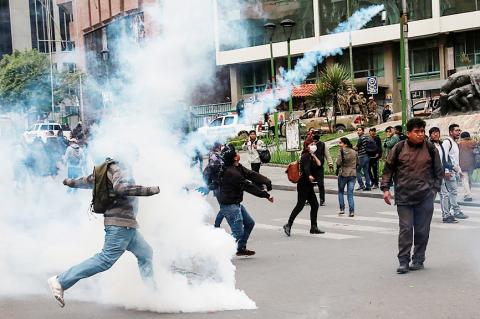
Photo: Reuters
The sessions — dismissed as invalid by Anez’s faction — added to the political uncertainty following the resignation of Morales, the nation’s first indigenous leader, after nearly 14 years in power.
In the streets, angry demonstrators tore off corrugated sheets of metal and wooden planks from construction sites to use as weapons, and some set off sticks of dynamite.
Many protesters flooded the streets of the capital, La Paz, and its sister city, El Alto, a Morales stronghold, waving the multicolored indigenous flag and chanting: “Now, civil war.”
“We don’t want any dictators. This lady has stepped on us — that’s why we’re so mad,” Paulina Luchampe said. “We’re going to fight with our brothers and sisters until Evo Morales is back. We ask for his return. He needs to put the house in order.”
Ten people have died since the protests began, the prosecutor’s office said on Wednesday.
Morales, 60, who arrived in Mexico on Tuesday under a grant of asylum, has vowed to remain active in politics and said he would be willing to go back home.
“If the people ask me, we are willing to return,” Morales said at news conference in Mexico City on Wednesday.
The Bolivian constitution states that an interim president has 90 days to organize an election and the disputed accession of Anez, who until Tuesday was second vice president of the Senate, was an example of the long list of obstacles she faces.
Morales’ backers, who hold a two-thirds majority in Congress, boycotted the session she called on Tuesday night to formalize her claim to the interim presidency, preventing a quorum.
She claimed power anyway, saying the constitution did not specifically require congressional approval.
“My commitment is to return democracy and tranquility to the country,” she said. “They can never again steal our vote.”
Eduardo Gamarra, a Bolivian political scientist at Florida International University, said the constitution clearly states that Anez did not need a congressional vote to assume the interim presidency.
Even so, “the next two months are going to be extraordinarily difficult for president Anez,” he said.
“It doesn’t seem likely” that Morales’ party will accept Anez as president, said Jennifer Cyr, an associate professor of political science and Latin American studies at the University of Arizona. “So the question of what happens next remains — still quite unclear and extremely worrying.”
Anez would need to form a new electoral court, find non-partisan staff for the electoral tribunal and get Congress, which is controlled by Morales’ Movement for Socialism party, to vote on a new election, Cyr said.
Morales resigned on Sunday following weeks of violent protests fed by allegations of electoral fraud in an Oct. 20 election, which he claimed to have won.
An Organization of American States audit reported widespread irregularities in the vote count and called for a new election.

The Burmese junta has said that detained former leader Aung San Suu Kyi is “in good health,” a day after her son said he has received little information about the 80-year-old’s condition and fears she could die without him knowing. In an interview in Tokyo earlier this week, Kim Aris said he had not heard from his mother in years and believes she is being held incommunicado in the capital, Naypyidaw. Aung San Suu Kyi, a Nobel Peace Prize laureate, was detained after a 2021 military coup that ousted her elected civilian government and sparked a civil war. She is serving a

REVENGE: Trump said he had the support of the Syrian government for the strikes, which took place in response to an Islamic State attack on US soldiers last week The US launched large-scale airstrikes on more than 70 targets across Syria, the Pentagon said on Friday, fulfilling US President Donald Trump’s vow to strike back after the killing of two US soldiers. “This is not the beginning of a war — it is a declaration of vengeance,” US Secretary of Defense Pete Hegseth wrote on social media. “Today, we hunted and we killed our enemies. Lots of them. And we will continue.” The US Central Command said that fighter jets, attack helicopters and artillery targeted ISIS infrastructure and weapon sites. “All terrorists who are evil enough to attack Americans are hereby warned

Seven wild Asiatic elephants were killed and a calf was injured when a high-speed passenger train collided with a herd crossing the tracks in India’s northeastern state of Assam early yesterday, local authorities said. The train driver spotted the herd of about 100 elephants and used the emergency brakes, but the train still hit some of the animals, Indian Railways spokesman Kapinjal Kishore Sharma told reporters. Five train coaches and the engine derailed following the impact, but there were no human casualties, Sharma said. Veterinarians carried out autopsies on the dead elephants, which were to be buried later in the day. The accident site

‘EAST SHIELD’: State-run Belma said it would produce up to 6 million mines to lay along Poland’s 800km eastern border, and sell excess to nations bordering Russia and Belarus Poland has decided to start producing anti-personnel mines for the first time since the Cold War, and plans to deploy them along its eastern border and might export them to Ukraine, the deputy defense minister said. Joining a broader regional shift that has seen almost all European countries bordering Russia, with the exception of Norway, announce plans to quit the global treaty banning such weapons, Poland wants to use anti-personnel mines to beef up its borders with Belarus and Russia. “We are interested in large quantities as soon as possible,” Deputy Minister of National Defense Pawel Zalewski said. The mines would be part


 RSS
RSS