


Once-sworn enemies in Bougainville’s cruel decade-long civil war are holding a series of reconciliation ceremonies, hoping shared tears and apologies can bury the past ahead of a landmark vote on the region’s independence from Papua New Guinea (PNG).
Former separatist fighters and PNG military are meeting face-to-face, trying to come to terms with a conflict that left up to 20,000 people dead in the bloodiest fighting the South Pacific witnessed since World War II.
Until a 1997 truce, George Diva was a fighter with the pro-independence Bougainville Revolutionary Army.
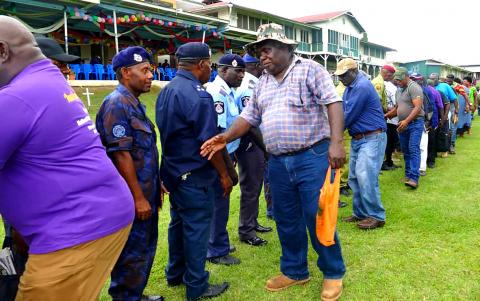
Photo: AFP
Now 50 years old, he still carries deep scars on his chest from a battle that left him unable to work.
However, he is adamant that reconciliation is the only way the next generation can enjoy a brighter future.
“We had enough loss, sorrow and pain,” he said during a reconciliation ceremony this week on the neighboring island of New Britain, where he fled.
“We don’t want to fight any more,” he added.
Tens of thousands like him were displaced as the internecine and complex conflict raged through the 1990s, amid extrajudicial executions, torture, mass killing and the arrival of foreign mercenaries from Britain and beyond.
“I killed one of my own cousins. I killed more people, but I have made compensation for the lives I took,” Diva said.
To cap the 20-year peace process, more than 200,000 Bougainvilleans are, from Nov. 23 on, to go to the ballot box to choose between independence from PNG or more autonomy.
The island territory’s residents — many of whom feel culturally closer to the nearby Solomon Islands than PNG, a complex patchwork of tribes and language groups — are expected to back independence.
The process then requires a “negotiated outcome” between the central and regional governments to achieve final status.
Since the truce, armed groups have been laying down their weapons and holding reconciliation ceremonies, seeking forgiveness for atrocities of the past.
Those ceremonies are now quickening in pace and carry extra weight ahead of the vote.
Self-styled “Melanesian brothers” meet to embark on symbolic customs, including sharing in the popular stimulant betel nut, breaking of bows and arrows, and planting coconut trees for peace.
Accompanying gun amnesties have so far netted thousands of weapons, but thousands more are believed to remain in circulation.
“We got it wrong in the start in 1989, that is why we lost men and women,” said Jerry Singarok, a retired PNG defense force commander, during the two-day ceremony in Kokopo.
Singarok was a key player in the conflict and blew the whistle on the “Sandline affair” — which saw a British company contracted by the PNG government sending mercenaries and military equipment to kill secessionist leaders in Bougainville.
At Kokopo, retired generals embraced ex-combatants, and tears were shed over wartime confessions, with Singarok calling on former PNG prime ministers and leaders to continue the healing process.
“We need those people in the past who were responsible for those decisions to come and say sorry,” he said.
In Bougainville’s old capital of Arawa, about 1,000 people gathered last week for a similar reconciliation ceremony.
A procession of women and children in tribal colors kicked off proceedings, followed by prayers before ex-combatants huddled in a circle with families seeking forgiveness for a long list of past grievances.
“Seeing the different groups forgive each other, it shows that we are just one big family,” Arawa village chief Mark Niniku said.
However, like similar reconciliation initiatives from South Africa to Rwanda, the process is designed as much to inoculate against further atrocities as to address the wrongs of the past.
“It is about rebuilding relationships,” Australian National University anthropologist Thiago Oppermann said.
“It is likely that there will be more problems and reconciliation, but that’s how it works. Living in a small community in Bougainville is a little bit like living in a shared house, where no one is ever evicted,” he said
“You just can’t vote people off the island, but there is a constant effort to make things work,” he added.
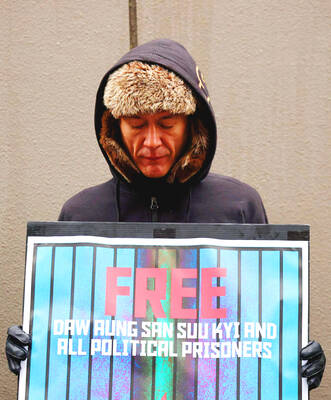
The Burmese junta has said that detained former leader Aung San Suu Kyi is “in good health,” a day after her son said he has received little information about the 80-year-old’s condition and fears she could die without him knowing. In an interview in Tokyo earlier this week, Kim Aris said he had not heard from his mother in years and believes she is being held incommunicado in the capital, Naypyidaw. Aung San Suu Kyi, a Nobel Peace Prize laureate, was detained after a 2021 military coup that ousted her elected civilian government and sparked a civil war. She is serving a
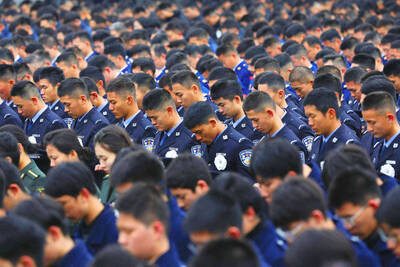
China yesterday held a low-key memorial ceremony for the 1937 Nanjing Massacre, with Chinese President Xi Jinping (習近平) not attending, despite a diplomatic crisis between Beijing and Tokyo over Taiwan. Beijing has raged at Tokyo since Japanese Prime Minister Sanae Takaichi last month said that a hypothetical Chinese attack on Taiwan could trigger a military response from Japan. China and Japan have long sparred over their painful history. China consistently reminds its people of the 1937 Nanjing Massacre, in which it says Japanese troops killed 300,000 people in what was then its capital. A post-World War II Allied tribunal put the death toll
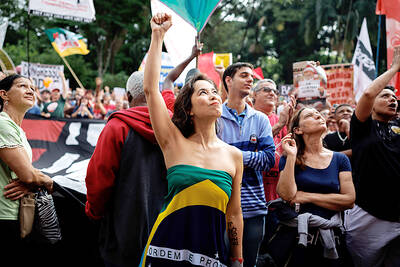
‘NO AMNESTY’: Tens of thousands of people joined the rally against a bill that would slash the former president’s prison term; President Lula has said he would veto the bill Tens of thousands of Brazilians on Sunday demonstrated against a bill that advanced in Congress this week that would reduce the time former president Jair Bolsonaro spends behind bars following his sentence of more than 27 years for attempting a coup. Protests took place in the capital, Brasilia, and in other major cities across the nation, including Sao Paulo, Florianopolis, Salvador and Recife. On Copacabana’s boardwalk in Rio de Janeiro, crowds composed of left-wing voters chanted “No amnesty” and “Out with Hugo Motta,” a reference to the speaker of the lower house, which approved the bill on Wednesday last week. It is
FALLEN: The nine soldiers who were killed while carrying out combat and engineering tasks in Russia were given the title of Hero of the Democratic People’s Republic of Korea North Korean leader Kim Jong-un attended a welcoming ceremony for an army engineering unit that had returned home after carrying out duties in Russia, North Korean state media KCNA reported on Saturday. In a speech carried by KCNA, Kim praised officers and soldiers of the 528th Regiment of Engineers of the Korean People’s Army (KPA) for “heroic” conduct and “mass heroism” in fulfilling orders issued by the ruling Workers’ Party of Korea during a 120-day overseas deployment. Video footage released by North Korea showed uniformed soldiers disembarking from an aircraft, Kim hugging a soldier seated in a wheelchair, and soldiers and officials


 RSS
RSS