


Deep in the rainforest of Rwanda’s Volcanoes National Park, a 23-year-old female gorilla named Kurudi feeds on a stand of wild celery. She bends the green stalks and, with long, careful fingers, peels off the exterior skin to expose the succulent inside.
Biologist Jean Paul Hirwa notes her meal on his tablet computer as he peers out from behind a nearby stand of stinging nettles.
The large adult male sitting next to her, known as a silverback, looks at him quizzically.
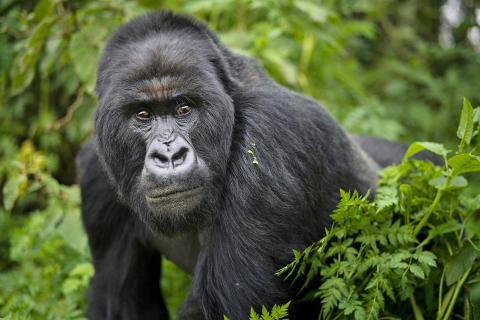
Photo: AP
Hirwa makes a low hum — “Ahh-mmm” — imitating the gorillas’ usual sound of reassurance.
“I’m here,” Hirwa is trying to say. “It’s OK. No reason to worry.”
Hirwa and the two great apes are all part of the world’s longest-running gorilla study — a project begun in 1967 by famed US primatologist Dian Fossey.
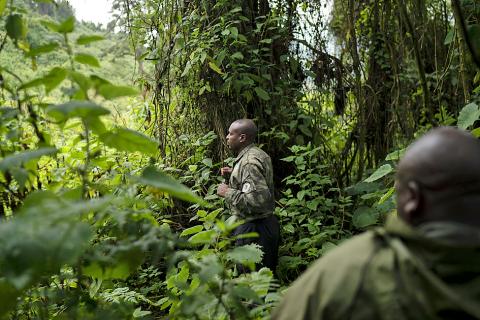
Photo: AP
Yet Fossey herself, who died in 1985, would likely be surprised that any mountain gorillas are still left to study.
Alarmed by rising rates of poaching and deforestation in central Africa, she predicted that the species could go extinct by 2000.
Instead, a concerted and sustained conservation campaign has averted the worst and given a second chance to these great apes, which share about 98 percent of human DNA.
Last fall, the Switzerland-based International Union for Conservation of Nature changed the status of mountain gorillas from “critically endangered” to “endangered,” an improved, if still-fragile designation.
Highly regulated tour groups hike in the Rwandan rainforest to watch gorillas.
Ticket revenue pays for operating costs and outstrips what might have been made from converting the rainforest to potato farms and cattle pastures.
“With tourism, the tension is always not to overexploit,” said Dirck Byler, great ape conservation director at the non-profit Global Wildlife Conservation. “But in Rwanda, so far they’re careful, and it’s working.”
The idea of using tourism to help fund conservation was contentious when conservationists Bill Weber and Amy Vedder first proposed it while living in Rwanda during the 1970s and 1980s. Fossey herself was skeptical.
“The wonder of the gorillas’ lives, their curiosity, their social interactions — that’s something that could be accessible to others through tourism,” Vedder said.
Jean Claude Masengesho lives with his parents and helps them farm potatoes. About once a week, the 21-year-old earns a little extra money helping tourists carry their bags up the mountain, totaling about US$45 a month. He would someday like to become a tour guide, which could earn him about US$320 monthly.
The obstacle is that most tour guides have attended college and Masengesho is not sure how his family can afford tuition.
“It’s my dream, but it’s very hard,” he said. “In this village, every young person’s dream is to work in the park.”

REVENGE: Trump said he had the support of the Syrian government for the strikes, which took place in response to an Islamic State attack on US soldiers last week The US launched large-scale airstrikes on more than 70 targets across Syria, the Pentagon said on Friday, fulfilling US President Donald Trump’s vow to strike back after the killing of two US soldiers. “This is not the beginning of a war — it is a declaration of vengeance,” US Secretary of Defense Pete Hegseth wrote on social media. “Today, we hunted and we killed our enemies. Lots of them. And we will continue.” The US Central Command said that fighter jets, attack helicopters and artillery targeted ISIS infrastructure and weapon sites. “All terrorists who are evil enough to attack Americans are hereby warned

‘POLITICAL LOYALTY’: The move breaks with decades of precedent among US administrations, which have tended to leave career ambassadors in their posts US President Donald Trump’s administration has ordered dozens of US ambassadors to step down, people familiar with the matter said, a precedent-breaking recall that would leave embassies abroad without US Senate-confirmed leadership. The envoys, career diplomats who were almost all named to their jobs under former US president Joe Biden, were told over the phone in the past few days they needed to depart in the next few weeks, the people said. They would not be fired, but finding new roles would be a challenge given that many are far along in their careers and opportunities for senior diplomats can

Seven wild Asiatic elephants were killed and a calf was injured when a high-speed passenger train collided with a herd crossing the tracks in India’s northeastern state of Assam early yesterday, local authorities said. The train driver spotted the herd of about 100 elephants and used the emergency brakes, but the train still hit some of the animals, Indian Railways spokesman Kapinjal Kishore Sharma told reporters. Five train coaches and the engine derailed following the impact, but there were no human casualties, Sharma said. Veterinarians carried out autopsies on the dead elephants, which were to be buried later in the day. The accident site

The death of a former head of China’s one-child policy has been met not by tributes, but by castigation of the abandoned policy on social media this week. State media praised Peng Peiyun (彭珮雲), former head of China’s National Family Planning Commission from 1988 to 1998, as “an outstanding leader” in her work related to women and children. The reaction on Chinese social media to Peng’s death in Beijing on Sunday, just shy of her 96th birthday, was less positive. “Those children who were lost, naked, are waiting for you over there” in the afterlife, one person posted on China’s Sina Weibo platform. China’s


 RSS
RSS