


Motorists in socialist Venezuela have long enjoyed the world’s cheapest gasoline, with fuel so heavily subsidized that a full tank these days costs a tiny fraction of US$0.01.
However, the economy is in such shambles that drivers are now paying for fill-ups with a little food, a candy bar or just a cigarette.
Bartering at the pump has taken off as hyperinflation has made Venezuela’s paper currency, the bolivar, hard to find and rendered some denominations all but worthless, so that nobody would accept them.
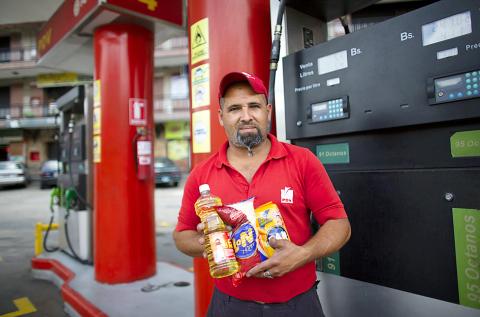
Photo: AP
Without cash in their wallets, drivers often hand gas station attendants a bag of rice, cooking oil or whatever is within reach.
“You can pay with a cigarette,” said Orlando Molina, filling up his subcompact Ford Ka in Caracas. “Heck, it’s no secret to anyone that it goes for nothing.”
Gas is so dirt-cheap that station attendants do not even know the price. Emptyhanded drivers get waved through, paying nothing at all.
This barter system, while perhaps the envy of cash-strapped drivers outside the country, is just another symptom of bedlam in Venezuela.
The South American nation of about 30 million people is gripped by a deepening political and economic crisis. People live with a nagging feeling that anything from violent street protests to a massive power failure could throw their lives into chaos at any moment.
More than 4 million Venezuelans have fled the country in the past few years, escaping low wages, broken hospitals, failing basic services and lack of security.
The IMF has said inflation is expected to hit a staggering 200,000 percent this year. Venezuela last year dropped five zeros from its currency in a futile attempt to keep up with inflation. Soaring prices quickly devoured the new denominations.
The smallest bill in circulation, 50 bolivars, is worth about one-quarter of US$0.01. City buses and even banks do not accept it, arguing it would take such a thick wad of bills to pay for even the most modest items that it would not be worth the trouble.
The largest bill, 50,000 bolivars, equals US$2.50.
Venezuela, which sits atop the world’s largest oil reserves, was once rich. However, the economy has fallen into ruin because of what critics said has been two decades of corruption and mismanagement under socialist rule.
Venezuelan President Nicolas Maduro’s hold on power is under challenge from Venezuelan National Assembly President Juan Guaido, who has the backing of the US and more than 50 other countries that contend Maduro’s re-election last year was crooked.
Gasoline prices are a deadly serious matter in Venezuela. About 300 people died in 1989 during riots that erupted after the president at the time ordered a modest rise in fuel prices.
Amid the economic crash, Maduro has not substantially raised gas prices, a strategy that was probably reinforced after violent protests recently forced the president of Ecuador to back off plans to end fuel subsidies there.
Maduro has acknowledged that the state-run oil company, PDVSA, loses billions of US dollars a year because of the discrepancy between the price of gasoline and the costs of production.
At the most, a tank of Venezuelan gasoline has historically cost the equivalent of a few US cents. Because of inflation and devaluation of the currency, that has plunged even further.
Caracas resident Maria Perez handed the attendant the equivalent of US$0.01, the smallest bill she had.
Most drivers would gladly pay the true price of gas if the government would use the proceeds to invest in services, she said.
“Our roads are unbearable,” she said while running errands on her day off with her mother in the passenger seat. “There are huge holes — craters — that not only damage our cars, but also put our own lives at risk.”
Gasoline in Caracas, the largest population center, has so far been immune from the shortages and kilometers-long lines that plague other parts of the country and can leave drivers waiting for days to reach the pump.
Officials have blamed the shortages on US sanctions against PDVSA.
Service station attendant Orlando Godoy stacked the food and drinks he received from drivers on top of the pumps — a bag of cooking flour, cooking oil, a bottle of mango juice.
He earns minimum wage, which amounts to a few US dollars a month, so the food helps feed his family.
“A lot of people show up saying they don’t have cash to pay,” he said. “The idea is to help people because Venezuelans are going through a rough situation.”

REVENGE: Trump said he had the support of the Syrian government for the strikes, which took place in response to an Islamic State attack on US soldiers last week The US launched large-scale airstrikes on more than 70 targets across Syria, the Pentagon said on Friday, fulfilling US President Donald Trump’s vow to strike back after the killing of two US soldiers. “This is not the beginning of a war — it is a declaration of vengeance,” US Secretary of Defense Pete Hegseth wrote on social media. “Today, we hunted and we killed our enemies. Lots of them. And we will continue.” The US Central Command said that fighter jets, attack helicopters and artillery targeted ISIS infrastructure and weapon sites. “All terrorists who are evil enough to attack Americans are hereby warned

The death of a former head of China’s one-child policy has been met not by tributes, but by castigation of the abandoned policy on social media this week. State media praised Peng Peiyun (彭珮雲), former head of China’s National Family Planning Commission from 1988 to 1998, as “an outstanding leader” in her work related to women and children. The reaction on Chinese social media to Peng’s death in Beijing on Sunday, just shy of her 96th birthday, was less positive. “Those children who were lost, naked, are waiting for you over there” in the afterlife, one person posted on China’s Sina Weibo platform. China’s
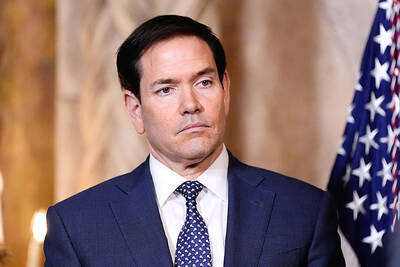
‘POLITICAL LOYALTY’: The move breaks with decades of precedent among US administrations, which have tended to leave career ambassadors in their posts US President Donald Trump’s administration has ordered dozens of US ambassadors to step down, people familiar with the matter said, a precedent-breaking recall that would leave embassies abroad without US Senate-confirmed leadership. The envoys, career diplomats who were almost all named to their jobs under former US president Joe Biden, were told over the phone in the past few days they needed to depart in the next few weeks, the people said. They would not be fired, but finding new roles would be a challenge given that many are far along in their careers and opportunities for senior diplomats can
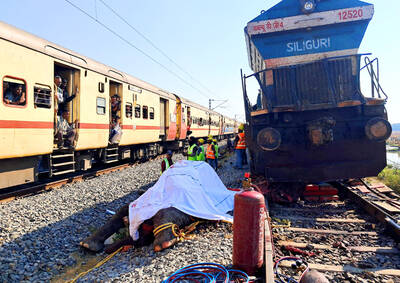
Seven wild Asiatic elephants were killed and a calf was injured when a high-speed passenger train collided with a herd crossing the tracks in India’s northeastern state of Assam early yesterday, local authorities said. The train driver spotted the herd of about 100 elephants and used the emergency brakes, but the train still hit some of the animals, Indian Railways spokesman Kapinjal Kishore Sharma told reporters. Five train coaches and the engine derailed following the impact, but there were no human casualties, Sharma said. Veterinarians carried out autopsies on the dead elephants, which were to be buried later in the day. The accident site


 RSS
RSS