


Tunisians yesterday headed to the polls for the third round of legislative elections since the country’s 2011 revolution, weeks after a presidential vote swept aside the post-Arab Spring political establishment.
Polling stations for the 7 million electorate were set to remain open until 6pm, with preliminary official results scheduled for Wednesday, although exit polls were expected late yesterday.
The vote comes two weeks after the first round of a presidential election that eclipsed traditional political parties in favor of independent candidates, a trend likely to be repeated in the ballot for members of parliament.
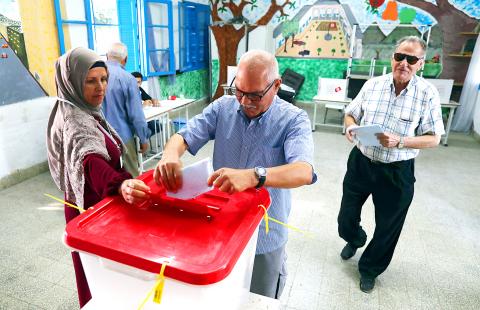
Photo: EPA-EFE
More than 15,000 candidates on 1,500 lists are contesting 217 seats in a parliament dominated by the Islamist-inspired Ennahdha in alliance with centrist party Nidaa Tounes that has been nearly destroyed by infighting.
At a polling station in central Tunis, voter Ribeh Hamdi, in her 60s, said she hoped the polls would bring “security and stability.”
Informal surveys, in the absence of opinion polls, predict Ennahdha would lose ground to the new Qalb Tounes (Heart of Tunisia) party of jailed business tycoon Nabil Karoui, who has reached a two-way runoff in the presidential contest, with voting scheduled for next Sunday.
The sidelining of the ruling political class in the first round on Sept. 15 was rooted in frustration over a stagnant economy, high unemployment, failing public services and rising prices.
Karoui, a media mogul held since August on money-laundering charges, came second behind Kais Saied, an independent law professor. Courts have rejected several appeals for his release during the campaign.
Interim Tunisian President Mohammed Ennaceur — filling in since the death of Beji Caid Essebsi in July brought forward the vote for head of state — on Friday said that Karoui’s detention could have “serious and dangerous repercussions on the electoral process.”
While the presidential race might have overshadowed the legislative contest, parliament is responsible for tackling the main challenges facing Tunisian society.
A strong showing for Qalb Tounes could bolster Karoui’s campaign and supporters say it could make a case for him to take over as prime minister if he loses to Saied.
The socially conservative professor has not come out in support of any party.
With the electorate fed up with political maneuvering and failure to improve living conditions since the ouster of longtime autocrat Zine El Abidine Ben Ali, new movements have been vying for votes.
Aich Tounsi, which calls itself an “anti-party,” has emerged from the civil society movement, while Islamist populist lawyer Seifeddine Makhlouf’s Karama aims to take seats from Ennahdha, which has been weakened by past alliances with political elites.
With the plethora of parties and movements in contention, the stage is set for complex and rowdy negotiations before any side emerges with the minimum 109 seats needed to head Tunisia’s next government.
In the run-up to the vote, Qalb Tounes and Ennahdha have officially ruled out forming an alliance.
Parliament will have two months to agree on the formation of a new government.

The death of a former head of China’s one-child policy has been met not by tributes, but by castigation of the abandoned policy on social media this week. State media praised Peng Peiyun (彭珮雲), former head of China’s National Family Planning Commission from 1988 to 1998, as “an outstanding leader” in her work related to women and children. The reaction on Chinese social media to Peng’s death in Beijing on Sunday, just shy of her 96th birthday, was less positive. “Those children who were lost, naked, are waiting for you over there” in the afterlife, one person posted on China’s Sina Weibo platform. China’s
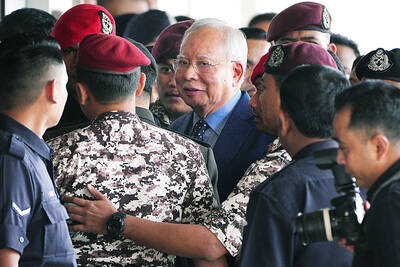
‘NO COUNTRY BUMPKIN’: The judge rejected arguments that former prime minister Najib Razak was an unwitting victim, saying Najib took steps to protect his position Imprisoned former Malaysian prime minister Najib Razak was yesterday convicted, following a corruption trial tied to multibillion-dollar looting of the 1Malaysia Development Berhad (1MDB) state investment fund. The nation’s high court found Najib, 72, guilty on four counts of abuse of power and 21 charges of money laundering related to more than US$700 million channeled into his personal bank accounts from the 1MDB fund. Najib denied any wrongdoing, and maintained the funds were a political donation from Saudi Arabia and that he had been misled by rogue financiers led by businessman Low Taek Jho. Low, thought to be the scandal’s mastermind, remains
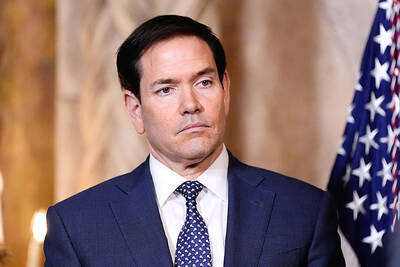
‘POLITICAL LOYALTY’: The move breaks with decades of precedent among US administrations, which have tended to leave career ambassadors in their posts US President Donald Trump’s administration has ordered dozens of US ambassadors to step down, people familiar with the matter said, a precedent-breaking recall that would leave embassies abroad without US Senate-confirmed leadership. The envoys, career diplomats who were almost all named to their jobs under former US president Joe Biden, were told over the phone in the past few days they needed to depart in the next few weeks, the people said. They would not be fired, but finding new roles would be a challenge given that many are far along in their careers and opportunities for senior diplomats can

Australian Prime Minister Anthony Albanese yesterday announced plans for a national bravery award to recognize civilians and first responders who confronted “the worst of evil” during an anti-Semitic terror attack that left 15 dead and has cast a heavy shadow over the nation’s holiday season. Albanese said he plans to establish a special honors system for those who placed themselves in harm’s way to help during the attack on a beachside Hanukkah celebration, like Ahmed al-Ahmed, a Syrian-Australian Muslim who disarmed one of the assailants before being wounded himself. Sajid Akram, who was killed by police during the Dec. 14 attack, and


 RSS
RSS