


A French man paralyzed in a night club accident can walk again thanks to a brain-controlled exoskeleton in what scientists on Wednesday said was a breakthrough, providing hope to tetraplegics seeking to regain movement.
The patient trained for months, harnessing his brain signals to control a computer-simulated avatar to perform basic movements before using the robot device to walk.
Doctors who conducted the trial cautioned that the device is years away from being publicly available, but added that it had “the potential to improve patients’ quality of life and autonomy.”
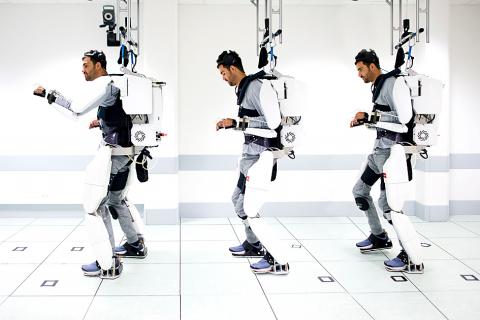
Photo: AFP / FONDS DE DOTATION CLINATEC - CLINATEC ENDOWMENT FUND
The man, identified only as Thibault, a 28-year-old from Lyon, said the technology had given him a new lease of life.
Four years ago that life changed forever when he fell 12m from a balcony while on a night out, severing his spinal cord and leaving him paralyzed from the shoulders down.
“When you’re in my position, when you can’t do anything with your body ... I wanted to do something with my brain,” Thibault said.
Training on a video-game avatar system for months to acquire the skills needed to operate the exoskeleton, he said he had to “relearn” natural movements from scratch.
“I can’t go home tomorrow in my exoskeleton, but I’ve got to a point where I can walk. I walk when I want and I stop when I want,” he said.
“The brain is still capable of generating commands that would normally move the arms and legs; there’s just nothing to carry them out,” said Alim-Louis Benabid, professor emeritus at Grenoble and lead author of the study published in The Lancet Neurology.
A team of experts from the Hospital of Grenoble Alpes, biomedical firm Cinatech and the CEA research center started by implanting two recording devices on either side of Thibault’s head, between the brain and the skin.
These read his sensorimotor cortex — the area that controls motor function. Each decoder transmits the brain signals, which are then translated by an algorithm into the movements the patient has thought about. It is this system that sends physical commands that the exoskeleton executes.
Thibault used the avatar and video game to think about performing basic physical tasks, such as walking and reaching out to touch objects.
Using the avatar, video game and exoskeleton combined, he was able to cover the length of one-and-a-half soccer pitches over the course of many sessions.
Several previous studies have used implants to stimulate muscles in patients’ own bodies, but the Grenoble study is the first to use brain signals to control a robot exoskeleton.

The death of a former head of China’s one-child policy has been met not by tributes, but by castigation of the abandoned policy on social media this week. State media praised Peng Peiyun (彭珮雲), former head of China’s National Family Planning Commission from 1988 to 1998, as “an outstanding leader” in her work related to women and children. The reaction on Chinese social media to Peng’s death in Beijing on Sunday, just shy of her 96th birthday, was less positive. “Those children who were lost, naked, are waiting for you over there” in the afterlife, one person posted on China’s Sina Weibo platform. China’s
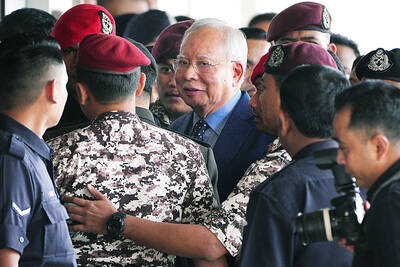
‘NO COUNTRY BUMPKIN’: The judge rejected arguments that former prime minister Najib Razak was an unwitting victim, saying Najib took steps to protect his position Imprisoned former Malaysian prime minister Najib Razak was yesterday convicted, following a corruption trial tied to multibillion-dollar looting of the 1Malaysia Development Berhad (1MDB) state investment fund. The nation’s high court found Najib, 72, guilty on four counts of abuse of power and 21 charges of money laundering related to more than US$700 million channeled into his personal bank accounts from the 1MDB fund. Najib denied any wrongdoing, and maintained the funds were a political donation from Saudi Arabia and that he had been misled by rogue financiers led by businessman Low Taek Jho. Low, thought to be the scandal’s mastermind, remains

‘POLITICAL LOYALTY’: The move breaks with decades of precedent among US administrations, which have tended to leave career ambassadors in their posts US President Donald Trump’s administration has ordered dozens of US ambassadors to step down, people familiar with the matter said, a precedent-breaking recall that would leave embassies abroad without US Senate-confirmed leadership. The envoys, career diplomats who were almost all named to their jobs under former US president Joe Biden, were told over the phone in the past few days they needed to depart in the next few weeks, the people said. They would not be fired, but finding new roles would be a challenge given that many are far along in their careers and opportunities for senior diplomats can

Australian Prime Minister Anthony Albanese yesterday announced plans for a national bravery award to recognize civilians and first responders who confronted “the worst of evil” during an anti-Semitic terror attack that left 15 dead and has cast a heavy shadow over the nation’s holiday season. Albanese said he plans to establish a special honors system for those who placed themselves in harm’s way to help during the attack on a beachside Hanukkah celebration, like Ahmed al-Ahmed, a Syrian-Australian Muslim who disarmed one of the assailants before being wounded himself. Sajid Akram, who was killed by police during the Dec. 14 attack, and


 RSS
RSS