


The Chinese military yesterday showed off new equipment at a parade in central Beijing to mark 70 years since the founding of the People’s Republic of China, including hypersonic-glide missiles that experts say could be difficult for the US to counter.
In a speech at the start of the nearly three-hour, highly choreographed spectacle, Chinese President Xi Jinping (習近平) said that his country would stay on the path of “peaceful development,” but that the military would resolutely safeguard the nation’s sovereignty and security.
China said the parade — the nation’s most important political event of the year, which featured more than 15,000 troops marching through part of Tiananmen Square as jet fighters trailing colored smoke soared overhead — is not meant to intimidate any specific country.
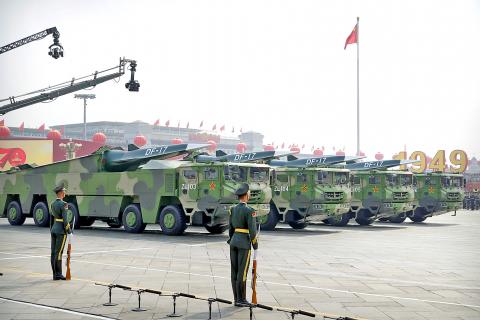
Photo: AP
However, defense experts see it as a message to the world that China’s military prowess is growing rapidly, even as it faces mounting challenges, including months of anti-government protests in Hong Kong and a slowing economy.
As expected, China unveiled new unmanned aerial vehicles (UAVs) and showcased its advancing intercontinental and hypersonic missiles, designed to attack the aircraft carriers and bases that undergird US military strength in Asia.
A state television announcer called the missile arsenal a “force for realizing the dream of a strong nation and strong military.”
Among the weapons were the “carrier killer” Dongfeng-21D (DF-21D), unveiled at military parade in 2015, designed to hit warships at sea at a range of up to 1,500km, and the DF-26 intermediate range missile, dubbed “Guam killer,” in reference to the US Pacific island base.
The People’s Liberation Army (PLA) also rolled out a hypersonic missile, known as the DF-17, which theoretically can maneuver sharply at many times the speed of sound, making it extremely difficult to counter.
Nozomu Yoshitomi, professor at Japan’s Nihon University and a retired major general in Japan’s Ground Self-Defence Force, said the DF-17 posed serious questions about the effectiveness of the regional missile defense system the US and Japan are building.
“There is a possibility that if we do not acquire a more sophisticated ballistic missile defense system, it will become impossible for both the United States and Japan to respond,” Yoshitomi said.
Bringing up the rear of the ground parade were 16 upgraded launchers carrying DF-41 intercontinental ballistic missiles, which are the backbone of China’s nuclear deterrent, capable of reaching the US with multiple nuclear warheads.
State media said 40 percent of the arms shown in the parade were appearing in public for the first time. Such hardware included new and revamped versions of missiles, such as the long-range submarine-launched and ship-based YJ-18A anti-ship cruise missiles, Xinhua news agency said.
China has a practice of only displaying systems in parades it says have entered some form of service, though analysts have cautioned that some of the new equipment could be experimental or prototypes.
For instance, the Gongji-11, described by the state-controlled Global Times as an attack drone and the “final version” of the Sharp Sword drone that first flew in 2013, was displayed for the first time on the back of a truck.
China showed jets in aerial refueling formation, and the Z-20 medium lift helicopter, similar to a US UH-60 Black Hawk, also made its public debut, Xinhua said.

The death of a former head of China’s one-child policy has been met not by tributes, but by castigation of the abandoned policy on social media this week. State media praised Peng Peiyun (彭珮雲), former head of China’s National Family Planning Commission from 1988 to 1998, as “an outstanding leader” in her work related to women and children. The reaction on Chinese social media to Peng’s death in Beijing on Sunday, just shy of her 96th birthday, was less positive. “Those children who were lost, naked, are waiting for you over there” in the afterlife, one person posted on China’s Sina Weibo platform. China’s
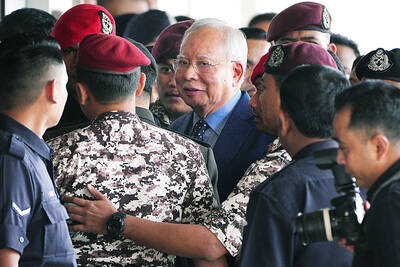
‘NO COUNTRY BUMPKIN’: The judge rejected arguments that former prime minister Najib Razak was an unwitting victim, saying Najib took steps to protect his position Imprisoned former Malaysian prime minister Najib Razak was yesterday convicted, following a corruption trial tied to multibillion-dollar looting of the 1Malaysia Development Berhad (1MDB) state investment fund. The nation’s high court found Najib, 72, guilty on four counts of abuse of power and 21 charges of money laundering related to more than US$700 million channeled into his personal bank accounts from the 1MDB fund. Najib denied any wrongdoing, and maintained the funds were a political donation from Saudi Arabia and that he had been misled by rogue financiers led by businessman Low Taek Jho. Low, thought to be the scandal’s mastermind, remains

‘POLITICAL LOYALTY’: The move breaks with decades of precedent among US administrations, which have tended to leave career ambassadors in their posts US President Donald Trump’s administration has ordered dozens of US ambassadors to step down, people familiar with the matter said, a precedent-breaking recall that would leave embassies abroad without US Senate-confirmed leadership. The envoys, career diplomats who were almost all named to their jobs under former US president Joe Biden, were told over the phone in the past few days they needed to depart in the next few weeks, the people said. They would not be fired, but finding new roles would be a challenge given that many are far along in their careers and opportunities for senior diplomats can

Australian Prime Minister Anthony Albanese yesterday announced plans for a national bravery award to recognize civilians and first responders who confronted “the worst of evil” during an anti-Semitic terror attack that left 15 dead and has cast a heavy shadow over the nation’s holiday season. Albanese said he plans to establish a special honors system for those who placed themselves in harm’s way to help during the attack on a beachside Hanukkah celebration, like Ahmed al-Ahmed, a Syrian-Australian Muslim who disarmed one of the assailants before being wounded himself. Sajid Akram, who was killed by police during the Dec. 14 attack, and


 RSS
RSS