


PAKISTAN
Mob attacks temple, school
A crowd ransacked a school and Hindu temple after a Hindu principal was accused of blasphemy, police said yesterday. The violence erupted in the southern province of Sindh after a student accused the Hindu principal of blasphemy in comments about the Muslim Prophet Mohammed. The enraged crowd ransacked the school and damaged a nearby temple, a district police chief said. The principal had been taken into protective custody and police were investigating the alleged blasphemy and the rioters, he added. “It seems the principal had not done anything intentionally,” district police chief Furrukh Ali said.
INDIA
Angry bees delay flight
An Air India flight on Sunday was delayed by three-and-a-half hours after a swarm of bees landed on the cockpit window, officials said. The insects landed on the window just before the plane was due to leave Kolkata for Agartala with 136 passengers, including Bangladesh’s information minister. Ground staff tried to shoo the insects off, angering them, and when attempts to use the windscreen wipers failed, officials switched to “Plan B” and blasted them off with water. “Fire tenders were deployed to spray water to dislodge the honey bees and they could be driven away after nearly an hour-long operation,” airport official Kaushik Bhattcharya said.
JAPAN
Outage hits 80,000 homes
About 78,700 households were still without power in Chiba after a powerful typhoon battered the east, Tokyo Electric spokesman Naoya Kondo said yesterday. Typhoon Faxai powered into the Tokyo region in the early hours of Monday last week, packing record winds that brought down power lines and prompted the government to order tens of thousands of people to leave their homes. The storm killed two people and at least three elderly people later died due to heatstroke as temperatures soared above 35°C in areas affected by a post-typhoon blackout. The national weather agency yesterday issued new warnings for heavy rain in Chiba, while local authorities issued non-compulsory evacuation orders to 46,300 people due to the risk of landslides.
SPAIN
Court rejects extradition
The High Court yesterday ruled that the government should refuse a request from the US that it extradite Venezuela’s former military intelligence chief. Former general Hugo Carvajal was arrested on drug trafficking charges by Spanish police in April at the request of Washington, which believes he would share incriminating information about Venezuelan President Nicolas Maduro. Carvajal, an ally of former Venezuelan president Hugo Chavez, has turned against Maduro.
SOUTH KOREA
Eatery removes Kim images
You can sell North Korean food in South Korea, but you will get into trouble if you decorate your restaurant with something deemed praising Pyongyang. Authorities said the owner of a Seoul restaurant under construction yesterday removed signs with the portrait of North Korean leaders and the image of a North Korean flag from the restaurant’s exterior wall. The restaurant had been criticized over the weekend after local media published those signs. Police said they are investigating if the owner breached security laws that punish an act of praising North Korea with up to seven years in prison. The owner said that the North Korea-themed exterior decoration would draw more attention and help him make profits.
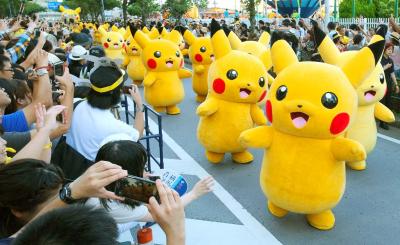
China’s military news agency yesterday warned that Japanese militarism is infiltrating society through series such as Pokemon and Detective Conan, after recent controversies involving events at sensitive sites. In recent days, anime conventions throughout China have reportedly banned participants from dressing as characters from Pokemon or Detective Conan and prohibited sales of related products. China Military Online yesterday posted an article titled “Their schemes — beware the infiltration of Japanese militarism in culture and sports.” The article referenced recent controversies around the popular anime series Pokemon, Detective Conan and My Hero Academia, saying that “the evil influence of Japanese militarism lives on in

DIPLOMATIC THAW: The Canadian prime minister’s China visit and improved Beijing-Ottawa ties raised lawyer Zhang Dongshuo’s hopes for a positive outcome in the retrial China has overturned the death sentence of Canadian Robert Schellenberg, a Canadian official said on Friday, in a possible sign of a diplomatic thaw as Canadian Prime Minister Mark Carney seeks to boost trade ties with Beijing. Schellenberg’s lawyer, Zhang Dongshuo (張東碩), yesterday confirmed China’s Supreme People’s Court struck down the sentence. Schellenberg was detained on drug charges in 2014 before China-Canada ties nosedived following the 2018 arrest in Vancouver of Huawei chief financial officer Meng Wanzhou (孟晚舟). That arrest infuriated Beijing, which detained two Canadians — Michael Spavor and Michael Kovrig — on espionage charges that Ottawa condemned as retaliatory. In January

A sign hanging from a rusty ice-green shipping container installed by Thai forces on what they say is the border with Cambodia reads: “Cambodian citizens are strictly prohibited from entering this area.” On opposite sides of the makeshift barricade, fronted by coils of barbed wire, Cambodians lamented their lost homes and livelihoods as Thailand’s military showed off its gains. Thai forces took control of several patches of disputed land along the border during fighting last year, which could amount to several square kilometers in total. Cambodian Kim Ren said her house in Chouk Chey used to stand on what is now the Thai
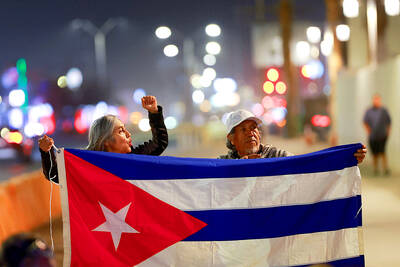
NEW RULES: There would be fewer school days, four-day workweeks, and a reduction in transportation services as the country battles a crisis exacerbated by US pressure The Cuban government on Friday announced emergency measures to address a crippling energy crisis worsened by US sanctions, including the adoption of a four-day work week for state-owned companies and fuel sale restrictions. Cuban Deputy Prime Minister Oscar Perez-Oliva Fraga blamed Washington for the crisis, telling Cuban television the government would “implement a series of decisions, first and foremost to guarantee the vitality of our country and essential services, without giving up on development.” “Fuel will be used to protect essential services for the population and indispensable economic activities,” he said. Among the new measures are the reduction of the working week in


 RSS
RSS