


Famed for valuing Gross National Happiness over economic growth, Bhutan is a poster child for sustainable development. However, booming car sales might impact efforts to preserve its rare status as a carbon negative country — and an increase in traffic is testing the good humor of its citizens.
Bhutan has seen a more than five-fold increase in cars, buses and trucks on its roads in the past two decades, Bhutanese Road Safety and Transport Authority Director-General Pemba Wangchuk said, with the capital, Thimphu, hardest hit by the influx of vehicles.
Phuntsho Wangdi, a media consultant, said the congestion and lack of parking make driving stressful in the tiny Himalayan kingdom where there are no traffic lights.
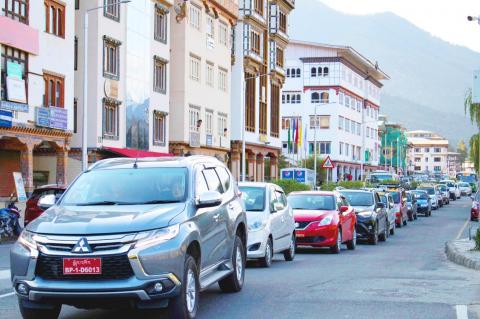
Photo: AFP
“I wish there were fewer cars. It wasn’t like this before,” he said of life in Thimphu, which is home to half the vehicles in the nation.
The Bhutanese economy has grown 7.5 percent each year in the past decade, according to the World Bank.
Officials estimate there is now one car for every seven people in Bhutan, which has a total population of 750,000.
However, the nation’s narrow country lanes and outdated city roads can barely cope.
A lack of infrastructure, along with poor driving etiquette — some simply leave their cars parked in the middle of the road — compounds the problem.
“Every year the number of cars and the number of people are increasing, and the roads have remained the same, and it’s a problem for us,” taxi driver Lhendup said.
Morning rush hour journeys that once took five minutes now take more than half an hour. This might seem a small figure compared with the hours of gridlock faced by commuters in Manila, Jakarta and Bangkok, but it is a step-change for the Bhutanese who say the situation has rapidly deteriorated in the past year.
“Its chaotic. I eat my breakfast in the car now to save time,” said Kuenzang Choden, who drops her four-year-old daughter at school every day before heading to work.
The traffic jams are a sign of the wider economic changes the nation is facing.
Bhutan is renowned for prioritizing Gross National Happiness over GDP, and has captured tourists’ imagination as a tranquil, idyllic land, but there are signs of malcontent.
According to last year’s World Bank report, the youth unemployment rate is high, as is rural-to-urban migration, which puts a strain on the resources of towns and cities.
The proliferation of the Internet and smartphones are fueling modern desires, while dealers are filling their showrooms with new brands and models from Japan and South Korea to lure buyers.
And while taxes have increased and restrictions put on vehicle loans, car buyers are not discouraged.
Local financial institutions gave 3.2 billion ngultrum (US$46 million) in car loans in 2015, but by last year the amount had reached 6.7 billion ngultrum.
The figures please local businesspeople, but worry environmentalists keen to ensure Bhutan remains one of the world’s greenest countries.
“As a nation that prides itself on being a carbon-negative country, the increase in the number of fossil fuel vehicles speaks poorly of our leadership position in environmental conservation,” environmental activist Yeshey Dorji said.
Bhutan and Suriname, both with lush forests, are the only two countries to claim they are carbon negative, absorbing more carbon pollution than they give off.
Methane from cows, the burning of crops and other farm activities used to be Bhutan’s main source of greenhouse gases — but that has changed in recent years to industry and cars.
Bhutan’s constitution dictates that at least 60 percent of the country must be forest and the figure is currently above 70 percent.
However, the nation is now importing more in fossil fuels than it exports in hydropower to India — the nation’s biggest revenue earner.
Public transport is poor, particularly in Thimphu, which is home to 100,000 people, but barely 40 buses.
Thimphu Mayor Kinlay Dorji plans to introduce bus-only lanes on city roads and wants to buy more buses.
“Its time for radical measures,” he said.
“We have to make public transport more attractive and discourage owning cars,” he said, adding that unless action was taken, Thimphu risked grinding to a standstill.
To ease congestion, the city is also constructing its first two multi-story car parks that will each take about 600 cars.
The National Environment Commission insists Bhutan is still carbon negative despite the traffic jams and vehicle boom, but wants to stop things worsening.
“We cannot stop people from buying cars, but we can introduce alternative, less polluting cars such as the hybrid and electric ones to reduce carbon footprint,” commission Secretary Dasho Sonam Wangdi said.

Through the noise of rushing papers and whirring belts at a print factory in Kyoto, two creators watch their photo essay come to life in broadsheet form — part of an effort to win new audiences in the age of artificial intelligence (AI). Despite the decline of the publishing industry, self-publication and handmade “zine” magazines are growing in popularity in Japan, reflecting the nation’s enduring love of paper in the digital era. While speaking to Agence France-Presse at the plant, his hands black with ink, one of the creators, Kazuma Obara, said: “I think [paper] is a medium that engages all five

‘CROSSING THE LINE’: China’s embassy in Seoul criticized US Forces Korea Commander General Xavier Brunson, asking if his ‘hostile’ remarks were authorized by Washington South Korea and the US are in talks over recent public remarks by the commander of US Forces Korea, Seoul’s presidential office said yesterday, after the comments drew sharp criticism from China. In a recent podcast interview, US Forces Korea Commander General Xavier Brunson described South Korea as “the dagger in the heart of Asia” from China’s east coast, prompting the Chinese embassy in Seoul to say that he had “truly crossed the line.” The interview came amid growing speculation that Washington might seek to expand the role of US Forces Korea in countering the growing regional influence of China, a key

Australian researchers have trained lab-grown brain cells on a silicon computer chip to play the 1990s shooter game Doom and said they are just scratching the surface of what the neurons could be capable of doing. It is the science-fiction work of biotech boffins at Cortical Labs, who researched and developed the technology that harnesses the workings of the brain’s networking system. Each so-called “biological computer” contains about 200,000 living human brain cells, grown from stem cells that were harvested from blood donations. Having mastered the simple computer game Pong, where a paddle is moved up and down to send a ball

France experienced its hottest spring on record, the French weather service said on Tuesday, after an exceptional early heat wave that also broke highs for the season in England and Wales. Meteo-France said the average nationwide temperature over March to May was 13.8°C — about 1.7°C above the norm, and surpassing records set in 2011 and 2020. “The warmest spring since records began in 1900,” it said in a bulletin. All three months were warmer than average, but the onset of an “unprecedented heatwave” late last month pushed the mercury to highs typically seen at the height of the summer. “Our country had never


 RSS
RSS