


An Australian student released after a week in detention in North Korea yesterday described his condition to reporters in Beijing as “very good” without saying what happened.
Australian Prime Minister Scott Morrison announced to parliament that 29-year-old Alek Sigley had been released hours earlier following intervention from Swedish diplomats on Wednesday and had been taken to the Australian embassy in Beijing.
Sigley looked relaxed on arriving at Beijing Capital International Airport. He did not respond to reporters’ questions about what had happened in Pyongyang.
“I’m OK, I’m OK, I’m good. I’m very good,” Sigley said.
His father, Gary Sigley, said his son would soon be reunited with his Japanese wife, Yuka Morinaga, in Tokyo.
“He’s fine. He’s in very good spirits. He’s been treated well,” Gary Sigley told reporters in his hometown of Perth.
Alek Sigley’s friend and fellow student of North Korea, University of Technology Sydney academic Bronwyn Dalton, said that she had spoken to his wife, who was thrilled by the news.
“We were jumping up and down and we love Sweden,” Dalton told the Australian Broadcasting Corp.
“He’s a fine, young, emerging Asian scholar, he is very applied to his studies. I really doubted whether he did actually anything wrong by the regime,” Dalton said.
Swedish diplomats had raised concerns about Alek Sigley with North Korean authorities in Pyongyang, where Australia does not have an embassy.
“Alek is safe and well. Swedish authorities advised the Australian government that they met with senior officials from the DPRK yesterday and raised the issue of Alek’s disappearance on Australia’s behalf,” Morrison said, using the acronym for North Korea’s official name, the Democratic People’s Republic of Korea.
Morrison thanked Swedish authorities for “their invaluable assistance in securing Alek’s prompt release.”
“This outcome demonstrates the value of discrete behind-the-scenes work of officials in resolving complex and sensitive consular cases in close partnership with other governments,” Morrison said.
The university student and tour guide had been out of contact with family and friends in Japan and Australia since Tuesday last week.
He had been active in social media about his experiences in North Korea and had boasted about the extraordinary freedom he had been allowed as one of the few foreign students living in Pyongyang.
Morrison’s announcement was the first confirmation that he had been detained.
Morrison said that he discussed Alek Sigley’s disappearance with other world leaders attending the G20 summit last week and accepted offers to find out what happened to him.
Morrison had dined with US President Donald Trump in Osaka, Japan, but declined to say with whom he had discussed Alek Sigley’s disappearance.
North Korea has been accused of detaining Westerners and using them as political pawns to gain concessions.
Australia advises its people to reconsider their need to travel to North Korea and warns that foreigners have been subject to arbitrary arrests and long detentions.
Leonid Petrov, an Australian National University expert on North Korea, last week speculated that Alek Sigley had been “deliberately cut off from means of communications” temporarily because Trump was in the region.
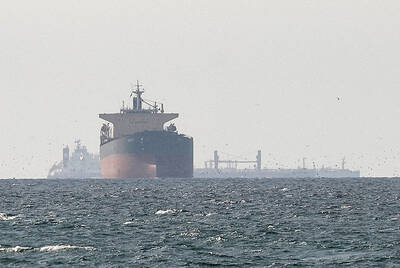
A ship that appears to be taking on the identity of a scrapped gas carrier exited the Strait of Hormuz on Friday, showing how strategies to get through the waterway are evolving as the Middle East war progresses. The vessel identifying as liquefied natural gas (LNG) carrier Jamal left the Strait on Friday morning, ship-tracking data show. However, the same tanker was also recorded as having beached at an Indian demolition yard in October last year, where it is being broken up, according to market participants and port agent’s reports. The ship claiming to be Jamal is likely a zombie vessel that

German Chancellor Friedrich Merz’s conservative Christian Democratic Union (CDU) yesterday faced a regional election battle in Rhineland-Palatinate, now held by the center-left Social Democratic Party (SPD). Merz’s CDU has enjoyed a narrow poll lead over the SPD — their coalition partners at the national level — who have ruled the mid-sized state for 35 years. Polling third is the far-right Alternative for Germany (AfD), which spells a greater threat to the two centrist parties in several state elections in September in the country’s ex-communist east. The picturesque state of Rhineland-Palatinate, bordering France, Belgium and Luxembourg and with a population of about 4 million,
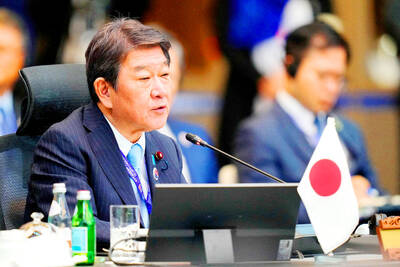
LAW CONSTRAINTS: The US has been pressing allies to send warships to open the Strait, but Tokyo’s military actions are limited under its postwar pacifist constitution Japan could consider deploying its military for minesweeping in the Strait of Hormuz if a ceasefire is reached in the war on Iran, Japanese Minister of Foreign Affairs Toshimitsu Motegi said yesterday. “If there were to be a complete ceasefire, hypothetically speaking, then things like minesweeping could come up,” Motegi said. “This is purely hypothetical, but if a ceasefire were established and naval mines were creating an obstacle, then I think that would be something to consider.” Japan’s military actions are limited under its postwar pacifist constitution, but 2015 security legislation allows Tokyo to use its Self-Defense Forces overseas if an attack,

Ugandan wildlife authorities have reintroduced rhinos into a remote protected area where they were once poached into extinction, an event seen by conservationists as a milestone in efforts to support the recovery of a species threatened by poaching. On Tuesday, two southern white rhinos from a private ranch in the East African country were reintroduced into Kidepo Valley National Park in the country’s northeast. Two more rhinos in metallic crates arrived on Thursday. There have been no rhinos in the park since 1983, the result of poaching. However, a private ranch in central Uganda — the Ziwa Rhino Sanctuary — has been


 RSS
RSS