


The New Zealand government yesterday launched a six-month, multimillion-dollar “buy-back” scheme to compensate owners of powerful, but newly banned semi-automatic weapons prohibited in the wake of deadly attacks on two mosques in the southern city of Christchurch.
New Zealand Minister of Finance Grant Robertson and Minister of Police Stuart Nash said in a joint e-mailed statement that NZ$208 million (US$136 million) had been set aside to compensate owners of the banned semi-automatic firearms up to 95 percent of the original cost.
They would have until Dec. 20 to hand in their weapons.
“Police have detailed plans in place for the next step, which is the collection of firearms from the community. It will be a huge logistical exercise and is expected to get under way in mid-July,” Nash said.
Parliament passed the gun reform law — the first substantial changes to the nation’s gun laws in decades — by a vote of 119 to 1 in April.
The vote came less than a month after the nation’s worst-ever peacetime mass shooting in which 51 people were killed and dozens injured in attacks on two mosques in Christchurch.
The new curbs bar the circulation and use of most semi-automatic firearms, parts that convert firearms into semi-automatic firearms, magazines over a certain capacity and some shotguns.
Existing gun laws had provided for a standard “A-category” gun license covering semi-automatics limited to seven shots.
Police forecast that about 14,300 semi-automatics would be covered by the new legislation, though the government said it was difficult to predict the exact number.
Almost 700 weapons had already been handed in before the compensation scheme was launched and almost 5,000 had been registered by owners with police while they awaited collection.
“There is high uncertainty around any [costs], owing to the lack of information on the number of prohibited items, their type and condition,” Robertson said, adding that better estimates of the total cost would be available once the buy-back was under way and the government would top up the amount if needed.
The government has also begun work on a second arms amendment bill to tackle issues regarding a gun registry, among other things.
New Zealand Prime Minister Jacinda Ardern on Monday told reporters that she expected the government to announce its plans for the law in the next few weeks.
With a population of just under 5 million, New Zealand is home to an estimated total of 1.5 million firearms, making it the nation with the 17th-highest rate of civilian firearm ownership in the world, according to the Small Arms Survey.
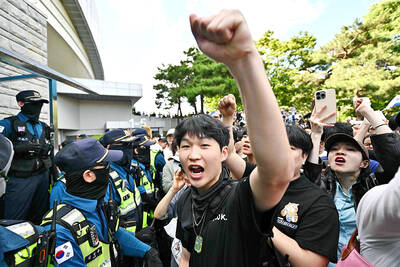
‘ABSURD MISTAKE’: The election commission said that there had been a failure to anticipate turnout after 14 polling stations ran short of ballot papers South Korean riot police yesterday cleared protesters from a Seoul polling station after a 35-hour blockade sparked by a shortage of ballot papers during local elections earlier this week. Wednesday’s election was the first nationwide vote since South Korean President Lee Jae-myung took office following the ouster of Yoon Suk-yeol over his short-lived martial law declaration. Lee’s ruling Democratic Party swept most races, but failed to flip the crucial Seoul mayoral seat. The South Korean National Election Commission apologized, blaming a failure to anticipate turnout after 14 polling stations in Seoul ran short of ballot papers. Some polling stations stayed open until 10pm to

France experienced its hottest spring on record, the French weather service said on Tuesday, after an exceptional early heat wave that also broke highs for the season in England and Wales. Meteo-France said the average nationwide temperature over March to May was 13.8°C — about 1.7°C above the norm, and surpassing records set in 2011 and 2020. “The warmest spring since records began in 1900,” it said in a bulletin. All three months were warmer than average, but the onset of an “unprecedented heatwave” late last month pushed the mercury to highs typically seen at the height of the summer. “Our country had never
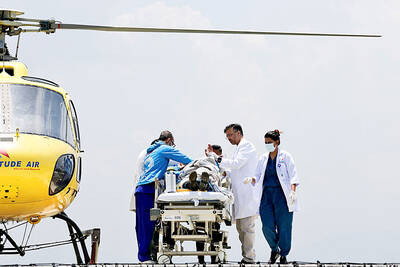
A Sherpa guide was found crawling to base camp on Mount Everest a week after he went missing and was reunited with his family, who had given up hope he would return. Dawa Sherpa was last seen on Friday last week descending the mountain, but he did not reach base camp even though his client did. The pair were among the last climbers on the mountain as the climbing season came to an end and the route was dismantled. Dawa was located by a cleaning crew on Thursday morning as he was crawling down the snowy slopes around the Khumbu Icefall, just above
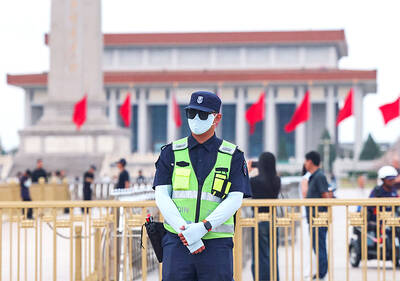
Chinese authorities are snuffing out any remembrance of the deadly 1989 military crackdown on student-led pro-democracy protests in Tiananmen Square, which happened 37 years ago yesterday, in a further tightening of a years-long campaign to erase what happened from public memory. Police told relatives of the victims they would not be allowed to visit a cemetery in Beijing on the anniversary of the crackdown, a person with knowledge of the matter said. Relatives of the victims visited the cemetery on the anniversary for more than 30 years to read memorial statements with police keeping watch, Amnesty International said. Hundreds of people,


 RSS
RSS