


A herd of endangered deer wait under the shade of one of the sparse trees in the parched landscape of central Myanmar, watching as rangers dispatch drinking water — a life-saving resource funded by wellwishers across the country.
Shwe Settaw Nature Reserve in Magway Division is home to the endemic species of Eld’s, or golden, deer. However, their habitat lies in the nation’s central dry zone, a low-lying plain astride the Irrawaddy River where water shortages are rife in the hot season. This year temperatures have soared to a record 47°C.
The sanctuary’s 20-odd lakes and ponds — a lifeline for the deer, wild boar, jackals, peacocks and other creatures — have all dried up.
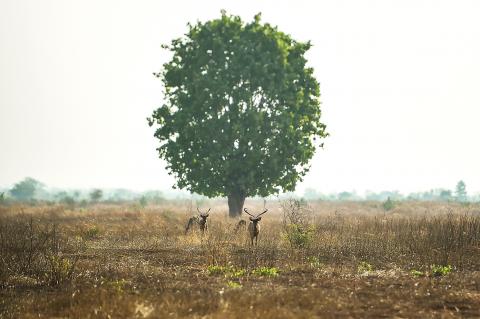
Photo: AFP
In one lake bed, a water depth-measuring rod stands marooned in the middle of a mosaic of cracked, arid earth.
Many of the park’s estimated 1,000 deer started venturing dangerously close to villages outside the reserve, putting themselves at risk of poaching, rangers say.
At the end of last month, the park’s dozen rangers started pooling their money to travel to a nearby river to collect water and refill a couple of the scorched craters.
After realizing that this was unsustainable, they turned to Facebook for help.
Donations poured in from as far away as Yangon, Mandalay and Shan state.
“Luckily, it really captured people’s interest,” ranger Thein Lwin tells reporters with a smile, adding that within a few days they had received more than 1 million kyat (US$650).
The sum is enough to pay for the petrol and fees needed to hire water-carrying tankers that take six daily trips to a small river about 15km away. Each tanker holds about 4,500 liters of water.
They have even stopped accepting money on the assumption that the funds will see them through to the monsoon season in the coming weeks.
In another section of the reserve, a breeding program for the critically endangered Burmese star tortoise faces similar problems.
“We lost some tortoises because of the extreme heat,” says Steve Platt, a herpetologist with the World Conservation Society.
“That doesn’t happen every year. Three or four — we just found them dead,” he says.
However, the plight of the park’s fauna will not end when the rains arrive.
The sanctuary is the center of an ongoing conflict between conservationists and local people, some of Myanmar’s poorest.
About 40 villages lie close to the reserve — most without electricity — and many people enter to search for firewood.
Poaching is also a huge problem in a country where the illegal trade of wildlife parts flourishes, due largely to the insatiable appetite from neighboring China.
“We need more guard posts and more staff,” the ranger says with a sigh. “The deer’s future is at stake.”

Through the noise of rushing papers and whirring belts at a print factory in Kyoto, two creators watch their photo essay come to life in broadsheet form — part of an effort to win new audiences in the age of artificial intelligence (AI). Despite the decline of the publishing industry, self-publication and handmade “zine” magazines are growing in popularity in Japan, reflecting the nation’s enduring love of paper in the digital era. While speaking to Agence France-Presse at the plant, his hands black with ink, one of the creators, Kazuma Obara, said: “I think [paper] is a medium that engages all five

‘CROSSING THE LINE’: China’s embassy in Seoul criticized US Forces Korea Commander General Xavier Brunson, asking if his ‘hostile’ remarks were authorized by Washington South Korea and the US are in talks over recent public remarks by the commander of US Forces Korea, Seoul’s presidential office said yesterday, after the comments drew sharp criticism from China. In a recent podcast interview, US Forces Korea Commander General Xavier Brunson described South Korea as “the dagger in the heart of Asia” from China’s east coast, prompting the Chinese embassy in Seoul to say that he had “truly crossed the line.” The interview came amid growing speculation that Washington might seek to expand the role of US Forces Korea in countering the growing regional influence of China, a key

Australian researchers have trained lab-grown brain cells on a silicon computer chip to play the 1990s shooter game Doom and said they are just scratching the surface of what the neurons could be capable of doing. It is the science-fiction work of biotech boffins at Cortical Labs, who researched and developed the technology that harnesses the workings of the brain’s networking system. Each so-called “biological computer” contains about 200,000 living human brain cells, grown from stem cells that were harvested from blood donations. Having mastered the simple computer game Pong, where a paddle is moved up and down to send a ball

France experienced its hottest spring on record, the French weather service said on Tuesday, after an exceptional early heat wave that also broke highs for the season in England and Wales. Meteo-France said the average nationwide temperature over March to May was 13.8°C — about 1.7°C above the norm, and surpassing records set in 2011 and 2020. “The warmest spring since records began in 1900,” it said in a bulletin. All three months were warmer than average, but the onset of an “unprecedented heatwave” late last month pushed the mercury to highs typically seen at the height of the summer. “Our country had never


 RSS
RSS