


The Amritsar massacre, 100 years ago yesterday in which British troops opened fire on thousands of unarmed protesters, remains one of the darkest hours of British colonial rule in India.
Known in India as the Jallianwala Bagh massacre, it is still an emotive subject, with many demanding a British apology — which so far has been unforthcoming.
The number of casualties on April 13, 1919, is unclear, with colonial-era records showing 379 deaths, while Indian figures put the number at closer to 1,000.
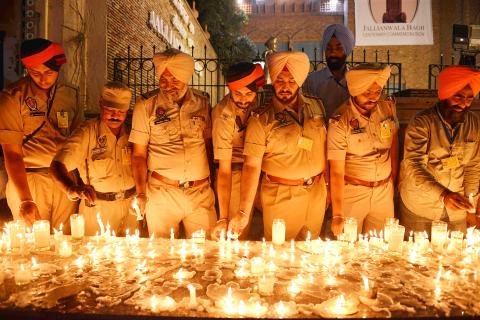
Photo: AFP
In March 1919, the British colonial government passed the Anarchical and Revolutionary Crimes Act, or the Rowlatt Act, extending repressive measures in force during World War I.
These included incarceration without trial and caused widespread anger, particularly in the northern Punjab region, with Mahatma Gandhi calling for a nationwide general strike.
In Amritsar, news that prominent Indian leaders had been arrested and banished from the city sparked violent protests on April 10.
These saw soldiers fire upon civilians and buildings looted and burned, while angry mobs killed several foreign nationals and attacked a Christian missionary.
British brigadier g eneral Reginald Edward Harry Dyer was tasked with ensuring order and he imposed measures including a ban on public gatherings.
On the afternoon of April 13, about 10,000 people gathered at the Jallianwala Bagh, an area in Amritsar surrounded by high walls with only one exit.
It was also Baisakhi, a harvest festival in northern India.
The crowd included men, women, children and pilgrims who were visiting the nearby Golden Temple, one of the holiest sites in Sikhism. Some estimates put the crowd at 20,000.
Dyer, later dubbed “The Butcher of Amritsar,” reached the spot with dozens of soldiers and sealed off the exit.
Without warning, he ordered the soldiers to fire on the unarmed crowd. Many tried unsuccessfully to escape by scaling the walls. Others jumped into an open well at the site.
The troops reportedly fired until they ran out of ammunition, letting off hundreds of rounds into the crowd before withdrawing.
The Indian Express newspaper earlier this week shared eyewitness accounts compiled by two historians. They included Mani Ram, whose 13-year-old son Madan Mohan used to play in the square with his friends.
“I, with eight or nine others, had to search for about half an hour till I could pick up his corpse as it was mixed up with hundreds of dead bodies lying in heaps there,” Ram said.
Dyer later said that the firing was “not to disperse the meeting, but to punish the Indians for disobedience.”
The event marked a nadir in Britain’s occupation of India, and served to boost Indian nationalism and harden support for independence.
Reaction in the UK varied, with Dyer receiving support in the British House of Lords and not least from Rudyard Kipling, who is said to have called him “the man who saved India.”
Then-British secretary of state for war Winston Churchill called the massacre “monstrous.”
Former British prime minister Herbert Asquith called it “one of the worst outrages in the whole of our history.”
“The crowd was unarmed, except with bludgeons. It was not attacking anybody or anything... Pinned up in a narrow place considerably smaller than Trafalgar Square,” Churchill said.
Dyer was removed from command forced into retirement. He died in 1927.
Demands by several past Indian leaders and politicians for the UK to apologize for the massacre have fallen on deaf ears.
In 2013, David Cameron became the first serving British prime minister to visit Jallianwala Bagh.
He described the episode as “deeply shameful,” but stopped short of a public apology.
British Prime Minister Theresa May on Wednesday told the British parliament that the country “deeply regretted what happened and the suffering caused.”
However, she too did not say sorry.
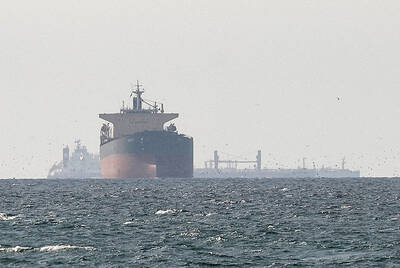
A ship that appears to be taking on the identity of a scrapped gas carrier exited the Strait of Hormuz on Friday, showing how strategies to get through the waterway are evolving as the Middle East war progresses. The vessel identifying as liquefied natural gas (LNG) carrier Jamal left the Strait on Friday morning, ship-tracking data show. However, the same tanker was also recorded as having beached at an Indian demolition yard in October last year, where it is being broken up, according to market participants and port agent’s reports. The ship claiming to be Jamal is likely a zombie vessel that

German Chancellor Friedrich Merz’s conservative Christian Democratic Union (CDU) yesterday faced a regional election battle in Rhineland-Palatinate, now held by the center-left Social Democratic Party (SPD). Merz’s CDU has enjoyed a narrow poll lead over the SPD — their coalition partners at the national level — who have ruled the mid-sized state for 35 years. Polling third is the far-right Alternative for Germany (AfD), which spells a greater threat to the two centrist parties in several state elections in September in the country’s ex-communist east. The picturesque state of Rhineland-Palatinate, bordering France, Belgium and Luxembourg and with a population of about 4 million,

LAW CONSTRAINTS: The US has been pressing allies to send warships to open the Strait, but Tokyo’s military actions are limited under its postwar pacifist constitution Japan could consider deploying its military for minesweeping in the Strait of Hormuz if a ceasefire is reached in the war on Iran, Japanese Minister of Foreign Affairs Toshimitsu Motegi said yesterday. “If there were to be a complete ceasefire, hypothetically speaking, then things like minesweeping could come up,” Motegi said. “This is purely hypothetical, but if a ceasefire were established and naval mines were creating an obstacle, then I think that would be something to consider.” Japan’s military actions are limited under its postwar pacifist constitution, but 2015 security legislation allows Tokyo to use its Self-Defense Forces overseas if an attack,
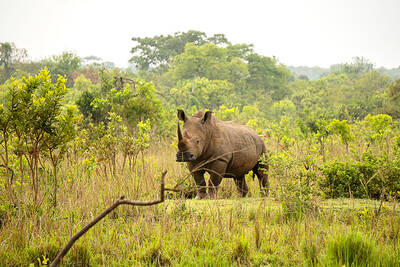
Ugandan wildlife authorities have reintroduced rhinos into a remote protected area where they were once poached into extinction, an event seen by conservationists as a milestone in efforts to support the recovery of a species threatened by poaching. On Tuesday, two southern white rhinos from a private ranch in the East African country were reintroduced into Kidepo Valley National Park in the country’s northeast. Two more rhinos in metallic crates arrived on Thursday. There have been no rhinos in the park since 1983, the result of poaching. However, a private ranch in central Uganda — the Ziwa Rhino Sanctuary — has been


 RSS
RSS