


On a barren hillside in northern Albania lies a portal to the country’s communist past: A massive steel door creaks open to reveal a hidden former air base burrowed into the heart of the mountain.
Made up of 600m of tunnels that once teemed with military life, the secret Gjader air base is now a depot for dozens of communist-era MiG jets collecting dust in the darkness.
Three decades after shedding communism, Albanian authorities are still trying to sell off the Soviet and Chinese-made aircraft, of which there are dozens more in another nearby air base.
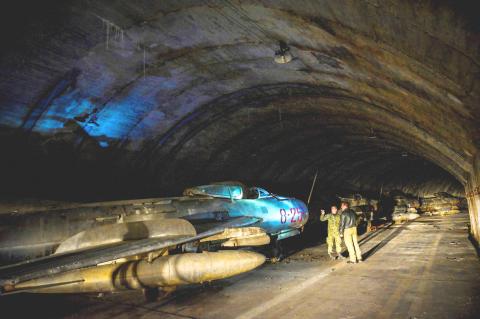
Photo: AFP
“Aligning our equipment and our weapons to the NATO standards” is part of Albania’s “new chapter” with the alliance, which it joined in 2009, Albanian Chief of Defense Bardhyl Kollcaku said.
As for the MiGs, “apart from nostalgia, [for which] we will keep some of them in our museum ... the rest will be treated according to the domestic legislation for sale or other usage,” he said.
The communist-era jets, which include MiG-19, MiG-17 and MiG-21 models among others, have been out of commission for more than a decade, but museums, collectors and other aviation aficionados have already expressed interest in giving the relics a new home.
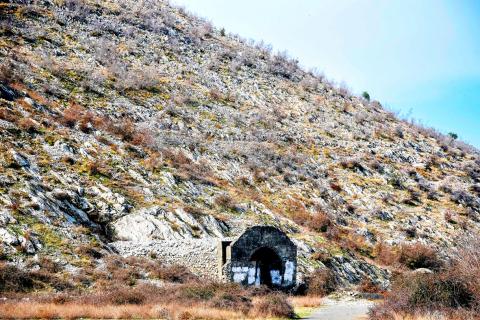
Photo: AFP
When Albania first discussed selling the MiGs in 2016, requests came in from the Air and Space Museum in France, as well as a flight school in Germany. Yet no sales have been completed to date, with legal paperwork holding up the process.
Individuals are also on the waiting list, including Albania-based French businessman Julien Roche, who plans to install the plane in his garden.
“It’s not so easy to get this kind of aircraft now, because all of them have been mainly destroyed, not stored like they are in Albania,” he said, from a house brimming with eccentric items.
He has put his name down for one of the oldest models, a Chinese-made MiG-15 with a price tag of about 10,000 euros (US$11,000), which was used by North Koreans before being gifted to Albania.
Like the 7,000 concrete security bunkers that dot the countryside, the clandestine Gjader base was part of former communist dictator Enver Hoxha’s plan to fortify his hermit state against feared foreign invasions that never materialized.
More than 600 military personnel used to work inside the maze of tunnels that were shuttered in 2000 and remain off limits to the public. Jets flown after 2000 used a different military base, until the last of the planes were taken out of service following an accident in 2004.
After opening up the dark and damp tunnels to reporters, the base’s commander, Fatmir Danaj, admits the old planes evoke an unexpected nostalgia.
“The pleasure of flying and of working in this base was unimaginable,” 52-year-old Danaj said, as he shone his torch on a row of silver jets, which, as a young pilot, he used to land on the runway that feeds into the mountain.
Today, the scores of rooms inside — including a cafeteria, dorms and array of other offices — are empty except for a scattering of debris and the faded signs on their doors announcing their function.
In one empty office, a reminder still hangs on the wall: “Attention! Put documents in their files and submit them to the secret administrative office before leaving the workplace.”
During his nearly 40 years of rule, Hoxha turned Albania into the most militarized country in the Balkans.
That backfired spectacularly in 1997, seven years after the fall of communism when the country was swept up by an armed rebellion that saw citizens raid armories and military bases for weapons.
Gjader was also breached, with people looting weapons and selling parts of some MiGs as scrap metal. Today the Albanian air force has only a small fleet of helicopters and its air space is protected by NATO.
In a sign of the changing times, the first NATO base in the Balkan region is to be built in Albania’s Kucova, once known as “Stalin City” as a symbol of friendship at that time between Albania and the Soviet Union.
However, Danaj still dreams of seeing Gjader returned to its former glory.
“The base could serve as a museum, but with its modern infrastructure, its tunnel system, it can be functional again and serve NATO,” he said.

Through the noise of rushing papers and whirring belts at a print factory in Kyoto, two creators watch their photo essay come to life in broadsheet form — part of an effort to win new audiences in the age of artificial intelligence (AI). Despite the decline of the publishing industry, self-publication and handmade “zine” magazines are growing in popularity in Japan, reflecting the nation’s enduring love of paper in the digital era. While speaking to Agence France-Presse at the plant, his hands black with ink, one of the creators, Kazuma Obara, said: “I think [paper] is a medium that engages all five

‘CROSSING THE LINE’: China’s embassy in Seoul criticized US Forces Korea Commander General Xavier Brunson, asking if his ‘hostile’ remarks were authorized by Washington South Korea and the US are in talks over recent public remarks by the commander of US Forces Korea, Seoul’s presidential office said yesterday, after the comments drew sharp criticism from China. In a recent podcast interview, US Forces Korea Commander General Xavier Brunson described South Korea as “the dagger in the heart of Asia” from China’s east coast, prompting the Chinese embassy in Seoul to say that he had “truly crossed the line.” The interview came amid growing speculation that Washington might seek to expand the role of US Forces Korea in countering the growing regional influence of China, a key

Australian researchers have trained lab-grown brain cells on a silicon computer chip to play the 1990s shooter game Doom and said they are just scratching the surface of what the neurons could be capable of doing. It is the science-fiction work of biotech boffins at Cortical Labs, who researched and developed the technology that harnesses the workings of the brain’s networking system. Each so-called “biological computer” contains about 200,000 living human brain cells, grown from stem cells that were harvested from blood donations. Having mastered the simple computer game Pong, where a paddle is moved up and down to send a ball

France experienced its hottest spring on record, the French weather service said on Tuesday, after an exceptional early heat wave that also broke highs for the season in England and Wales. Meteo-France said the average nationwide temperature over March to May was 13.8°C — about 1.7°C above the norm, and surpassing records set in 2011 and 2020. “The warmest spring since records began in 1900,” it said in a bulletin. All three months were warmer than average, but the onset of an “unprecedented heatwave” late last month pushed the mercury to highs typically seen at the height of the summer. “Our country had never


 RSS
RSS