


SpaceX is to try to send a dummy to the International Space Station this weekend in a key test for resuming crewed US space flights, perhaps this year if all goes well.
Since the shuttle Atlantis returned to Earth on July 21, 2011, no American astronaut has blasted off from US soil for a tour in space.
NASA pays Russia to take its people up to the orbiting research facility at a cost of US$82 million a head, round trip.
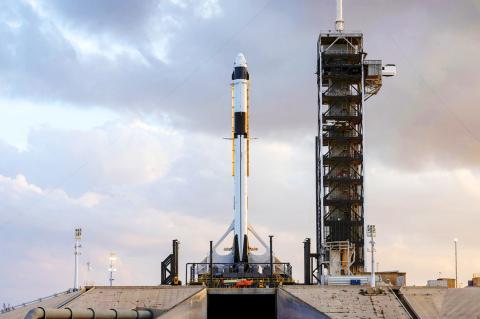
Photo: SpaceX via AP
In 2014, the US space agency awarded contracts to SpaceX and Boeing for them to take over this task, but the program has suffered delays as safety requirements are much more stringent for crewed flights than for uncrewed missions to deploy satellites.
No one in America wants to relive the tragedies of the US space shuttles Challenger and Columbia, which disintegrated in mid-air in 1986 and 2003.
Three years behind schedule, a Falcon 9 rocket is scheduled to blast off today from Cape Canaveral at 7:49am GMT with a Crew Dragon capsule in its nose. It will aim to rendezvous tomorrow with the International Space Station. The capsule is scheduled to return to Earth on Friday.
If all goes well, two astronauts are to be aboard the next time such a seven-seat capsule is launched. That is supposed to happen in July, but delays are possible.
“These things always take longer than you think,” said Lori Garver, who was the number two official at NASA when the contracts were awarded to SpaceX and Boeing under then-US president Barack Obama.
Back then this decision was controversial, with lawmakers complaining about changing the way the US sends people into space and the loss of contracts and jobs for big, veteran aerospace companies based in their states.
“We have very few heroes left, and astronauts are our heroes, and loosening our grip at NASA and allowing companies to take the lead on transporting them was a challenge for some. It still is,” Garver said.
SpaceX is no rookie when it comes to trips to and from the space station. The company founded by Elon Musk and based in Los Angeles has carried out 15 resupply missions to the orbiter since 2012. One of its rockets bound for the International Space Station exploded in 2015.
The second, crewed version of the Dragon rocket has been adapted from the cargo model, which has proved to be reliable.
Today’s mission is still a “big deal,” SpaceX vice president Hans Koenigsmann said.
“This is an absolutely critical first step that we do as we move towards returning the crewed launch capability back here to the US,” said William Gerstenmaier, associate administrator with NASA Human Exploration and Operations.
It has taken years to be within reach of that goal.
“I don’t think very many people thought that the length of time between the termination of shuttle and a new vehicle was going to be as long as it has been,” former NASA chief historian Roger Launius said.
The cooling of US relations with Russia has increased pressure for the US to be able to send people to space on its own.
NASA has always relied on the aerospace industry for its manned space programs.
Launius said that in the days of the Apollo moon missions “almost everybody in that room were contractors, not NASA employees.”
What is new now is that NASA no longer covers all development costs and does not own the spacecraft that are to be used to send people into space.
Rather, it buys a service for a set price: The 2014 contracts call for US$4.2 billion for Boeing and US$2.6 billion for SpaceX, with six missions and a test flight.
That is a fraction of the US$4 billion per year it would have cost to keep the original shuttle program alive, Garver said.
An uncrewed Boeing test flight is scheduled for next month.


Showcasing phallus-shaped portable shrines and pink penis candies, Japan’s annual fertility festival yesterday teemed with tourists, couples and families elated by its open display of sex. The spring Kanamara Matsuri near Tokyo features colorfully dressed worshipers carrying a trio of giant phallic-shaped objects as they parade through the street with glee. The festival, as legend has it, honors a local blacksmith in the Edo Period (1603-1868) who forged an iron dildo to break the teeth of a sharp-toothed demon inhabiting a woman’s vagina that had been castrating young men on their wedding nights. A 1m black steel phallus sits in the courtyard of

JAN. 1 CLAUSE: As military service is voluntary, applications for permission to stay abroad for over three months for men up to age 45 must, in principle, be granted A little-noticed clause in sweeping changes to Germany’s military service policy has triggered an uproar after it emerged that the law requires men aged up to 45 to get permission from the armed forces before any significant stay abroad, even in peacetime. The legislation, which went into effect on Jan. 1 aims to bolster the military and demands all 18-year-old men fill out a questionnaire to gauge their suitability to serve in the armed forces, but stops short of conscription. If the “modernized” model fails to pull in enough recruits, parliament will be compelled to discuss the reintroduction of compulsory service, German

Filipino farmers like Romeo Wagayan have been left with little choice but to let their vegetables rot in the field rather than sell them at a loss, as rising oil prices linked to the Iran war drive up the cost of harvesting, labor and transport. “There’s nothing we can do,” said Wagayan, a 57-year old vegetable farmer in the northern Philippine province of Benguet. “If we harvest it, our losses only increase because of labor, transportation and packing costs. We don’t earn anything from it. That’s why we decided not to harvest at all,” he said. Soaring costs caused by the Middle East

Hungarian Prime Minister Viktor Orban’s officially declared wealth is fairly modest: some savings and a jointly owned villa in Budapest. However, voters in what Transparency International deems the EU’s most corrupt country believe otherwise — and they might make Orban pay in a general election this Sunday that could spell an end to his 16-year rule. The wealth amassed by Orban’s inner circle is fueling the increasingly palpable frustration of a population grappling with sluggish growth, high inflation and worsening public services. “The government’s communication machine worked well as long as our economic situation remained relatively good,” said Zoltan Ranschburg, a political analyst


 RSS
RSS