


Egyptian President Abdel-Fattah al-Sisi is demanding Egyptians lose weight.
In televised comments earlier this month, the general-turned-president railed about the number of overweight people he sees and told Egyptians they must take better care of themselves.
He said physical education should become core curriculum at schools and universities, and suggested TV shows should not let presenters or guests on the air if they are overweight.

Photo: AP
The next morning, before sunrise, he drove his point home by energetically cycling to the national military academy in a Cairo suburb. In black sweat pants, a dark top and a matching baseball hat, he told cadets that he was adamant they would not leave basic training before fulfilling fitness requirements.
It was the typical style of al-Sisi, who sees even the smallest minutiae as needing his shaping and weighs in on anything from road building to filmmaking, often while scolding and haranguing Egyptians to correct their behavior.
However, al-Sisi’s critics said he was fat-shaming and taking an elitist approach to a problem whose roots lie to a large extent in poverty. They also criticized him for not offering concrete plans to combat obesity and spread fitness.
Prices for food — particularly fruits and vegetables — have spiraled because of economic reforms introduced by al-Sisi, often making cheaper junk foods more appealing.
No one disputes that Egypt has a weight problem. One in three Egyptians suffers from obesity, the world’s highest rate, according to a global study last year by the University of Washington’s Institute for Health Metrics and Evaluation.
It found 35 percent of adults — about 19 million people in a nation of 100 million — are obese, again the world’s highest rate, as well as 10.2 percent of Egyptian children, or about 3.6 million.
Al-Sisi, who often tells Egyptians they must buckle down and accept hardships to get through hard times, said they must change their habits to shed the fat.
“The second I walk into any place I look at things you cannot possibly imagine I would notice; and I ask myself: ‘What is this? Who are these people? Why are these people not looking after themselves?’” al-Sisi said in the Dec. 15 comments.
He derided Egyptians for not walking enough and, laughing, turned to his prime minister — seated next to him — and told him not to put on weight.
Egypt’s pro-government media prominently trumpeted his comments. Parliament, packed by his supporters, has said it intends to introduce legislation making physical education part of the core curriculum at schools.
Similarly, his education minister said students taking a 10-stop ride on the Cairo metro should get off two stops early and walk to their destination as a form of exercise.
In social media, possibly the only platform of relatively free speech left in Egypt, the response was more critical.
Some said al-Sisi was removed from reality or speaks his mind without weighing his words first. A flood of jokes spilled forth on Twitter and Facebook, playing on the risks of being too fat under a president whose security forces have arrested thousands in a widespread crackdown against dissent.
One joke that went viral told of people in a car sucking in their bellies as they approached a police checkpoint.
Another has a man asking to hide at a friend’s house from police until he loses weight. In another, a man informs on his overweight wife to authorities on the phone.
Al-Sisi’s comments “laid bare a great deal of elitism,” novelist and sociopolitical analyst Amar Ali Hassan said. “They are symptomatic of an authoritarian ruler who’s convinced he’s on a mission, that he alone knows what is in the public interest while everyone else is ignorant of the lofty goals in his head.”
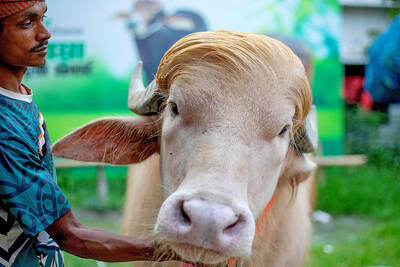
Crowds in Bangladesh are flocking to snap photographs with an unlikely social media star — an albino buffalo with flowing blond hair nicknamed “Donald Trump” that is due to be sacrificed within days. Owner Zia Uddin Mridha, 38, said his brother named the 700kg bull over its flowing helmet of hair resembling the signature look of the US president. “My younger brother picked this name because of the buffalo’s extraordinary hair,” he said at his farm in Narayanganj, just outside the capital, Dhaka. Mridha said that a constant stream of curious visitors — social media fans, onlookers and children — have come throughout

It began as a satirical online project. Now millions of young people in India are flocking to it as an outlet for their frustration. A parody political party called the Cockroach Janta Party, with the insect as its symbol, has exploded across India’s social media by turning absurdist humor into protest. Memes and short videos mocking corruption, joblessness and political dysfunction have flooded social media sites, where millions of users are embracing the cockroach — known for its ability to survive harsh conditions — as a tongue-in-cheek symbol of endurance. The online movement’s rise has been unusually rapid. The Cockroach Janta Party (CJP)
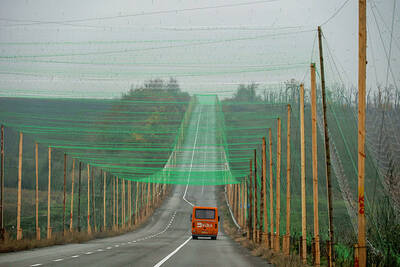
BIGGER ROLE: Beijing has said it maintains an impartial stance on the war in Ukraine, but by training Russian troops, China is far more involved than previously known China’s armed forces secretly trained about 200 Russian military personnel in China late last year, and some have since returned to fight in Ukraine, according to three European intelligence agencies and documents seen by Reuters. While China and Russia have held a number of joint military exercises since Moscow’s full-scale invasion of Ukraine in 2022, Beijing has repeatedly said that it is neutral in the conflict and presents itself as a peace mediator. The covert training sessions, which predominantly focused on the use of drones, were outlined in a dual-language Russian-Chinese agreement signed by senior Russian and Chinese officers in Beijing on
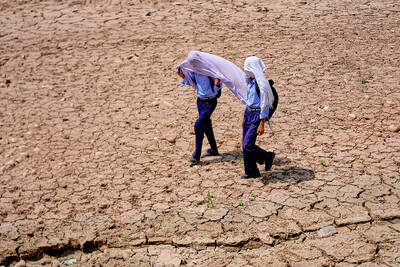
HOTTER: While Indians are accustomed to summer heat, climate change has caused northwestern India to warm faster than other parts of the country, an academic said Roads and markets have emptied during afternoons and some farmers have switched to nighttime work to avoid scorching temperatures as a heat wave grips large parts of India. The India Meteorological Department forecast maximum temperatures for yesterday of about 45°C in the capital, New Delhi, where authorities have opened temporary “cooling zones” to help people cope. The weather department warned that conditions would likely persist across several northern regions in the coming days, with temperatures staying well above seasonal averages. Authorities urged people to stay indoors during the hottest hours and take precautions against heat-related illnesses. India declares a heat wave whenever maximum temperatures


 RSS
RSS