


Kids across the world expressed concerns about global warming by creating what organizers say is the world’s biggest postcard on a glacier in the Swiss Alps.
Bearing messages of hope and commitment, more than 125,000 colorful and hand-written postcards from kids around the world have emblazoned a glacier in Switzerland to create one giant one, half the size of a football field.
It is a cry of help — from New Orleans to Hong Kong, from sub-Saharan Africa to India — ahead of the UN Framework Convention on Climate Change in Katowice, Poland, next month.
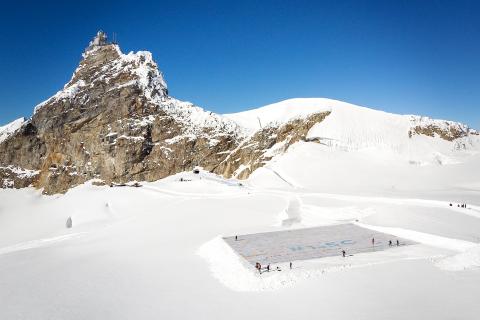
Photo: AFP
The Swiss Agency for Development and Cooperation and partners on Friday unfurled a “compound postcard” on top of the threatened Aletsch Glacier, the longest and deepest in the Alps, which is on track to melt to nonexistence by the end of this century if global warming trends continue.
Organizers say the postcards delivered to the glacier 3,400m above sea level near Switzerland’s famed Jungfraujoch aimed to set a Guinness World Record for the “postcard with the most contributions.”
Guinness said the attempt has not been registered. The current record is only 16,000.
Pinned down with clamps and nets, and laminated in long glued-together strips to protect them from the ice and snow, the postcards bore messages of efforts to fight climate change and help the environment, such as limiting water use, promises to use public transportation or recycling old goods before buying new ones.
“They are asking us and their leaders to take action to preserve the planet Earth for them to have a future on it,” Swiss Youth for Climate founder Oceane Dayer said.
Ever mindful of the impact, organizers are calculating the CO2 footprint caused by sending so many postcards — often through Swiss diplomatic posts — and preparing to double the offset.
Drones with cameras buzzed overhead as sunshine bounced off the white mountainside.
Overhead, cards spelled out “Stop global warming” and “#1.5C” — an allusion to the goal of keeping global warming below 1.5°C.
Organizers want to launch a “Global Climate Change Youth Movement” to compliment the UN meeting.
Organizers plan to use a snapshot of the giant compound postcard to make, well, a postcard.


Through the noise of rushing papers and whirring belts at a print factory in Kyoto, two creators watch their photo essay come to life in broadsheet form — part of an effort to win new audiences in the age of artificial intelligence (AI). Despite the decline of the publishing industry, self-publication and handmade “zine” magazines are growing in popularity in Japan, reflecting the nation’s enduring love of paper in the digital era. While speaking to Agence France-Presse at the plant, his hands black with ink, one of the creators, Kazuma Obara, said: “I think [paper] is a medium that engages all five
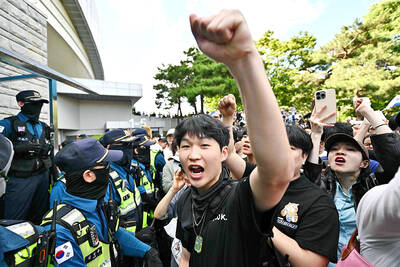
‘ABSURD MISTAKE’: The election commission said that there had been a failure to anticipate turnout after 14 polling stations ran short of ballot papers South Korean riot police yesterday cleared protesters from a Seoul polling station after a 35-hour blockade sparked by a shortage of ballot papers during local elections earlier this week. Wednesday’s election was the first nationwide vote since South Korean President Lee Jae-myung took office following the ouster of Yoon Suk-yeol over his short-lived martial law declaration. Lee’s ruling Democratic Party swept most races, but failed to flip the crucial Seoul mayoral seat. The South Korean National Election Commission apologized, blaming a failure to anticipate turnout after 14 polling stations in Seoul ran short of ballot papers. Some polling stations stayed open until 10pm to

France experienced its hottest spring on record, the French weather service said on Tuesday, after an exceptional early heat wave that also broke highs for the season in England and Wales. Meteo-France said the average nationwide temperature over March to May was 13.8°C — about 1.7°C above the norm, and surpassing records set in 2011 and 2020. “The warmest spring since records began in 1900,” it said in a bulletin. All three months were warmer than average, but the onset of an “unprecedented heatwave” late last month pushed the mercury to highs typically seen at the height of the summer. “Our country had never

A Sherpa guide was found crawling to base camp on Mount Everest a week after he went missing and was reunited with his family, who had given up hope he would return. Dawa Sherpa was last seen on Friday last week descending the mountain, but he did not reach base camp even though his client did. The pair were among the last climbers on the mountain as the climbing season came to an end and the route was dismantled. Dawa was located by a cleaning crew on Thursday morning as he was crawling down the snowy slopes around the Khumbu Icefall, just above


 RSS
RSS