


From any vantage point in La Paz, Bolivian President Evo Morales’ new presidential residence is hard to miss. The 29-story glass-fronted skyscraper towers over the low-rise historic center of the city.
For Morales and his supporters, it represents a new Bolivia, a break from a painful colonial past. For others, it is an overpriced vanity project aimed at glorifying the nation’s longest-serving leader.
Public disquiet turned to outrage when it was reported that Morales would enjoy a 1,068m2 suite fitted out with a jacuzzi, sauna, gym and massage room. Other luxuries included a private elevator, according to architectural plans leaked to local newspaper Pagina Siete.
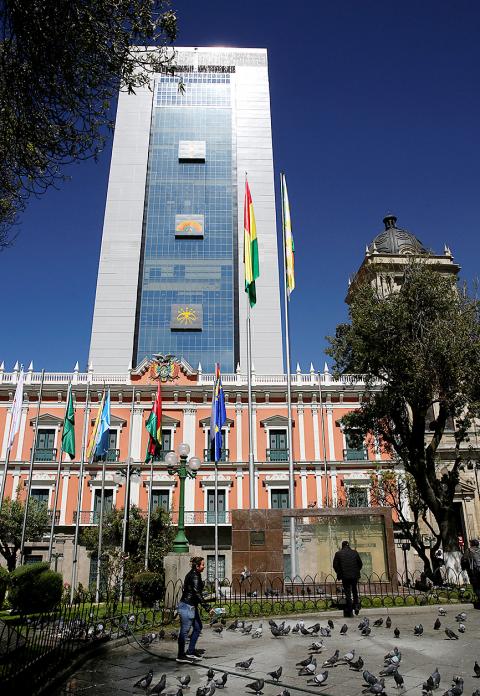
Photo: Reuters
Bolivian Minister of Communications Gisela Lopez refused to confirm or deny the report, but said the high-rise had been built “for the people” without running over a US$34 million budget, the state news agency reported.
However, the building has also become a focal point for growing anger at Morales’ refusal to relinquish power after 12 years and his vow to run for a fourth term in next year’s elections.
Amid street protests, Morales inaugurated the building on Thursday last week.
“We leave behind the palace of a colonial state to come here to the People’s Great House of the plurinational state of Bolivia,” he said in a speech, which listed the many presidents and independence leaders who had been killed inside or near the old palace during Bolivia’s tumultuous past.
At 120m tall, the People’s Great House, or Casa Grande del Pueblo, looms over the old government palace, which it replaces.
Known as the Burned Palace, or Palacio Quemado, the old building — which was twice gutted by fire — is to become a museum.
Its replacement flouts municipal bylaws prohibiting high-rise constructions in the city center, but Morales used his party’s parliamentary majority to override the ban.
“It’s an insult to the country,” political analyst Carlos Toranzo said.
“[Morales] wants to immortalize himself with a building which is not only anti-aesthetic, but also anti-ethical because in Bolivia we don’t have even the right to be ill,” he added, referring to the city’s under-resourced main hospital.
Opposition leader Samuel Doria said the building should be turned into a cancer hospital, which he said is an urgent necessity.
However, Morales has brushed off criticism, saying the construction would save government spending by housing, along with the presidential and administrative offices — five ministries that currently rent quarters costing about US$20 million a year.
Topped with a helipad and with three underground floors, the tower has architectural features resembling Tiwanaku, Bolivia’s preeminent archeological site.
It features indigenous symbols such as the chakana, or Andean cross, and has several large murals, some of which depict workers overcoming social injustice.
‘CROSSING THE LINE’: China’s embassy in Seoul criticized US Forces Korea Commander General Xavier Brunson, asking if his ‘hostile’ remarks were authorized by Washington South Korea and the US are in talks over recent public remarks by the commander of US Forces Korea, Seoul’s presidential office said yesterday, after the comments drew sharp criticism from China. In a recent podcast interview, US Forces Korea Commander General Xavier Brunson described South Korea as “the dagger in the heart of Asia” from China’s east coast, prompting the Chinese embassy in Seoul to say that he had “truly crossed the line.” The interview came amid growing speculation that Washington might seek to expand the role of US Forces Korea in countering the growing regional influence of China, a key
SEEKING ORDER: Rodrigo Paz said that ‘anyone who wants to destroy the nation will have to deal with this president and the full force of the constitution’ Bolivian President Rodrigo Paz on Wednesday said that the nation was at a “breaking point” after nearly a month of protests that have caused shortages of food, fuel and medicine. Paz, who took office six months ago amid the worst economic crisis there in four decades, is battling a groundswell of fury over his policies. The political capital, La Paz, has been besieged by low-income workers and members of the indigenous majority calling for his resignation. “The country needs order and is reaching breaking point,” the 58-year-old said at a public event in La Paz, renewing his appeal for dialogue. On Tuesday, the Bolivian

Through the noise of rushing papers and whirring belts at a print factory in Kyoto, two creators watch their photo essay come to life in broadsheet form — part of an effort to win new audiences in the age of artificial intelligence (AI). Despite the decline of the publishing industry, self-publication and handmade “zine” magazines are growing in popularity in Japan, reflecting the nation’s enduring love of paper in the digital era. While speaking to Agence France-Presse at the plant, his hands black with ink, one of the creators, Kazuma Obara, said: “I think [paper] is a medium that engages all five

Australian researchers have trained lab-grown brain cells on a silicon computer chip to play the 1990s shooter game Doom and said they are just scratching the surface of what the neurons could be capable of doing. It is the science-fiction work of biotech boffins at Cortical Labs, who researched and developed the technology that harnesses the workings of the brain’s networking system. Each so-called “biological computer” contains about 200,000 living human brain cells, grown from stem cells that were harvested from blood donations. Having mastered the simple computer game Pong, where a paddle is moved up and down to send a ball


 RSS
RSS