


As attendance at Hong Kong’s traditional protest rallies wanes, one pro-democracy group is trying to win hearts and minds in a more pragmatic way — through plumbing, electricity and household repairs.
Calling themselves Fixing Hong Kong, the group’s volunteers mend broken appliances, furniture, pipes and wiring, hoping that forging community spirit would lead to greater political awareness.
The novel approach comes as Hong Kong’s freedoms are under threat from an increasingly assertive Beijing and the territory’s splintered democracy movement struggles for momentum.
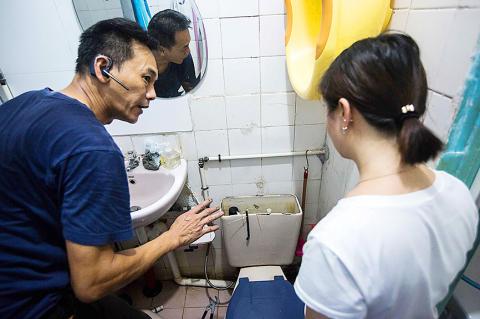
Photo: AFP
Volunteers visit homes in the To Kwa Wan neighborhood each week, making appointments for DIY jobs and offering repair services for free, with residents usually paying for their own replacement materials.
They work in pairs, one fixing, the other chatting. Sometimes the conversation turns to politics, other times not.
“We hope to gather more energy bit by bit through these most simple contacts and bonding,” Fixing Hong Kong member Max Leung said.
A resident surnamed Wong said volunteers from the group fixed his television, and helped him and others write letters to officials over concerns that local people were being rehoused in poor conditions to make way for development projects.
“Just one person’s power is not enough. We need neighbors joining forces for results,” Wong said.
Another resident surnamed Cheng, a wall painter originally from southern China, said he had not discussed politics with the group, but appreciated their help.
A volunteer was fixing a broken strip light in his apartment when reporters visited.
Cheng’s apartment is housed in one of numerous rundown blocks in To Kwa Wan, home to low to middle-income families and refugees.
He said he was too preoccupied with daily struggles to join any of the group’s activities, which range from barbecues to political campaigns, but did not mind the volunteers’ pro-democracy ideas.
“As long as it doesn’t hurt me, that’s fine,” Cheng said.
Fixing Hong Kong was formed by activists who ran a recycling operation at protest camps set up during the 2014 “Umbrella movement” rallies, which called for free and fair leadership elections in Hong Kong.
The rallies failed to win reform and, since then, activists have been prosecuted on protest-related charges and disqualified from the legislature, denting the democracy campaign.
At the same time, pro-democracy politicians have been criticized for losing touch with the grassroots, while some pro-Beijing candidates have become more strategically focused on working-class voters and livelihood issues.
Small groups like Fixing Hong Kong believe that going back to the neighborhood level is the best way to rebuild support.
The approach is a legacy of the rallies and the protests gave a rare opportunity for young Hong Kongers to “become aware of how to communicate and interact with strangers, and to do something together,” researcher Klavier Wong (王潔瑩) said.
Although the protest camps that sprawled over junctions and roadways in major commercial areas angered some residents, others embraced the spontaneous tent communities, which included homework areas for students and art installations.
Fixing Hong Kong is one of the best-known community groups to have grown out of the rallies. Other small-scale projects, from urban rooftop gardens to rural farms, have also been set up by activists.
The trend also taps into young people’s desire to reconnect with their surroundings as private housing estates and shopping malls erode a sense of community living, said Klavier Wong, who researches social movements and identity in Hong Kong.
Group activities such as reclaiming public spaces for community events might not be directly related to the wider political system, but are still “everyday politics,” Leung said.
“This is to regain control in our lives. Ultimately, democracy is like that too, to regain control of the place we live in,” he added.
And while volunteer fixer Leung Chan, an electrician, says it can be hard to engage residents in politics when they have a host of daily struggles, he believes the group should persevere.
“If we don’t make the first step, then nothing is possible,” he said. “First there needs to be trust between people.”

FAKE NEWS? ‘When the government demands the press become a state mouthpiece under the threat of punishment, something has gone very wrong,’ a civic group said The top US broadcast regulator on Saturday threatened media outlets over negative coverage of the Middle East war, after US President Donald Trump slammed critical headlines from the “Fake News Media.” The US president since his first term has derided mainstream media as “fake news” and has sued major outlets over what he sees as unfair coverage. Brendan Carr, head of the US Federal Communications Commission — which oversees the nation’s radio, television and Internet media — said broadcasters risked losing their licenses over news coverage. “The law is clear. Broadcasters must operate in the public interest, and they will

INFLUTENTIAL THEORIST: Habermas was particularly critical of the ‘limited interest’ shown by German politicians in ‘shaping a politically effective Europe Jurgen Habermas, whose work on communication, rationality and sociology made him one of the world’s most influential philosophers and a key intellectual figure in his native Germany, has died. He was 96. Habermas’ publisher, Suhrkamp, said he died on Saturday in Starnberg, near Munich. Habermas frequently weighed in on political matters over several decades. His extensive writing crossed the boundaries of academic and philosophical disciplines, providing a vision of modern society and social interaction. His best-known works included the two-volume Theory of Communicative Action. Habermas, who was 15 at the time of Nazi Germany’s defeat, later recalled the dawn of
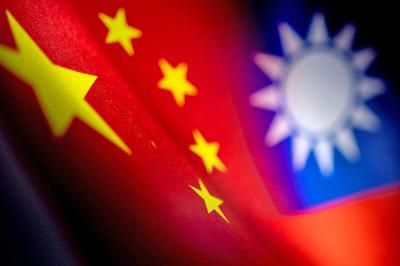
The Chinese public maintains relatively warm sentiments toward Taiwan and strongly prefers non-military paths to improving cross-strait relations, a recent survey conducted by the Atlanta, Georgia-based Carter Center and Emory University showed. The “China Pulse” research project, which polled 2,506 adults between Oct. 27 last year and Jan. 1 this year, found that 86 percent of respondents support strengthening cultural ties, while 81 percent favor deepening economic interaction. The report, co-authored by political scientists at Emory University and advisors at the Carter Center, indicates that the Chinese public views Taiwan’s importance through a lens of shared history and culture rather than geopolitical

A ship that appears to be taking on the identity of a scrapped gas carrier exited the Strait of Hormuz on Friday, showing how strategies to get through the waterway are evolving as the Middle East war progresses. The vessel identifying as liquefied natural gas (LNG) carrier Jamal left the Strait on Friday morning, ship-tracking data show. However, the same tanker was also recorded as having beached at an Indian demolition yard in October last year, where it is being broken up, according to market participants and port agent’s reports. The ship claiming to be Jamal is likely a zombie vessel that


 RSS
RSS