


A fake Web site offering girls to cater to “every taste and pocket” clocked up more than 1,000 subscribers on its first day, highlighting the challenge of tackling sex trafficking in India.
StayUncle, a Web site that enables unmarried couples to book into hotels without hassle in conservative India, launched the spoof site — staylaid.com — after tiring of requests from clients to procure a sex worker as well.
“We get nearly 3,000 calls every month from people asking for a partner along with a room. It was important to initiate this conversation,” StayUncle founder Sanchit Sethi said.
“We wanted people to see how real the problem of trafficking is ... how victims are affected. In our understanding, there was no better way than creating a fake Web site. It is only through technology that you can reach the masses,” he said.
Hotels and home rental services, such as Airbnb, have launched measures to tackle trafficking as concerns mount over their properties being used to exploit vulnerable women and girls.
More than 8,000 cases of human trafficking were reported in India in 2016, up 20 percent from the previous year, government data showed.
The Web site listed about a dozen girls and their physical attributes, adding that some had joined voluntarily while others were “procured from remote areas of India such as Assam and West Bengal by trusted brokers and promised big dreams.”
“Getting laid could never be easier,” it promised.
Subscribers then received an e-mail explaining that thousands of women are forced into sex slavery in India, calling for greater awareness to bring about change.
Many poor victims from rural areas are lured by traffickers with promises of good jobs, only to find themselves sold to brothels, forced to work in fields or brick kilns or enslaved in homes as domestic workers.
Staylaid.com’s offer of girls “suited for every taste, every demand and every pocket” provoked strong reactions on social media, with #StopWomenTrafficking trending on Twitter until late Tuesday night.
“It was surprising that people started talking about it on Twitter — but the fact is that people wanted to use it,” 29-year-old Sethi said.
Launched in 2015, StayUncle helps “privacy-starved lovers” find accommodation in about 900 partner hotels across India, where premarital sex is frowned upon.
Hasina Kharbhih, founder of anti-trafficking charity Impulse NGO Network, called on StayUncle to work more closely with established campaigners.
“Their idea might be good, but there was much confusion in the anti-trafficking sector last night on whether this was real,” she said.

An American scientist convicted of lying to US authorities about payments from China while he was at Harvard University has rebuilt his research lab in Shenzhen, China, to pursue technology the Chinese government has identified as a national priority: embedding electronics into the human brain. Charles Lieber, 67, is among the world’s leading researchers in brain-computer interfaces. The technology has shown promise in treating conditions such as amyotrophic lateral sclerosis and restoring movement in paralyzed people. It also has potential military applications: Scientists at the Chinese People’s Liberation Army have investigated brain interfaces as a way to engineer super soldiers by boosting

Indonesian police have arrested 13 people after shocking images of alleged abuse against small children at a daycare center went viral, sparking outrage across the nation, officials said on Monday. Police on Friday last week raided Little Aresha, a daycare center in Yogyakarta on Java island, following a report from a former employee. CCTV footage circulating on social media showed children, most younger than two, lying on the floor wearing only diapers, their hands and feet bound with rags. The police have confirmed that the footage is authentic. Police said they also found 20 children crammed into a room just 3m by 3m. “So
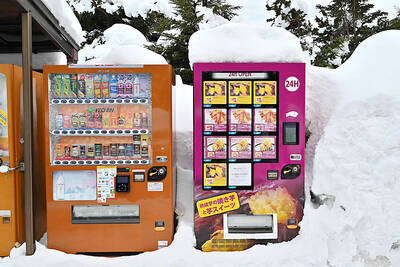
From post offices and parks to stations and even the summit of Mount Fuji, Japan’s vending machines are ubiquitous, but with the rapid pace of inflation cooling demand for their drinks, operators are being forced to rethink the business. Last month beverage giant DyDo Group Holdings announced it would remove about 20,000 vending machines — about 7 percent of their stock nationwide — by January next year, to “reconstruct a profitable network.” Pokka Sapporo Food & Beverage, based in Nagoya, also said last month it would sell its 40,000-machine operation to Osaka-based Lifedrink Co. “The strength of the vending machine

A highway bomb attack in a restive region of southwestern Colombia on Saturday killed 14 people and injured at least 38, the latest spate of violence ahead of next month’s presidential election. Authorities blamed the attack in the Cauca department — a conflict-ridden, coca-growing region — on dissidents of the now-disbanded FARC guerrilla army, who have been sowing violence across the country. “Those who carried out this attack ... are terrorists, fascists and drug traffickers,” Colombian President Gustavo Petro said on social media. “I want our very best soldiers to confront them,” he added. The leftist leader blamed the bombing


 RSS
RSS